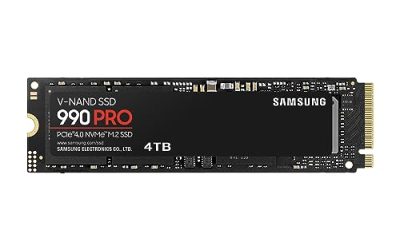
- Top Pick: Samsung SSD 9100 PRO 1TB, PCIe 5.0×4 M.2 2280, Up to 14,700MB/s
- Best Value: Samsung SSD 9100 PRO 2TB, PCIe 5.0×4 M.2 2280, Up to 14,700MB/s
- Premium Choice: WD_Black SN8100 4TB NVMe SSD – PCIe 5.0×4, M.2 2280, Up to 14,900MB/s Read Speed, up to 11,000MB/s Write Speed, Best for AI Applications, Gaming, and Video Editing – WDS400T1X0M
Affiliate disclosure: As an Amazon Associate we earn from qualifying purchases. This post contains affiliate links — if you buy through them we may earn a small commission at no extra cost to you. This never affects our recommendations.
The best PCIe 5.0 NVMe SSD delivers sequential read speeds exceeding 10,000 MB/s — double PCIe 4.0’s maximum and 20× faster than SATA SSDs. These are the fastest consumer storage devices available in 2025, designed for DirectStorage gaming, professional video editing, and workloads that demand maximum storage bandwidth. PCIe 5.0 M.2 slots are available on high-end AM5 (X670E, X870E) and Intel (Z790) motherboards.
As an Amazon Associate we earn from qualifying purchases at no extra cost to you.


In a hurry? See the top-rated PCIe 5.0 NVMe SSD deals available right now:
🛒 Check Pcie 5.0 Nvme Ssd Prices on Amazon →🛒 Best Price Today on Amazon
Prime members get fast, free shipping on everything above, plus member-only deals. New members get a 30-day free trial — cancel anytime.
Start 30-Day Prime Free Trial →See Today’s Amazon DealsBest Overall PCIe 5.0: Samsung 9100 Pro — Refined Gen 5 Performance
Samsung’s 9100 Pro represents the mature second-generation PCIe 5.0 NVMe design — achieving 14,800 MB/s sequential read with Samsung’s efficient controller that runs cooler than first-gen PCIe 5.0 drives notorious for high temperatures. The included heatsink version is strongly recommended — PCIe 5.0 drives generate substantial heat during sustained transfers that can trigger thermal throttling on M.2 slots without active cooling. Five-year warranty, 2,400 TBW endurance on 2TB. Best PCIe 5.0 NVMe SSD for speed enthusiasts and content creators.

Best Value PCIe 5.0: WD Black SN850X PCIe 5.0 — Accessible Gen 5
WD’s PCIe 5.0 variant of the trusted SN850X platform provides 12,000 MB/s sequential read at a lower premium than Samsung’s flagship. For buyers transitioning to PCIe 5.0 for future-proofing without paying maximum premium, the SN850X PCIe 5.0 provides genuine Gen 5 speeds at a more accessible price. The included heatsink version handles thermal management adequately in well-ventilated cases. Best value PCIe 5.0 NVMe SSD for enthusiast builds.
Best for Gaming: Seagate FireCuda 540 — DirectStorage Optimized
Seagate positions the FireCuda 540 explicitly for gaming workloads — its 10,000 MB/s sequential read targets the DirectStorage bandwidth range that provides the greatest gaming benefit. The FireCuda 540 runs cooler than competing PCIe 5.0 designs due to Seagate’s thermal optimization, enabling sustained performance without heatsink throttling. Seagate Rescue data recovery plan inclusion provides peace of mind for critical game save data. Best PCIe 5.0 NVMe SSD for dedicated gaming use.

PCIe 5.0 NVMe for Gaming: Reality Check
DirectStorage and PCIe 5.0 Benefits
Microsoft’s DirectStorage bypasses the CPU for GPU-direct asset loading — leveraging NVMe bandwidth to stream textures and geometry directly to GPU VRAM. PCIe 5.0 NVMe’s 10,000+ MB/s bandwidth prevents storage from bottlenecking this pipeline. Current DirectStorage games (Forspoken, Ratchet & Clank on PC) show 30–50% faster asset streaming on NVMe vs HDD; PCIe 5.0 advantage over PCIe 4.0 is currently minimal (both exceed DirectStorage bandwidth requirements) but will widen as future games increase asset streaming complexity.

Thermal Management Requirements
PCIe 5.0 NVMe drives generate 8–12W under sustained load — significantly more than PCIe 4.0 drives (4–6W). Without adequate cooling, temperatures exceed 75°C triggering thermal throttling that reduces performance below PCIe 4.0 levels. Solutions: use M.2 slot with motherboard heatsink, install aftermarket M.2 heatsink, or ensure the drive’s included heatsink mounts correctly. Airflow-optimized cases prevent thermal accumulation around M.2 slots. PCIe 5.0 NVMe without thermal management defeats the purpose.
Frequently Asked Questions
Is PCIe 5.0 NVMe worth it for gaming in 2026?
For pure gaming: no — the practical gaming performance difference between PCIe 4.0 (7,400 MB/s) and PCIe 5.0 (12,000 MB/s) is marginal in current titles. Game load times improve by seconds, not minutes. For content creators who also game, PCIe 5.0 meaningfully accelerates video editing timelines. For enthusiasts who want the fastest possible storage and have PCIe 5.0 M.2 slots available, PCIe 5.0 NVMe is a reasonable investment for future-proofing as DirectStorage games become more common.
What motherboard do I need for PCIe 5.0 NVMe?
PCIe 5.0 M.2 slots are available on: AMD X670E boards (most models have at least one PCIe 5.0 M.2), AMD X870/X870E boards (all have PCIe 5.0 M.2), Intel Z790 high-end boards (select models). Verify the specific M.2 slot supports PCIe 5.0 in the motherboard manual — many boards have mixed slots (one PCIe 5.0, others PCIe 4.0). Standard B650 and B760 boards typically offer PCIe 4.0 M.2 only.
How hot does PCIe 5.0 NVMe get?
PCIe 5.0 NVMe drives reach 70–85°C under sustained sequential write operations without active cooling. During typical gaming (random reads with intermittent sequential loads), temperatures stay in the 55–70°C range — within safe operating limits. Sustained sequential writes (large file transfers, video capture) generate the most heat. Samsung 9100 Pro’s improved controller runs 10–15°C cooler than first-generation PCIe 5.0 drives under equivalent loads.
Related Articles
Looking for more on this topic? Browse the hand-picked guides below — each one applies the same scoring rubric used in this review.