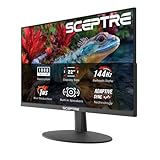
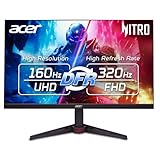
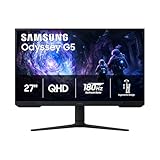
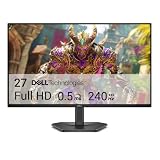
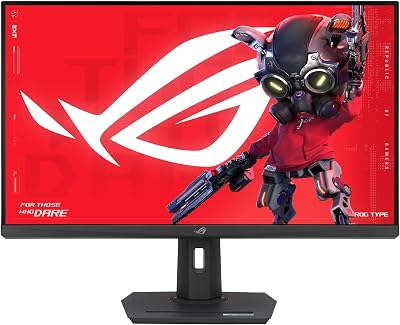
- Top Pick: 27" 360Hz QHD Fast IPS Gaming Monitor,0.5ms FreeSync+G-Sync,HDR400,VESA
- Best Value: ASUS ROG XG279CNS 27 Inch 1080p 380Hz USB-C Gaming Monitor
- Premium Choice: Alienware AW2725DF OLED Gaming Monitor – 26.7-inch Quantom-Dot WQHD (2560×1440) 360Hz 0.03Ms Display, AMD FreeSync Premium Pro, HDMI/DP/USB 3.2 Gen1, Height/Tilt/Swivel/Pivot Adjustability – Black
Affiliate disclosure: As an Amazon Associate we earn from qualifying purchases. This post contains affiliate links — if you buy through them we may earn a small commission at no extra cost to you. This never affects our recommendations.
- Best Overall 360Hz: ASUS ROG Swift 360Hz PG259QNR — The Pro Standard
- Best 1440p 360Hz: ASUS ROG Swift PG279QM — QHD at 360Hz
- Best Budget 360Hz: AOC AGON AG254FG — 360Hz Value
- Best 360Hz OLED: LG 27GR95QE-B — OLED at Ultra-High Refresh
- 360Hz Gaming Setup Requirements
- Frequently Asked Questions
- Related Articles
- Related Articles
A 360Hz gaming monitor delivers 360 frames per second — the peak of current consumer display technology, with 2.78ms between frames versus 4.17ms at 240Hz. Professional esports players at the highest competitive levels increasingly use 360Hz displays, where milliseconds of reaction time reduction translate to tangible ranking improvements. These are the best 360Hz gaming monitors available in 2025.
As an Amazon Associate we earn from qualifying purchases at no extra cost to you.


In a hurry? See the top-rated 360Hz Gaming Monitor deals available right now:
🛒 Check 360Hz Gaming Monitor Prices on Amazon →🛒 Best Price Today on Amazon
Prime members get fast, free shipping on everything above, plus member-only deals. New members get a 30-day free trial — cancel anytime.
Start 30-Day Prime Free Trial →See Today’s Amazon DealsBest Overall 360Hz: ASUS ROG Swift 360Hz PG259QNR — The Pro Standard
ASUS’s PG259QNR is the monitor of choice for professional esports players competing at 360Hz. The 24.5-inch 1080p Fast IPS panel delivers 0.5ms GtG response time at 360Hz — eliminating all motion blur in competitive FPS scenarios. NVIDIA Reflex Latency Analyzer integration measures system-level input latency from mouse click to pixel change, enabling precise optimization of competitive setups. G-Sync Esports certification provides tear-free performance under 360 FPS. Best 360Hz monitor for professional and semi-professional competitive play.

Best 1440p 360Hz: ASUS ROG Swift PG279QM — QHD at 360Hz
ASUS’s PG279QM pushes 1440p resolution to 360Hz using Fast IPS technology — combining the sharpness of 1440p (109 PPI at 27 inches) with maximum competitive frame rates. For players who want 1440p visual quality without sacrificing refresh rate, this monitor closes the previous compromise between resolution and frame rate ceiling. G-Sync module provides hardware-based adaptive sync. Best 1440p 360Hz gaming monitor for competitive players unwilling to drop to 1080p.
Best Budget 360Hz: AOC AGON AG254FG — 360Hz Value
AOC’s AG254FG brings 360Hz competitive display performance to a more accessible price point — Fast IPS panel, 0.5ms GtG, and FreeSync Premium support in a 24.5-inch 1080p format. While lacking G-Sync hardware certification, G-Sync Compatible approval provides tear-free NVIDIA GPU operation. For competitive players wanting 360Hz performance without premium flagship pricing, the AG254FG delivers the core 360Hz competitive experience. Best budget 360Hz gaming monitor.

Best 360Hz OLED: LG 27GR95QE-B — OLED at Ultra-High Refresh
LG’s OLED gaming monitor reaches 240Hz with OLED’s 0.03ms response time — effectively surpassing 360Hz IPS monitors in motion clarity due to OLED’s instantaneous pixel response. For players who prioritize motion clarity over raw Hz numbers, OLED’s response time advantage means 240Hz OLED often appears smoother than 360Hz IPS in practice. Best for competitive players valuing maximum motion clarity over maximum advertised refresh rate.
360Hz Gaming Setup Requirements
GPU Requirements for Consistent 360 FPS
Sustaining 360 FPS in competitive titles at 1080p requires substantial GPU power: CS2: RTX 4070 or better for consistent 360+ FPS at high settings. Valorant: RTX 3080 / RX 6800 XT for consistent 360+ FPS. Apex Legends: RTX 4070 Ti for consistent 360+ FPS at medium. Fortnite: RTX 4080 for consistent 360+ FPS at competitive settings. Frame rate consistency matters more than average — 1% lows below 360 FPS cause perceivable smoothness interruptions. DLSS Performance mode enables 360 FPS targets with lower GPU requirements.
360Hz vs 240Hz: Is the Upgrade Worth It?
The 240Hz → 360Hz upgrade provides the smallest perceptible improvement in the refresh rate progression (60→144→240→360Hz). Studies show approximately 2–5% competitive performance improvement in controlled aim scenarios at 360Hz vs 240Hz. For the top 1% of competitive players where marginal improvements matter, 360Hz is a justified investment. For the majority of competitive players, 240Hz provides adequate refresh rate — the GPU budget saved is better spent on hardware with larger performance impact.
Frequently Asked Questions
Do professional esports players use 360Hz monitors?
Yes — professional CS2 and Valorant players increasingly use 360Hz displays at tournaments and for practice. ASUS ROG Swift monitors are common on professional tournament stages. The professional adoption validates the competitive benefit, though the average player’s skill ceiling typically isn’t refresh rate limited at 240Hz. If you’re playing at a level where reaction time is the limiting factor, 360Hz provides marginal but real improvement.
Is 360Hz noticeable compared to 240Hz?
Side-by-side, most players notice the additional smoothness when moving between the two. In isolation during normal play, the improvement from 240Hz is subtler than the 144→240Hz upgrade. The key benefit isn’t visual smoothness perception — it’s the 1.39ms reduction in maximum display latency (4.17ms at 240Hz → 2.78ms at 360Hz). For reactions measured in milliseconds, every bit of latency reduction has theoretical value even when the difference isn’t visually obvious.
What resolution do 360Hz monitors use?
Most 360Hz monitors use 1080p resolution — the lower pixel count is necessary to achieve the GPU frame rate targets needed to actually utilize 360Hz. 1440p 360Hz monitors exist (ASUS PG279QM) but require very powerful GPUs to sustain 360 FPS at 1440p in competitive titles. For most competitive players, 1080p 360Hz is the practical choice — competitive games are optimized for high frame rates at 1080p settings.
Related Articles
Looking for more on this topic? Browse the hand-picked guides below — each one applies the same scoring rubric used in this review.