As an Amazon Associate we earn from qualifying purchases
The 27-inch size has become the sweet spot for PC gaming, and the under five hundred dollar class is where that size gets genuinely interesting. At this level you are no longer choosing between a sharp picture and a fast picture. You can have 1440p resolution with a refresh rate well above 144Hz, a proper IPS panel with wide viewing angles, variable refresh rate support for both major graphics card families, and a stand that adjusts properly. Some models in this group even add 4K resolution, USB-C video input, or a built-in KVM switch for a second computer.
This guide explains the criteria that separate a good pick from a frustrating one, then walks through five models for different players, from competitive 1440p gaming to dual-mode 4K play and mixed gaming and work setups.
If you are still deciding whether this size and resolution class fits your desk and your graphics card at all, our broader overview of the best gaming monitor 27 inch category is a useful starting point before you narrow down to a single model here.
How to Choose a 27-Inch Gaming Monitor in This Budget Class
Start with resolution. At 27 inches, 2560 by 1440, usually called 1440p or QHD, is the balanced choice for most gaming PCs: sharper than 1080p, crisp text without scaling, and high frame rates from a mid-range graphics card. A 3840 by 2160, or 4K, panel is sharper again, but asks much more of your graphics card, so it suits players who prioritise detail, console play, and media.
Refresh rate is next. A 165Hz or 180Hz panel already feels dramatically smoother than a 60Hz office screen. Rates of 200Hz and above help competitive players most, and only when the PC can deliver those frame rates. Dual-mode designs trade resolution for speed, running lower resolution at a much higher refresh rate for esports titles.
Panel type shapes colour and motion. Fast IPS and Nano IPS panels dominate this class for their wide viewing angles, strong colour, and manufacturer-rated 1ms grey-to-grey response times. Treat that rating as a guide to the panel generation rather than a promise about every transition. Variable refresh rate matters just as much: G-Sync Compatible and FreeSync Premium let the monitor match its refresh to the frame rate, removing tearing and reducing stutter.
Ports decide whether you get the full specification. DisplayPort usually unlocks the highest refresh rate at native resolution on a PC, while HDMI bandwidth varies by version. USB-C with DisplayPort Alt Mode is valuable if a laptop shares the desk, and a built-in KVM switch can remove cable swapping. Finally, check the stand, VESA mount, HDR certification, and colour gamut coverage such as DCI-P3 percentage.
ASUS ROG Strix XG27ACS

The ROG Strix XG27ACS is the straightforward recommendation for a player who wants a fast 1440p screen, modern connections, and no obvious weak point. Its Fast IPS panel runs at 180Hz with a manufacturer-rated 1ms grey-to-grey response time, and ASUS pairs that speed with Extreme Low Motion Blur Sync, which is designed to keep motion clear while variable refresh rate is active. G-Sync Compatible support handles tearing, and the listing also describes FreeSync compatibility through its variable refresh rate support, so either graphics card family can drive it smoothly.
Colour is a genuine strength. ASUS publishes 97 percent DCI-P3 and 133 percent sRGB coverage, along with DisplayHDR 400 support, giving games a wider palette than a basic office panel. Factory colour checks are part of the product description, which matters for players who also edit photos or video on the same screen.
Connectivity is where it pulls ahead of older designs. Alongside DisplayPort 1.4 and HDMI 2.0, USB Type-C supports DisplayPort Alt Mode for video and power delivery, so a laptop can connect with a single cable. The stand offers tilt, swivel, pivot, and height adjustment in a compact footprint, and its tripod socket suits streamers who mount a camera above the screen.
Specs
- Screen size: 27 inches
- Panel type: Fast IPS
- Resolution: 2560 x 1440
- Refresh rate: 180Hz
- Ports: DisplayPort 1.4, HDMI 2.0, USB Type-C with DisplayPort Alt Mode
- VRR support: G-Sync Compatible, FreeSync compatible variable refresh rate, ELMB Sync
LG UltraGear 27GP850-B

The LG UltraGear 27GP850-B has been a reference point in this class for a long time, and the specification explains why. Its Nano IPS panel delivers 1440p resolution at 165Hz, with an overclocked mode above that base rate described by the manufacturer, and a 1ms grey-to-grey response time rating. Nano IPS is LG’s approach to widening colour performance, and the published figure of 98 percent DCI-P3 coverage puts this monitor ahead of many rivals for colour-rich games, while the listed 400-nit brightness and DisplayHDR 400 support give highlights more punch than a basic panel.
Both variable refresh rate ecosystems are covered. It is NVIDIA G-Sync Compatible and supports AMD FreeSync Premium, so frame pacing stays smooth with either graphics card family, and LG includes Dynamic Action Sync and Black Stabilizer for tuning dark-scene visibility. The virtually borderless design on three sides also suits a future multi-monitor setup.
The port selection includes two HDMI inputs and DisplayPort, plus USB 3.0 hub connections, and the stand adjusts for tilt, height, and pivot. If your priority is a proven 1440p panel with especially strong colour, a high refresh rate, and broad compatibility, the 27GP850-B remains easy to justify.
Specs
- Screen size: 27 inches
- Panel type: Nano IPS
- Resolution: 2560 x 1440
- Refresh rate: 165Hz
- Ports: HDMI x2, DisplayPort, USB 3.0 hub, headphone out
- VRR support: NVIDIA G-Sync Compatible, AMD FreeSync Premium
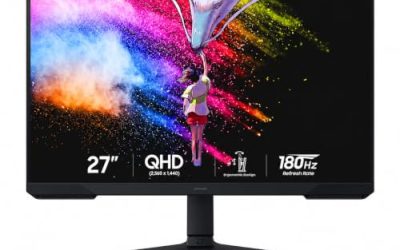
Samsung Odyssey G7 G70F (LS27FG706ENXZA)

The Samsung Odyssey G7 G70F takes a different approach from the 1440p models above: it is built around flexibility between resolution and speed. In its 4K UHD mode the Fast IPS panel runs at 180Hz, which is already fast for a 4K screen, and its dual mode lets you switch to Full HD at 360Hz for competitive titles where frame rate matters more than pixel count. That makes it the natural pick in this group for a player who mixes demanding, detail-heavy games with esports sessions on the same desk and does not want two monitors.
Samsung lists a 1ms grey-to-grey response time, HDR10 support for brighter highlights and more nuanced shadow detail, and a matte surface that helps in a bright room. Colour consistency across the screen is a stated aim of the Fast IPS panel, which matters at 4K during desktop work as well as in games.
G-Sync compatibility and AMD FreeSync Premium both feature, so variable refresh rate works across graphics card families. Auto Source Switch Plus moves between connected devices without digging through menus, and the stand tilts, adjusts for height, and pivots. If your graphics card is powerful enough for 4K, or you also connect a console, the G70F is the most versatile option here.
Specs
- Screen size: 27 inches
- Panel type: Fast IPS
- Resolution: 3840 x 2160 in 4K mode, Full HD in dual mode
- Refresh rate: 180Hz at 4K, 360Hz at Full HD in dual mode
- Ports: HDMI, DisplayPort, as listed for the Odyssey G7 G70F series
- VRR support: NVIDIA G-Sync Compatible, AMD FreeSync Premium
GIGABYTE M27Q

The GIGABYTE M27Q built its reputation by adding genuinely useful extras to a fast 1440p panel, and the headline extra is the built-in KVM switch. With KVM, one keyboard and mouse can control two connected computers, which is ideal for a gaming PC sitting next to a work laptop. The panel itself is a Super Speed IPS design at 2560 by 1440 with a refresh rate listed up to 170Hz and a manufacturer-rated 0.5ms MPRT response time, so the core gaming specification is competitive rather than compromised by the productivity features.
The listing describes 92 percent DCI-P3 coverage and HDR readiness, and FreeSync Premium keeps motion tear-free with compatible graphics cards. That makes the M27Q comfortable for long mixed sessions, from a competitive match to a spreadsheet, without a cable swap in between.
Connections reflect the two-computer idea: DisplayPort 1.2, two HDMI 2.0 inputs, USB 3.0 ports for the peripherals the KVM shares, and USB-C connectivity. The stand provides height and tilt adjustment, and Gigabyte includes game assist features such as timers and crosshair options. For a desk shared between play and work, the M27Q is the efficiency pick.
Specs
- Screen size: 27 inches
- Panel type: Super Speed IPS (SS IPS)
- Resolution: 2560 x 1440
- Refresh rate: 170Hz
- Ports: DisplayPort 1.2, HDMI 2.0 x2, USB 3.0 x2, USB-C
- VRR support: AMD FreeSync Premium
GIGABYTE M27Q2

The GIGABYTE M27Q2 is the newer, faster evolution of the idea behind the M27Q, aimed at players who liked the KVM concept but want a higher refresh rate and updated colour technology. Its SuperSpeed IPS panel runs at 200Hz, with an overclocked 210Hz mode, at 1440p resolution, and Gigabyte rates the response time at 1ms grey-to-grey. Quantum Dot technology is used to widen the colour range, and the published figures include 99 percent DCI-P3 coverage with an 8-bit colour depth and a 1000 to 1 contrast ratio, plus a listed brightness of 350 nits.
Variable refresh rate support is broader than on the older model, with both AMD FreeSync Premium and G-Sync Compatible support, plus Aim Stabilizer Sync, Game Assist, and Smart Overdrive. That makes it a stronger choice for competitive play than its predecessor, in the same sensible 27-inch 1440p format.
The Type-C KVM remains the centrepiece, letting you control multiple devices with one keyboard, video, and mouse setup. Connectivity includes two HDMI ports, DisplayPort, and USB Type-C alongside USB hub connections, and the stand adjusts for height and tilt. If you want the fastest refresh rate in this group at native 1440p, modern colour, and a desk that doubles as a workstation, the M27Q2 is the forward-looking pick.
Specs
- Screen size: 27 inches
- Panel type: SuperSpeed IPS (SS IPS) with Quantum Dot technology
- Resolution: 2560 x 1440
- Refresh rate: 200Hz, overclocked to 210Hz
- Ports: HDMI x2, DisplayPort, USB Type-C, USB hub ports
- VRR support: AMD FreeSync Premium, G-Sync Compatible
Frequently Asked Questions
Is 1440p or 4K better at 27 inches for gaming?
For most gaming PCs, 1440p is the better balance at 27 inches because it looks sharp at a normal viewing distance and lets the graphics card sustain high frame rates. Choose 4K at this size if your hardware is strong, you play slower-paced or detail-heavy games, you also use a console, or you want a dual-mode model that can drop to a lower resolution for much higher refresh rates in competitive titles.
How much refresh rate do you actually need?
A 165Hz or 180Hz monitor already delivers a large, obvious improvement over 60Hz for both games and desktop use, and it is the sensible target for most players. Higher rates such as 200Hz, 210Hz, or a dual-mode 360Hz setting help competitive players in fast shooters, but only when the PC can produce frame rates that high, so match the monitor to the performance your system can realistically sustain.
Do you need both G-Sync and FreeSync support?
Having both gives you flexibility rather than a picture-quality upgrade today. G-Sync Compatible and FreeSync Premium both synchronise the monitor refresh rate with the frame rate to reduce tearing and stutter, and a monitor that supports both ecosystems keeps working smoothly if you change graphics card brand later. Check that variable refresh rate is enabled over the connection you plan to use, ideally DisplayPort on a PC.
Is a KVM switch or USB-C worth looking for in this class?
Yes, if a second computer shares your desk. A built-in KVM switch lets one keyboard and mouse control two machines, and USB-C with DisplayPort Alt Mode can carry the laptop picture over a single cable, which removes daily cable swapping. If you only ever connect one gaming PC, those features matter less, and you can prioritise refresh rate, colour coverage, and stand adjustment instead.
Conclusion
The best 27 inch gaming monitor under five hundred dollars depends on how you actually play. The ASUS ROG Strix XG27ACS is the balanced all-rounder, with 180Hz 1440p speed, wide colour, and USB-C in one tidy design. The LG UltraGear 27GP850-B is the colour-focused 1440p favourite, with Nano IPS and both major variable refresh rate systems. The Samsung Odyssey G7 G70F is the flexible choice, switching between 4K detail and very high Full HD refresh rates. The GIGABYTE M27Q remains the practical KVM value pick for a shared desk, while the GIGABYTE M27Q2 updates that formula with 200Hz speed, Quantum Dot colour, and broader sync support. Pick by resolution and refresh rate first, confirm the ports match your PC and any console or laptop, and any of these five will be a clear step up from an older 1080p or 60Hz screen.