

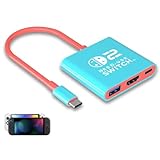
- Top Pick: Switch 2 Dock for Nintendo Switch 1 / 2 and Steam Deck Docking Station, Support TV Dock Mode, Portable TV HDMI Adapter Accessories for Nintendo Switch2 / OLED / 1, USB C to HDMI 2.0 Adapter 4K Output
- Best Value: KUNSLUCK Stand Base for Steam Deck/Nintendo Switch 2, Steam Deck Stand with Anti-Slip Silicone Pad (Black)
- Premium Choice: Overcooked! 2 – Nintendo Switch
Choosing between the Steam Deck and the Nintendo Switch 2 comes down to what you want to play and how much you want to tinker. We line them up on performance, library, battery life and value — and list the handhelds and accessories worth buying today.
As an Amazon Associate we earn from qualifying purchases at no extra cost to you.




📌 Part of our Best Linux OS for Gaming 2026: Proton, Steam Deck, and Native Picks guide — see the full breakdown, comparisons, and top picks.
Related: best gaming handheld accessories.
Related: best mini PCs for gaming.
Affiliate disclosure: As an Amazon Associate we earn from qualifying purchases. Prices and availability are accurate as of the date shown and are subject to change.
🛒 Best Price Today on Amazon
Prime members get fast, free shipping on everything above, plus member-only deals. New members get a 30-day free trial — cancel anytime.
Library: openness vs exclusives
The Steam Deck’s biggest strength is its library — your entire Steam catalogue, plus emulation, mods and even non-Steam launchers. The Switch 2 counters with Nintendo’s exclusives (Mario, Zelda, Metroid) that you simply can’t play anywhere else. If you already own a big Steam library, the Deck is compelling; if you want Nintendo games, the choice makes itself.
Power & performance
The Steam Deck runs full PC games and gives you control over resolution, frame caps and graphics settings — at the cost of complexity and shorter battery life in demanding titles. The Switch 2 is less raw-powerful but ruthlessly optimised: games are tuned to run smoothly with no settings to fiddle with. One rewards tinkering, the other just works.
Battery, screen & comfort
Both use large, bright screens. The Switch 2 generally holds an edge in efficiency and standby, while the Deck’s battery swings with how hard you push it. Ergonomically the Deck is larger and heavier with full-size grips; the Switch 2 is slimmer and more travel-friendly.
Price & value
The Switch 2 is priced as a console with a predictable accessory ecosystem. The Steam Deck’s value grows if you already buy PC games — frequent Steam sales make its library dramatically cheaper over time. Factor in a microSD/Express card for either, since modern games are large.
Which should you buy?
Buy the Switch 2 for exclusives, simplicity and travel. Buy the Steam Deck for library freedom, emulation and PC power. Many enthusiasts eventually own both. The handhelds and accessories below are ranked from this site’s live catalogue by buyer rating.
Our Top Picks


Quick Comparison
Frequently Asked Questions
Is the Steam Deck more powerful than the Switch 2?
In raw hardware terms the Steam Deck runs full PC games with adjustable settings, while the Switch 2 is more optimised and simpler. Real-world performance depends on the game and how each is tuned.
Can the Steam Deck play Nintendo Switch games?
No — the Deck cannot legally play Switch cartridges or eShop titles. It plays your Steam and PC library. Nintendo exclusives require a Switch or Switch 2.
Which has better battery life?
The Switch 2 is generally more consistent, while the Steam Deck’s battery varies widely with the game’s demands. Lighter indie titles last far longer than AAA games on the Deck.
Do I need a memory card for either handheld?
Yes, for most people. Both fill their internal storage quickly with modern games — a microSD (Deck) or microSD Express (Switch 2) card is a near-essential add-on.


