Choosing between HDMI and DisplayPort used to be simple, but in 2026 the decision genuinely matters for gamers chasing high frame rates, 4K clarity, and buttery-smooth variable refresh rate. Both connectors have matured into their latest generations, and the “right” cable now depends on whether you are wiring up a high-refresh PC monitor, a living-room OLED TV, or a next-gen console. This guide breaks down the real-world differences so you can plug in with confidence and never leave performance on the table.
As an Amazon Associate we earn from qualifying purchases. Prices and availability are accurate as of the date/time indicated and are subject to change.
As an Amazon Associate we earn from qualifying purchases at no extra cost to you.


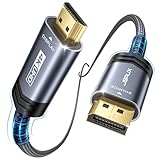


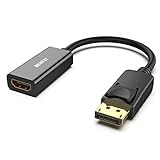



![IVANKY VESA Certified DisplayPort Cable, 6.6ft DP Cable 1.2, [4K@60Hz, 2K@165Hz, 2K@144Hz], High Speed Gold-Plated Display Port to Display Port Cabl, for Gaming Monitor, Graphics Card, TV, PC, Laptop](https://m.media-amazon.com/images/I/71w-nKtHOcL._AC_SL400_.jpg)
🛒 Best Price Today on Amazon
Prime members get fast, free shipping on everything above, plus member-only deals. New members get a 30-day free trial — cancel anytime.
HDMI vs DisplayPort: The Quick Answer
For most desktop gaming PCs connected to a dedicated gaming monitor, DisplayPort remains the connector of choice thanks to its higher raw bandwidth, native support for high refresh rates, and rock-solid VRR implementation. HDMI 2.1, however, has closed much of the gap and is the correct choice when you are gaming on a modern TV or connecting a console like the PlayStation 5 or Xbox Series X, both of which output exclusively over HDMI. In short: DisplayPort for the desk, HDMI for the couch. Everything below explains why, and where the exceptions live.
Bandwidth: HDMI 2.1 vs DisplayPort 2.1 and 1.4
Bandwidth is the foundation of everything a display cable can do. It determines the combination of resolution, refresh rate, and color depth you can push through the wire without compression. HDMI 2.1 delivers up to 48 Gbps of total bandwidth, with roughly 42 Gbps available for actual video data after overhead. That is a huge leap over the older HDMI 2.0 standard and is enough for 4K at 120Hz with full color.
DisplayPort 1.4, which is still extremely common on graphics cards sold over the past several years, offers 32.4 Gbps of raw bandwidth (about 25.9 Gbps usable). On paper that is less than HDMI 2.1, but DisplayPort 1.4 leans on Display Stream Compression (DSC), a visually lossless compression scheme, to hit 4K 120Hz and even 4K 144Hz. DisplayPort 2.1 is the current flagship, scaling up to an enormous 80 Gbps with UHBR20 signaling. That headroom makes DisplayPort 2.1 the most future-proof connector available in 2026, comfortably driving 4K at 240Hz or even 8K displays. Not every GPU or monitor supports the full UHBR20 tier, so always check the specific bandwidth rating rather than assuming the version number tells the whole story.
Maximum Resolution and Refresh: 4K120 and 1440p240
For the two resolutions most gamers actually care about, both connectors perform well. HDMI 2.1 handles 4K at 120Hz natively, which is exactly why it became the headline feature of current-generation consoles and gaming TVs. It can also drive 1440p at 240Hz, making it perfectly viable on a fast PC monitor. DisplayPort 1.4 with DSC matches 4K 120Hz and 1440p 240Hz, while DisplayPort 2.1 blows past both, reaching 4K 240Hz without breaking a sweat. If your ambition is a 240Hz 1440p esports panel, either connector will get you there; if you dream of 4K at 240Hz, DisplayPort 2.1 is the clear winner.
VRR, G-Sync and FreeSync
Variable refresh rate technology eliminates screen tearing and stutter by syncing the display’s refresh rate to your GPU’s frame output. This is arguably the single most impactful feature for smooth gameplay. DisplayPort has supported Adaptive-Sync (the backbone of AMD FreeSync and the foundation for NVIDIA G-Sync Compatible mode) for years, and its implementation is mature and reliable across virtually every gaming monitor.
HDMI historically lagged here, but HDMI 2.1 introduced native VRR support as part of the standard, and it also carries AMD FreeSync and NVIDIA G-Sync Compatible signals. This is what allows console gamers to enjoy tear-free play on a compatible TV. Full hardware G-Sync modules with a dedicated chip in the monitor still communicate over DisplayPort, so if you specifically want a certified hardware G-Sync display, DisplayPort is required. For the far more common “G-Sync Compatible” certification, both connectors work.
Multi-Monitor Daisy-Chaining with MST
One of DisplayPort’s unique advantages is Multi-Stream Transport (MST), which lets you daisy-chain multiple monitors from a single port on your graphics card. You run one cable from the GPU to the first monitor, then a second cable from that monitor’s DisplayPort output to the next display. This dramatically simplifies cable management for productivity and sim-racing setups with triple screens. HDMI has no equivalent feature; every HDMI display needs its own dedicated port on the source device. If a clean multi-monitor arrangement matters to you, this alone can tip the decision toward DisplayPort.
Cable Length and Certification
Cable length is a practical concern that quietly ruins many setups. DisplayPort passive copper cables are generally reliable up to about 2 meters at full bandwidth, after which you may need active or fiber-optic cables. HDMI has a slight edge for longer runs, with certified Ultra High Speed HDMI cables rated to carry the full 48 Gbps across greater distances, which is convenient when your PC or console sits far from a wall-mounted TV.
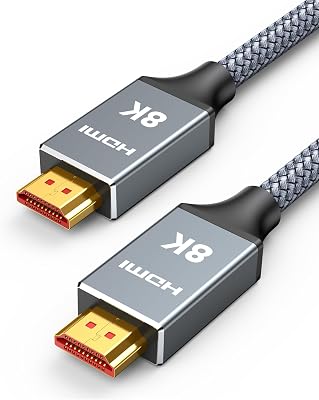
Certification is critical and often overlooked. For HDMI 2.1 performance you want a cable bearing the “Ultra High Speed HDMI” certification label; unbranded cables frequently fail to sustain 48 Gbps. For DisplayPort, look for VESA-certified DP40 or DP80 cables to guarantee UHBR13.5 or UHBR20 speeds. Buying a cheap uncertified cable is the most common reason a perfectly capable monitor refuses to hit its advertised refresh rate. If you are troubleshooting a display that won’t reach 4K120 or 1440p240, the cable is the first thing to swap.
When to Use Each Connector
Match the connector to the scenario. Use DisplayPort when you are building or upgrading a gaming PC paired with a dedicated monitor, when you need multi-monitor daisy-chaining, or when you want the absolute highest refresh rates at 4K. Use HDMI when gaming on a TV, connecting a PlayStation 5 or Xbox Series X, or when your run of cable is long. Many modern GPUs and monitors include both, so you can even keep a console on HDMI and your PC on DisplayPort simultaneously. If you are still weighing which display to buy, our best gaming monitors guide and the companion 4K vs 1440p gaming comparison pair naturally with this article.
| Feature | HDMI 2.1 | DisplayPort 2.1 | Best for |
|---|---|---|---|
| Overall recommendation | Best for TVs and consoles | Best for PC gaming monitors | DisplayPort 2.1 for desktop PCs |
| Max bandwidth | 48 Gbps | 80 Gbps (UHBR20) | DisplayPort 2.1 for future-proofing |
| 4K refresh rate | 4K at 120Hz | 4K at 240Hz | DisplayPort 2.1 for high-refresh 4K |
| Multi-monitor daisy-chain (MST) | Not supported | Supported | DisplayPort for triple-screen setups |
| Console and TV support | Native (PS5, Xbox Series X) | Rare on TVs | HDMI 2.1 for living-room gaming |
Whichever you choose, make sure your graphics card, cable, and display all support the same standard end to end. A weak link anywhere in that chain caps your entire setup. For a deeper hardware walkthrough, see our graphics card buying guide before locking in your next build.
Frequently Asked Questions
Is DisplayPort better than HDMI for gaming?
For PC gaming on a dedicated monitor, DisplayPort is generally better because it offers higher raw bandwidth, mature VRR support, multi-monitor daisy-chaining, and the highest refresh rates at 4K. However, HDMI 2.1 is better for console gaming and TVs, since the PlayStation 5 and Xbox Series X output only over HDMI. The best connector depends on your specific setup rather than one being universally superior.
Can HDMI 2.1 do 4K 120Hz?
Yes. HDMI 2.1 supports 4K at 120Hz natively with full color, which is one of its headline features and the reason it powers current-generation gaming consoles and high-end TVs. To achieve it reliably you need an Ultra High Speed HDMI certified cable and a source device with a genuine HDMI 2.1 port, not an older HDMI 2.0 connection.
Does DisplayPort support G-Sync and FreeSync?
Yes. DisplayPort supports both AMD FreeSync and NVIDIA G-Sync, and it is the required connector for monitors with a full hardware G-Sync module. It has offered mature Adaptive-Sync support for years, making it the most reliable choice for tear-free variable refresh rate gaming on a PC.
Which connector should I use for a 240Hz monitor?
For a 1440p 240Hz monitor, both HDMI 2.1 and DisplayPort will work, though DisplayPort is the traditional and most widely supported option. For a 4K 240Hz monitor, DisplayPort 2.1 with UHBR20 is the recommended connector because it has the bandwidth headroom to drive that demanding combination without heavy compression. Always confirm your GPU and cable support the same tier to reach the full refresh rate.