Every other system covered on this site asks a handheld to compute graphics. Laserdisc games ask it to play a film. Dragon’s Lair, Space Ace, and Cliff Hanger were arcade cabinets built around a LaserDisc player: the animation is pre-recorded video, and the machine watches for the right joystick move or button press at the right moment, then jumps to the scene where the hero survives or the scene where he does not. That odd design changes what a good handheld looks like. Raw processing power barely matters here. What matters is clean video decoding, a screen the picture sits well on, enough storage for games that are mostly movie, and firmware that actually ships the one emulator family this library needs.
As an Amazon Associate, we earn from qualifying purchases.
Quick Answer
For laserdisc games, buy the screen and the software route, not the processor. The Anbernic RG406H leads because its 4:3 panel matches the video and Android runs the Hypseus-based cores with hardware decoding. The AYN Thor Pro and Retroid Pocket 5 add widescreen AMOLED panels and decoding headroom for enhanced Singe editions, the RG556 is the gentler-priced Android route, and the RG35XX Plus covers the Linux firmware path for less.
The Library Is a Shelf of Short Films
The original laserdisc emulator, Daphne, is no longer actively developed. Its maintained successor is Hypseus Singe, a fork that plays the classic Daphne titles and adds the Singe engine: a Lua-scripted simulation layer behind the fan-enhanced editions of Dragon’s Lair and Space Ace, plus Singe 2 releases whose video ships as MP4. The combined catalogue is small but famous: Dragon’s Lair and its sequel, Space Ace, Cliff Hanger, Astron Belt, Galaxy Ranger, Cobra Command, Mach 3, Road Blaster, Super Don Quix-ote, and Thayer’s Quest, with the American Laser Games shooters alongside as Singe titles.
Under the hood, each game is a folder of video. The picture lives in MPEG-2 files, the sound in Ogg audio, and a small framefile tells the emulator which frame of the film each scene starts on. That structure explains the whole buying decision. Because the heavy lifting is video playback, the Hypseus-based cores lean on hardware decoding, using the Android MediaCodec path on Android devices, which lets even mid-range chips play standard rips smoothly. The exception is the enhanced Singe material, where high-resolution video rewards genuinely strong decoders. Storage is the other quiet cost: this library is measured in movie files, not cartridge images. One mercy: the HypseusHW core needs no BIOS files at all, just the game data laid out correctly.
Two Roads In: Android Cores and Linux Firmware
There are two mature ways onto this library, and the picks below split along that line. On Android, the route is RetroArch’s Daphne core, the HypseusHW build based on Hypseus Singe, tested on Android arm64 and decoding the laserdisc video in hardware where the platform allows it. A standalone Hypseus Singe app exists for players who prefer to skip RetroArch entirely.
On Linux, the route is firmware. Batocera-family systems such as Knulli and AmberELEC list Hypseus Singe as their laserdisc emulator in the system menu, so the games sit on the same shelf as every other console once the folders are in place. Both roads converge on the same engine and the same game data, so the real choice is ecosystem: Android’s flexibility and touchscreens, or the tidy, everything-in-one-menu feel of a Linux build. Either road demands more setup patience than a cartridge system, because the Daphne folder layout has to be right before anything plays.
The 4:3 Purists
Laserdisc video is natively 4:3, the shape of the arcade monitors it was mastered for. On a 4:3 handheld screen it fills the panel edge to edge, with no wasted space. Two picks take that route, one on each software road.
Anbernic RG406H: The Native Fit

The RG406H is the laserdisc pick that wastes nothing. Its 4-inch IPS touchscreen runs 960 by 720, an exact 4:3 match for the source video, so Dragon’s Lair plays at the largest size this screen class allows. Android gives it the HypseusHW RetroArch core and the standalone app, both decoding MPEG-2 in hardware through the Unisoc T820, comfortably strong enough for standard rips and lighter Singe titles. The touchscreen also earns its keep on the American Laser Games shooters, where aiming by tap is far kinder than nudging a stick crosshair.
Specs
- Display: 4-inch IPS touchscreen, 960 by 720
- Processor: Unisoc T820
- Memory: 8 GB RAM, 128 GB internal storage
- Battery: 5,000 mAh
- Controls: Hall effect sticks, analog triggers
- System: Android
- Tier: mid-range
Anbernic RG35XX Plus: The Linux Budget Route

The RG35XX Plus is the cheapest honest way into this library, through firmware rather than apps. Under Knulli, the Batocera-family build for this hardware, Hypseus Singe appears in the menu as the laserdisc emulator, and the H700 chip handles standard-definition Daphne rips without drama, because the work is video playback rather than 3D rendering. Its 3.5-inch screen is the same 4:3 shape as the RG406H, just smaller, suiting the pick-up-and-die rhythm of the Bluth games. The honest caveat is the ceiling: the enhanced Singe editions with high-resolution video are beyond this tier. Buy it for the classics in standard definition and it delivers exactly that.
Specs
- Display: 3.5-inch IPS, 640 by 480
- Processor: Allwinner H700 quad-core Cortex-A53
- Memory: 1 GB LPDDR4
- Battery: 3,300 mAh
- Connectivity: Wi-Fi and Bluetooth
- System: Linux-based firmware with RetroArch
- Tier: budget
Widescreen Android: Living With Pillarboxes
A 16:9 screen shows a 4:3 film with bars down the sides. Players fill that space with bezels and overlays, or accept it, because a bigger panel still draws the picture larger than a small native screen can. The three Android picks below trade shape for size, panel quality, and decoding muscle.
AYN Thor Pro: The Two-Screen Flagship

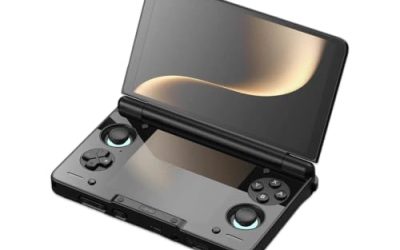
The Thor Pro is the laserdisc overkill pick, and the library gives its excesses somewhere to go. The Snapdragon 8 Gen 2 is the strongest decoder here, the chip to choose for the enhanced Singe editions whose high-resolution MPEG-2 and MP4 video separates strong hardware from adequate hardware. The 6.31-inch AMOLED main screen makes the pillarboxed picture genuinely large, and the second touchscreen gives scoreboard overlays and bezel art a home that does not crowd the film. Storage is the other flagship argument: 256 GB internally plus a card slot swallows a full shelf of video-heavy games.
Specs
- Main display: 6.31-inch AMOLED, 1920 by 1080, 120Hz
- Secondary display: 3.92-inch AMOLED touchscreen
- Processor: Qualcomm Snapdragon 8 Gen 2
- Memory: 12 GB RAM, 256 GB internal storage
- Battery: 6,000 mAh
- System: Android 13
- Tier: premium
Retroid Pocket 5: The Balanced Android Pick
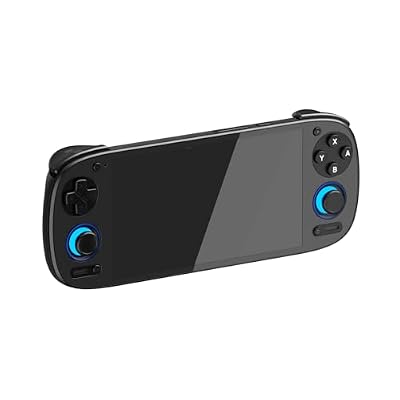
The Retroid Pocket 5 is the straightforward recommendation for most laserdisc curious players. The Snapdragon 865 decodes the standard library in hardware without effort and keeps the mainstream Singe editions smooth, its 5.5-inch AMOLED renders the saturated hand-drawn animation beautifully, and Android offers both the HypseusHW core and the standalone app. It lacks the Thor Pro’s second screen and ultimate headroom, so the very heaviest enhanced rips are the flagship’s territory, but for the canonical catalogue this is the complete package in a single-screen shell.
Specs
- Display: 5.5-inch AMOLED touchscreen, 1920 by 1080
- Processor: Qualcomm Snapdragon 865
- Memory: 8 GB RAM, 128 GB internal storage
- Battery: 5,000 mAh, 27W fast charging over USB-C
- System: Android 13
- Controls: Hall effect sticks, analog triggers
- Tier: premium
Anbernic RG556: The Marathon AMOLED

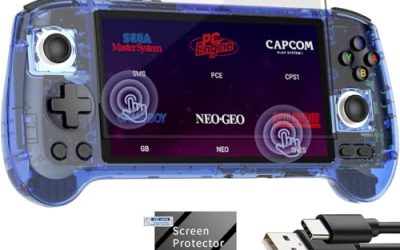
The RG556 takes the same Android road as the Retroid Pocket 5 with a rounder shell and the biggest battery in this guide. That 5,500 mAh cell matters for a video library: sessions are short per attempt but the screen and decoder run constantly, and the RG556 outlasts the field across an evening of retries. The Unisoc T820 is a step down from the Snapdragon chips, yet hardware MPEG-2 decoding keeps standard rips and most Singe titles at full speed; only the enhanced editions argue for the premium tier. This is the mid-range pick for players who value endurance over ceiling.
Specs
- Display: 5.48-inch AMOLED touchscreen, 1920 by 1080
- Processor: Unisoc T820
- Memory: 8 GB RAM, 128 GB internal storage
- Battery: 5,500 mAh
- Controls: Hall effect sticks, analog triggers
- System: Android
- Tier: mid-range
How to Choose
Decide your rip tier first. If the standard-definition Daphne catalogue is the goal, every pick here plays it, and the choice collapses to screen and budget. If the enhanced Singe editions are the draw, with their remastered high-resolution video, shop the premium tier: the Thor Pro first, the Retroid Pocket 5 second. Next, pick a screen philosophy. Native 4:3 panels, the RG406H and RG35XX Plus, show the film at full frame with no filler; widescreen panels show it larger, framed by bezels. Budget storage like a movie collection, because that is what this is. Check controls too: the Bluth games need a D-pad and one dependable button, which everything here has, while the gun games play best on touchscreen models. Finally, choose the ecosystem you will actually maintain, since both run the same engine underneath.
Who Should Skip Laserdisc Entirely
Skip this library if pick-up-and-play setup is the appeal of retro handhelds for you. The folder layout, framefiles, and video rips demand more assembly than any cartridge system before the first game starts. Skip it if quick-time-event gameplay irritates you: the flagship titles are memorisation and timing dressed as cartoons, and no handheld fixes that. Skip it too if your sessions run long, because these are short arcade films built for three-minute attempts, not evening-long campaigns. And if you expect every laserdisc oddity ever pressed to run, temper that now: a handful of titles remain partial even in Hypseus Singe.
Frequently Asked Questions
What emulator do these handhelds use for laserdisc games?
Hypseus Singe, the maintained fork of the original Daphne emulator. On Android it arrives as the HypseusHW core in RetroArch or as a standalone app. On Linux handhelds it is bundled by Batocera-family firmwares such as Knulli and AmberELEC, where laserdisc appears as its own system.
Do laserdisc games need a BIOS file?
No. The HypseusHW core needs no BIOS or system files, which removes one usual setup chore. What it does need is the game data itself arranged in the standard Daphne layout, with the ROMs, the framefile, and the video and audio folders in their expected places.
How much storage does a laserdisc library take up?
Far more than a cartridge library of similar size, because every game is mostly movie. Standard rips add up quickly, and the enhanced Singe editions multiply the footprint again with higher-resolution video. Treat a roomy memory card or generous internal storage as part of the purchase.
Can I play the light-gun laserdisc games on a handheld?
Yes, with a compromise. Hypseus Singe supports gamepad input and light-gun style aiming, and on a handheld the aiming maps to the analog stick. Touchscreen models make the American Laser Games titles friendlier, since tapping a target beats steering a crosshair, though neither replaces a real light gun on a television.
Final Verdict
Laserdisc rewards the buyer who shops for a video player rather than a games console. The Anbernic RG406H is the purist answer, a native 4:3 screen on the flexible Android road. The AYN Thor Pro is the flagship for enhanced editions and big storage, the Retroid Pocket 5 is the balanced premium pick, the RG556 stretches the same idea across a longer battery, and the RG35XX Plus proves the Linux route on a budget. Choose by rip tier and screen shape, and the strangest shelf in the arcade opens up.
Product and ASIN Reference
| Product | ASIN |
|---|---|
| AYN Thor Pro | B0FV3HKG9P |
| Retroid Pocket 5 (Black) | B0DT4G4PD2 |
| Anbernic RG556 (Blue) | B0FKHBVGLQ |
| Anbernic RG406H (White) | B0DNF3LD4C |
| Anbernic RG35XX Plus (64GB) | B0CN3CJFZH |