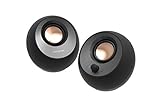
The Creative Pebble 2.0 Channel Stereo Speakers are one of the genuine success stories of budget PC audio — a small, USB-powered 2.0 set sold for under $30 that has become the default upgrade from laptop or built-in speakers. The cabinets are spherical, the drivers tilt up at 45 degrees toward the listener and the entire setup runs from a single USB cable for power plus a 3.5mm jack for audio. There is no Bluetooth in the original Pebble and no subwoofer — just an honest, well-tuned little 2.0 system. This Creative Pebble review covers the sound quality and bass response, connectivity and controls, build and aesthetics, setup and placement, who they are for and a verdict.

Creative Pebble 2.0, USB Desktop Stereo Speakers for PC/Laptop, Black | USB-Powered, 2.0 Speaker, Compact, Stereo, PC Speakers, Laptop Speakers, Minimal Design, Desktop Audio, Black


As an Amazon Associate we earn from qualifying purchases. Product prices and availability are accurate as of the date/time indicated.
🛒 Best Price Today on Amazon
Prime members get fast, free shipping on everything above, plus member-only deals. New members get a 30-day free trial — cancel anytime.
As an Amazon Associate we earn from qualifying purchases.



Creative Pebble at a Glance
| Feature | Specification |
|---|---|
| Configuration | 2.0 stereo (two satellites, no subwoofer) |
| Total power output (RMS / Peak) | 4.4W RMS / 8W Peak |
| Driver size | 2.25-inch full-range drivers, angled 45 degrees up |
| Frequency response | 100Hz – 17kHz (manufacturer specified) |
| Connectivity | 3.5mm analogue input; USB for power |
| Controls | Right-cabinet rotary volume / power dial |
| Headphone output | No |
| Subwoofer | No (2.0 stereo design) |
| Approx. price | Around $25 |
Sound Quality & Bass Response
Before getting into the specifics of this speaker system it is worth a brief refresher on the technical choices that shape any PC speaker review: channel configuration (2.0 versus 2.1), power delivery (USB-bus power versus mains power) and connection type (3.5mm analogue, USB digital or Bluetooth). A 2.0 system consists of two stereo satellite speakers with the bass and treble drivers contained within each cabinet — simple, tidy and the right answer for the majority of desk setups where the speakers sit either side of a monitor. A 2.1 system adds a dedicated subwoofer, which usually lives on the floor and reproduces the lowest frequencies. The advantage is genuine low-end extension for games, films and electronic music; the trade-off is desk and floor footprint plus extra cabling. Most office and casual-gaming users are well served by a competent 2.0 set; gamers and film viewers who want chest-thumping bass benefit from 2.1.
Power matters too. USB-bus-powered speakers — the Amazon Basics Stereo, Logitech S150 and original Creative Pebble belong here — draw their power from the computer’s USB port and produce modest, near-field volume that suits a single user at a desk. Mains-powered speakers (such as the Edifier R1280T, Logitech Z313 and Klipsch ProMedia 2.1) draw from a wall outlet and can drive much louder, fuller sound, with room to fill a small or medium room. As a rule, USB-powered 2.0 sets sit in the budget tier and prioritise convenience; mains-powered 2.0 and 2.1 sets occupy the mid and upper tiers and prioritise sound quality and headroom. The Creative Pebble V2 sits in between — USB-C bus-powered but with a higher 8W RMS rating than the original Pebble.
Finally, connectivity. The traditional PC speaker input is a single 3.5mm analogue jack, which works with any computer, console, phone or tablet with a headphone output. USB speakers add a digital audio path, bypassing the PC sound card and often acting as a USB sound card themselves. Bluetooth, where present, allows wireless playback from a phone or tablet, which is useful when the same speakers are used for music as well as PC audio — the Edifier R1280T is a good example of a desk speaker that adds RCA inputs but keeps to wired connections. A headphone output on the speaker unit is a quietly important convenience: a forward-facing 3.5mm jack lets you plug headphones into the speakers themselves rather than reaching behind the PC each time you want a private listening session.
The Creative Pebble’s most-praised feature is how confident it sounds for the money. The 4.4W RMS rating is modest, but the 45-degree upward-tilted drivers project sound directly toward the listener’s ears when the speakers sit on a desk, which makes a real difference to perceived clarity and presence at typical near-field listening distances. Voice content, gaming dialogue, video calls and casual music are reproduced with a warmth and fullness that genuinely surprises buyers stepping up from laptop or monitor speakers. The published 100Hz lower bound is honest — there is no deep sub-bass and no dedicated woofer — but within the 100Hz to 17kHz range the Pebble is well tuned and avoids the harsh, hollow character that cheaper sets fall into. For gaming, the sound is engaging at near-field volume; for chest-thumping low end you want a 2.1 system. The Pebble’s biggest practical achievement is sounding pleasant rather than merely loud. Mid-tier upgrades are covered in our best budget PC speakers guide.
Connectivity & Controls
Connectivity follows the budget-2.0 template: a 3.5mm analogue jack carries audio and a USB cable supplies bus power. The original Pebble has no Bluetooth and no USB audio path — for that, look at the newer Creative Pebble V2 with USB-C, also covered in this guide. The 3.5mm input keeps the Pebble compatible with any PC, laptop, phone, tablet or console headphone output. Controls are simple: the right-hand cabinet has a rotary dial on the back that combines on/off and volume, easy to find by touch. There is no microphone input, no headphone passthrough and no software, which is appropriate for the price tier — the speakers are intentionally a single, predictable function.
Build & Aesthetics
The spherical design is one of the Pebble’s strongest visual choices. Compared with the rectangular bricks that dominated the budget category before its release, the Pebble looks deliberate and modern, in a way that suits a tidy home-office or a clean gaming setup rather than a stereotypical RGB rig. The matte black finish is unobtrusive, the cabinets are small enough to sit close to a monitor base without crowding the desk, and the design has become genuinely iconic in budget audio. Build is plastic but solid; the 45-degree mounting is integral to each cabinet rather than a separately moulded stand, which keeps the geometry consistent and prevents the drivers from being knocked out of alignment. It is a genuinely tidy product at this price.
Setup & Placement
Plug the USB cable into the PC or laptop for power, plug the 3.5mm jack into the headphone output for audio, turn the right-cabinet dial on, done. Placement-wise, the Pebble rewards a little symmetry: keep the two cabinets equidistant from the monitor centre, leave a few centimetres between each cabinet and any back wall to reduce reflections, and aim the upward-angled drivers toward where your head sits when you are at the desk. Because the drivers angle up at 45 degrees, sitting too tall or too low relative to the speakers slightly changes the perceived clarity — the design assumes a typical seated desk position. There is no subwoofer to place, no rear bass port to worry about and no calibration to run. For a desk speaker that just works, this is one of the best starting points. Compare with other tidy desk options in our best USB-powered speakers guide.
Who It’s For
The Creative Pebble is for the buyer who wants a meaningful upgrade from laptop or monitor speakers on a strict budget and does not need subwoofer-grade bass. If you spend the bulk of your time on a desk, listen mainly to voice content, light music and casual gaming, and value a tidy, modern design that does not advertise itself as a gaming product, the Pebble is squarely your set. It is not for buyers who want film-grade low end — for that, a 2.1 system such as the Logitech Z313 or a powered bookshelf set such as the Edifier R1280T is the right step up — and it is not for buyers who want Bluetooth or a USB digital audio path, in which case the Creative Pebble V2 in this guide is a closer match. For the budget desk, the Pebble remains the default recommendation. The wider category is covered in our best PC speakers guide.
Pros and Cons
Pros: Confident, warm sound for a USB-powered 2.0 set; clever 45-degree upward driver angle; tidy, iconic spherical design; very low price; effectively zero-configuration setup; widely positively reviewed by buyers.
Cons: No subwoofer or deep bass below 100Hz; no Bluetooth or USB audio in the original Pebble; no headphone passthrough; modest total volume limits use to near-field desk listening.
Verdict
At around $25 the Creative Pebble 2.0 set has been the default budget PC speaker recommendation for several years for good reason. It sounds appreciably better than its price implies, looks deliberately tidy on a modern desk and asks nothing of the user beyond two cables and a knob turn. Bass-hungry gamers and film viewers should look at the 2.1 options in this guide; everyone else who simply wants a real improvement on built-in audio without spending much will find the Pebble does the job exactly as intended. The newer Creative Pebble V2 in this guide adds USB-C and more power for buyers who want the same character with a small step up. Either way, this is genuinely good value. Bigger systems are covered in our best gaming speakers guide.
Frequently Asked Questions
How much power does the Creative Pebble output?
The original Creative Pebble is rated at 4.4W RMS total power, with an 8W peak. That is enough for confident near-field desk listening, but not for filling a room.
Does the original Creative Pebble have Bluetooth?
No. The original Pebble uses a 3.5mm analogue input for audio and a USB cable for power. For wireless connectivity, look at later models in the Pebble line.
How are the Creative Pebble drivers angled?
The drivers are tilted up at 45 degrees toward the listener, which projects sound directly at ear height for typical seated desk listening and improves perceived clarity.
Is the Creative Pebble good for gaming?
Yes, for casual desk gaming. For chest-thumping low end in films and action games, a 2.1 system such as the Logitech Z313 or a more powerful set such as the Logitech Z623 will be more satisfying.
More PC Speaker Reviews
- Logitech S120 2.0 Stereo Speakers Review
- Edifier R1280T Powered Bookshelf Speakers Review (2.0)
- Amazon Basics USB-Powered Computer Speakers Review
- Logitech Z313 2.1 Multimedia Speaker System Review
- Logitech Z130 PC Speakers Stereo 2.0 Review
- Logitech S150 USB Speakers Review (Digital Sound)
- Redragon GS520 RGB Desktop Speakers 2.0 Review
- Klipsch ProMedia 2.1 THX Computer Speaker System Review
Affiliate Disclosure: As an Amazon Associate, we earn from qualifying purchases. If you click a link and make a purchase, we may earn a small commission at no extra cost to you. Prices and availability are accurate as of publication and may change.
Related Articles
Looking for more on this topic? Browse the hand-picked guides below — each one applies the same scoring rubric used in this review.