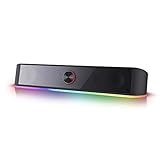
The Redragon GS520 is one of the standout RGB-lit budget gaming speaker pairs available, and an obvious answer to the buyer who finds the plain styling of the Amazon Basics, Logitech and Creative Pebble pairs in this guide too understated for a serious gaming rig. The GS520 keeps the standard 2.0 USB-powered formula — a 3.5mm audio input, a USB cable for power and bus-powered amplification — but adds vibrant RGB lighting around each cabinet, a sleeker modern shape and the kind of styling that fits a clean gaming setup. Priced around $35, it sits in the lower budget tier where it competes squarely with the Creative Pebble. This Redragon GS520 review covers the sound quality, connectivity, build, setup, who they suit and a verdict.
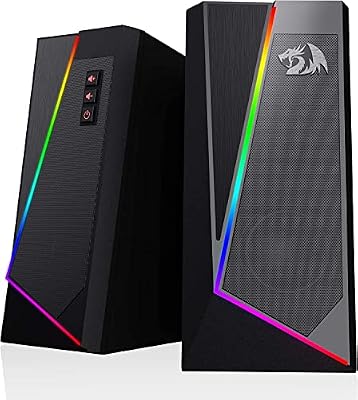
Redragon GS520 Wired 2.0 Channel Stereo Sound Desktop RGB Computer Speakers | Enhanced Auido Quality, Plug & Play USB Powered PC Gaming Speaker, 6 Colorful Backlight Modes, Easy-Access Volume Control


As an Amazon Associate we earn from qualifying purchases. Product prices and availability are accurate as of the date/time indicated.
🛒 Best Price Today on Amazon
Prime members get fast, free shipping on everything above, plus member-only deals. New members get a 30-day free trial — cancel anytime.
As an Amazon Associate we earn from qualifying purchases.




Redragon GS520 at a Glance
| Feature | Specification |
|---|---|
| Configuration | 2.0 stereo (two satellites, no subwoofer) |
| Total power output (RMS / Peak) | 6W RMS total (3W + 3W) |
| Driver size | Approx. 2-inch full-range per satellite |
| Frequency response | Not documented in detail; typical compact USB 2.0 range |
| Connectivity | 3.5mm analogue input; USB for power and RGB |
| Controls | On-cabinet volume / power / RGB control |
| Headphone output | No |
| Subwoofer | No (2.0 stereo design) |
| Approx. price | Around $35 |
Sound Quality & Bass Response
Before getting into the specifics of this speaker system it is worth a brief refresher on the technical choices that shape any PC speaker review: channel configuration (2.0 versus 2.1), power delivery (USB-bus power versus mains power) and connection type (3.5mm analogue, USB digital or Bluetooth). A 2.0 system consists of two stereo satellite speakers with the bass and treble drivers contained within each cabinet — simple, tidy and the right answer for the majority of desk setups where the speakers sit either side of a monitor. A 2.1 system adds a dedicated subwoofer, which usually lives on the floor and reproduces the lowest frequencies. The advantage is genuine low-end extension for games, films and electronic music; the trade-off is desk and floor footprint plus extra cabling. Most office and casual-gaming users are well served by a competent 2.0 set; gamers and film viewers who want chest-thumping bass benefit from 2.1.
Power matters too. USB-bus-powered speakers — the Amazon Basics Stereo, Logitech S150 and original Creative Pebble belong here — draw their power from the computer’s USB port and produce modest, near-field volume that suits a single user at a desk. Mains-powered speakers (such as the Edifier R1280T, Logitech Z313 and Klipsch ProMedia 2.1) draw from a wall outlet and can drive much louder, fuller sound, with room to fill a small or medium room. As a rule, USB-powered 2.0 sets sit in the budget tier and prioritise convenience; mains-powered 2.0 and 2.1 sets occupy the mid and upper tiers and prioritise sound quality and headroom. The Creative Pebble V2 sits in between — USB-C bus-powered but with a higher 8W RMS rating than the original Pebble.
Finally, connectivity. The traditional PC speaker input is a single 3.5mm analogue jack, which works with any computer, console, phone or tablet with a headphone output. USB speakers add a digital audio path, bypassing the PC sound card and often acting as a USB sound card themselves. Bluetooth, where present, allows wireless playback from a phone or tablet, which is useful when the same speakers are used for music as well as PC audio — the Edifier R1280T is a good example of a desk speaker that adds RCA inputs but keeps to wired connections. A headphone output on the speaker unit is a quietly important convenience: a forward-facing 3.5mm jack lets you plug headphones into the speakers themselves rather than reaching behind the PC each time you want a private listening session.
The GS520 is rated at 6W RMS total, a modest but useful step up from the 4.4W of the original Creative Pebble and significantly above the 2.4W of the Amazon Basics USB pairs in this guide. The extra power translates into a more confident performance at near-field desk volume and a small amount more headroom before the small drivers lose composure. Sound character is the standard budget USB-bus tuning: clean treble, adequate mid-range for voice and casual music, and modest low end. There is no dedicated woofer and the USB-bus power budget caps how hard the small full-range drivers can be driven; do not expect film-grade bass. For gaming, the sound is engaging at desk distance and the RGB lighting adds a dimension to the experience that none of the plain-styled rivals in this guide attempt. The wider RGB category is in our best RGB gaming speakers guide.
Connectivity & Controls
Connectivity follows the budget USB template: a 3.5mm analogue jack carries audio from the PC, laptop, phone or console, and a USB cable carries both power for the amplification and electricity for the RGB lighting. There is no USB digital audio path on the GS520 — the USB is for power only — and there is no Bluetooth or RCA. That keeps compatibility broad through the 3.5mm input but means buyers who want wireless playback should look elsewhere. Controls are on-cabinet rather than on a control pod: volume control and an RGB cycle button on the front of the right satellite. The lighting cycles through a range of patterns and colours, easy to set to a single steady colour for users who find the cycling distracting. There is no headphone passthrough.
Build & Aesthetics
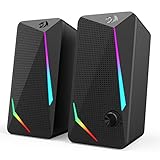
The GS520 is the most explicitly gamer-styled speaker in this entire guide, and that is the appeal. The cabinets are angular, with a clear RGB ring around the front baffle that lights up the surrounding driver area and casts a soft glow onto the desk. The overall shape is contemporary and deliberately matches the look of Redragon’s wider keyboard, mouse and headset range — the speakers will look right alongside a Redragon RGB keyboard and a clean white or black gaming desk. Build quality is appropriate for the price tier: plastic cabinets, stable enough on the desk, with reasonable cable lengths and a positive feel to the control buttons. Buyers who want a stealthy, neutral look should look elsewhere in this guide; the GS520 is the answer for buyers who want their speakers to participate in the visual style of the rig.
Setup & Placement
Setup is the standard USB-bus zero-fuss process. Plug the USB cable into a free PC or laptop port for power, plug the 3.5mm jack into the headphone output for audio, switch the speakers on at the cabinet control and listen. There is no driver to install, no software to download and no pairing — the RGB lighting cycles through patterns under the on-cabinet button rather than requiring an app. Placement should follow the same desk-2.0 rules every speaker in this guide rewards: symmetrical either side of the monitor, close to ear height, with a small gap behind each cabinet. The RGB lighting looks best when the cabinets are slightly forward of the monitor base so the glow is visible — keep them a centimetre or two in front rather than tucked back against the screen. Wider gaming category coverage is in our best gaming speakers guide.
Who It’s For
The GS520 is for the gamer who wants USB-powered desktop 2.0 audio with explicit gamer styling and visible RGB lighting, on a strict budget. If you have a Redragon, RGB-themed or otherwise visually styled gaming desk and find the plain-black look of the Amazon Basics, Logitech and Creative Pebble pairs in this guide too understated for your rig, the GS520 is squarely your set. It is not for buyers who want film-grade low end — for that, any 2.1 system in this guide is a better choice — and not for buyers who want premium hi-fi character (the Edifier R1280T is the obvious choice in that direction). For the budget RGB gaming desk, the GS520 is the defining choice. The wider RGB tier is covered in our best RGB gaming speakers guide.
Pros and Cons
Pros: Distinct RGB lighting that fits a styled gaming desk; modestly more power than the cheapest USB-bus rivals; zero-configuration USB setup; tidy on-cabinet controls; sensible price.
Cons: No real bass; no USB digital audio path, Bluetooth or headphone passthrough; explicitly gamer-styled look will not suit office or family desks; modest total power limits volume.
Verdict
At around $35 the Redragon GS520 is a well-judged budget RGB desktop speaker pair — it does not try to compete with 2.1 systems on bass or with bookshelf speakers on hi-fi character, but it adds visible gamer styling that none of the plain rivals at this price match. Buyers who want neutral styling should look at the Creative Pebble; buyers who want real low end should look at the Logitech Z313 or Z623; everyone else who wants their desktop speakers to participate in the visual identity of an RGB gaming rig will find the GS520 a sensible choice. Compare with mid-tier gaming options in our best gaming speakers guide.
Frequently Asked Questions
Does the Redragon GS520 have RGB lighting?
Yes. The GS520 has a clear RGB ring around the front of each cabinet, with multiple lighting patterns and colours selectable via an on-cabinet button.
How powerful are the Redragon GS520 speakers?
They are rated at 6W RMS total (3W per cabinet), which is modestly more than the cheapest USB-bus 2.0 pairs but well below any 2.1 system in this guide.
Do the Redragon GS520 work with consoles?
Yes through the 3.5mm analogue input, provided the console (or controller) has a headphone output. They also need a USB port for power, which most consoles provide.
Is the Redragon GS520 a 2.0 or 2.1 system?
It is a 2.0 stereo system — two satellite speakers with no dedicated subwoofer. For real low-end weight, look at the 2.1 options in this guide.
More PC Speaker Reviews
- Klipsch ProMedia 2.1 THX Computer Speaker System Review
- Creative Pebble V2 USB-C Computer Speakers Review
- Logitech Z623 400W 2.1 THX Speaker System Review
- Amazon Basics Stereo 2.0 PC Speakers Review (USB-Powered)
- Creative Pebble 2.0 Channel Stereo Speakers Review
- Logitech S120 2.0 Stereo Speakers Review
- Edifier R1280T Powered Bookshelf Speakers Review (2.0)
- Amazon Basics USB-Powered Computer Speakers Review
Affiliate Disclosure: As an Amazon Associate, we earn from qualifying purchases. If you click a link and make a purchase, we may earn a small commission at no extra cost to you. Prices and availability are accurate as of publication and may change.
Related Articles
Looking for more on this topic? Browse the hand-picked guides below — each one applies the same scoring rubric used in this review.