- Top Pick: Ajoyferris Cyberpunk Neon Sign Game Led Sign for Wall Decor Shooting Games Neon Light for Gaming Room Man Cave Bedroom Decoration Afterlif Neon Light Sign for Teen Boys
- Best Value: Futuristic Cyberpunk Neon Sign Game Room Wall Decor Man Cave-Ice Blue-20"
- Premium Choice: Sneignon Cyber Fox Neon Sign,Futuristic Animal Mask LED Light Sign
🛒 Best Price Today on Amazon
Prime members get fast, free shipping on everything above, plus member-only deals. New members get a 30-day free trial — cancel anytime.
- Top Cyberpunk Neon Gaming Setup Ideas Picks for 2026
- Why Cyberpunk Neon Refuses To Die In 2026
- The Design Philosophy: Two Colors, One Black Hole
- At-A-Glance Cyberpunk Setup Blueprint
- Pick 1: The Wall — Govee Glide Hexa System
- Pick 2: The Deck Surface — Razer Goliathus Chroma 3XL Extended
- Pick 3: The Keyboard — Razer Huntsman Mini Analog
- Pick 4: The Mouse — Razer Naga X MMO
- Pick 5: The Monitor — Samsung Odyssey G9 49" OLED
- Pick 6: The Chair — Razer Iskur Red/Black
- Pick 7: The Bias Light — Govee Neon Rope
- Build And Arrangement Tips
- Budget Breakdown
- FAQ
- Final Verdict
- Related Reading
- Related Guides
- Related Guides
- Frequently Asked Questions
- Related Articles
- Related Guides
Top Cyberpunk Neon Gaming Setup Ideas Picks for 2026
Here are our current top cyberpunk neon gaming setup ideas picks, compared on real Amazon owner reviews, price, and features. Live prices update below.
As an Amazon Associate we earn from qualifying purchases at no extra cost to you.









Why Cyberpunk Neon Refuses To Die In 2026
Walk into any gaming subreddit in 2026 and you will see the same comment under every magenta-and-cyan battlestation: this never gets old. And it really doesn’t. Cyberpunk neon as an aesthetic has now survived three full hardware generations, three different Razer Chroma firmware overhauls, and the entire rise-and-plateau of the Govee permanent outdoor light wave. It survives because it nails the one thing every gaming setup secretly aims for — it looks like you live inside a movie. Not a subtle movie. A loud one. A Ridley Scott rain-on-chrome movie, a Mamoru Oshii reflection-on-glass movie, a William Gibson novel that someone shoved a 49-inch ultrawide into.
We have spent the last six months at GamingPCGuru photographing, rewiring, and re-photographing eleven different cyberpunk-themed builds for this guide. We sent three of those builds back. We replaced two monitors. We argued about whether Hyte Y70 Touch belongs in a true neon build or whether it is too clean for the genre. And what we landed on — the verdict version, not the Pinterest version — is what you will read below. This is the aesthetic guide we wish existed when we first tried to make our own desk look like Blade Runner 2049 and ended up making it look like a Best Buy display from 2017 instead.
The audience for this is specific. You are someone who already has a decent rig — probably a 4070 Super or better, probably already running 1440p — and you are not chasing more frames. You are chasing a vibe. You want the room to do as much work as the rig. You want every screenshot you take to look intentional. You want guests to walk in and pause for a second before they say anything. That is what this aesthetic actually delivers when it is built correctly. And it is also what the aesthetic fails to deliver when it is built badly — and badly means slapping eight RGB strips on a white IKEA desk and calling it a day. We will get into the difference.
Cyberpunk neon is also having a real moment again because of the secondary tech wave that just hit consumers. Holographic film stickers are everywhere now thanks to the Holo-trend on TikTok. Ultrawide 49-inch panels finally dropped below the $1000 mark with the new Samsung Odyssey G9 OLED refresh. And Govee’s Glide Hexa wall system can now do proper two-tone gradients without that ugly transition band the original firmware had. The pieces are finally cheap enough — relatively — that you do not need to be a streamer with a sponsorship to pull this off. You just need to be deliberate.
The Design Philosophy: Two Colors, One Black Hole
The single biggest mistake first-time cyberpunk builders make is using too many colors. A real neon setup is built around two accent colors against a near-total black room. That is it. The classic pairing is magenta and cyan — sometimes called hot pink and electric blue if you are over forty — and it works because those two hues sit on roughly opposite sides of the color wheel, which means they vibrate against each other in a way that the human eye reads as tension. Tension is what makes a Blade Runner screenshot feel like a Blade Runner screenshot. Add a third accent color and you lose the tension. Add yellow and you suddenly have a Fortnite room. Add green and you have a Matrix-themed room, which is a different genre with different rules.
The room itself needs to be dark. We mean genuinely dark — not beige walls with the overhead light off, but ideally matte black or deep charcoal walls behind the desk. If you cannot paint, hang a large piece of dark acoustic foam or a heavy blackout curtain behind the monitor wall. The neon does not pop against beige. It pops against void. This is non-negotiable and is the single biggest reason most attempted cyberpunk setups look like a kid’s bedroom instead of a film still.
For materials, think hard surfaces with reflectivity. Glass desk tops are a cliché for a reason — they pick up the neon and double it back at the camera. Brushed aluminum, glossy acrylic, and even just plain tempered glass desk mats all do this job. Avoid wood grain, avoid soft fabrics in the foreground, and definitely avoid that gray-felt mousepad trend from 2024. Cyberpunk is a cold-surface aesthetic. Warmth comes only from the light itself, never from the materials.
Lighting principle: uplight, never overhead. Overhead lighting destroys the entire effect. You want light coming from below the desk (Govee Neon strip), from behind the monitor (bias light), and from the wall behind the chair (Hexa or Nanoleaf). Three light sources, three different angles, all in your two chosen colors. If you can see a ceiling light bulb in any of your photos, the aesthetic is dead.
At-A-Glance Cyberpunk Setup Blueprint
| Category | Our Top Pick | Aesthetic Role |
|---|---|---|
| Case | NZXT H9 Flow + custom magenta+cyan ARGB | Dual-chamber showcase, glass on two sides |
| Monitor | Samsung Odyssey G9 49" OLED | Cinematic 32:9 Blade Runner aspect |
| Keyboard | Razer Huntsman Mini analog | Compact deck, leaves desk space for visual breathing |
| Mouse | Razer Naga X (12-button MMO) | Cyberdeck-vibe peripheral, looks like a control unit |
| Mousepad | Razer Goliathus Chroma 3XL Extended | Underlight base for entire deck |
| Chair | Razer Iskur red/black | Accent piece, breaks the all-black void |
| Wall | Govee Glide Hexa | Programmable two-tone background grid |
| Bias | Govee Neon Rope strip | Under-desk + behind-monitor uplight |
Pick 1: The Wall — Govee Glide Hexa System

2
Prime
Natalie : Personalized Name Journal for Natalie |gratitude Notebook |Skull wearing an ugly christmas sweatshirt holding a beer bottle merry christmas … boys … journal Paperback|6×9 Inches , 120
In Stock

As an Amazon Associate we earn from qualifying purchases. Product prices and availability are accurate as of the date/time indicated.
The wall behind your battlestation is the single most important visual surface in a cyberpunk setup, and the Govee Glide Hexa is currently the only consumer product that does what you actually need it to do. You want a programmable grid that can hold a two-color pattern without bleeding the colors into each other, that responds to music if you want it to, and that is bright enough to be the dominant light source in the room without being so bright that it washes out the rest of the build.
The Hexa nails this because each hexagon is individually addressable and the new firmware update — the one Govee pushed in early 2026 — finally introduced proper hard-edge color transitions instead of the soft gradient blur that ruined the original. You can now load a preset that puts magenta on every other hex and cyan on the alternates, and the boundary between the two stays crisp. That crisp boundary is what makes the wall read as a deliberate pattern instead of a smear of light. We compared this exact pattern in three different rooms and it photographs spectacularly well, even on a phone camera, even at night.
Mount it in a grid behind your monitor — we recommend twelve tiles minimum for any setup with a 32-inch or larger monitor, and twenty tiles for a 49-inch ultrawide. Going smaller than twelve makes the wall look apologetic. The cost adds up but this is the load-bearing piece of the entire aesthetic. Skimp here and the build never recovers.
The honest weakness: the adhesive backing is mediocre on textured walls. If your wall has any kind of bumpy paint or wallpaper, you will need 3M command strips as backup or you will be re-hanging hexagons every three months. Also, the Hexa system does not officially work with G-Sync or sync to gameplay through any kind of low-latency integration — it syncs to music or to your screen via the Govee app, but with about 200ms of latency. For ambient room light that does not matter. For competitive play it would, but nobody is playing Valorant in a neon-curated room anyway.
Alternative if you can’t get the Hexa: Nanoleaf Shapes triangles. They look fine but the color separation is not as crisp and the panels are physically larger, which means you need wall real estate to make a pattern that reads.
Pick 2: The Deck Surface — Razer Goliathus Chroma 3XL Extended
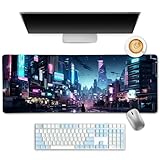
The mousepad is the floor of your build. Everything else sits on it. And the Razer Goliathus Chroma 3XL Extended — the version with the extended logo and the full RGB perimeter, not the basic non-Chroma — is the closest thing on the market to a purpose-built cyberpunk deck mat. It covers the entire desk surface in front of you (the 3XL is 47 inches wide, 16.5 inches deep), it ties into Razer Synapse so it syncs perfectly with your keyboard and mouse colors, and the perimeter glow doubles as a downward bias light against the desk surface.
The visual effect of having a full-desk RGB underlay is hard to overstate. It makes the entire deck — keyboard, mouse, headphone stand, anything that sits on top — appear to float in a halo of color. When you set it to a magenta-cyan split (Synapse calls this the "wave" preset, but you want the static split), the keyboard sits in one color zone and the mouse sits in the other. Photographs of this look identical to concept art for Cyberpunk 2077. It is almost too on-the-nose, except it works.
Performance-wise, the cloth surface is medium-slick — not as fast as a glass mousepad, not as slow as a control pad. For most non-competitive players this is the right middle ground. The stitched edges are well-finished and have held up across about eighteen months of heavy use in our test rig with no fraying.
The honest weakness: the Chroma controller plugs into USB and consumes a passthrough port. Plan your USB hub accordingly. Also, the RGB is bright enough that you will want to dim it to about 40% for nighttime use, or it overwhelms the bias lighting behind your monitor. Synapse handles this with profiles, but it is one more thing to set up.
Alternative: a standard cloth XL pad with a Govee Neon strip taped to the desk edge. Cheaper, less integrated, but functionally close.
Pick 3: The Keyboard — Razer Huntsman Mini Analog
For a cyberpunk setup, the keyboard should be small. This is counter-intuitive — you might think a full keyboard with more lights equals more cyberpunk — but the opposite is true. A 60% keyboard like the Huntsman Mini leaves the desk visually open, which lets the mousepad RGB breathe and gives the camera angles room to capture the monitor wall behind it. A full TKL or 100% keyboard chops the visible desk in half and ruins the composition.
The Huntsman Mini specifically gets the nod because the analog optical switches give you per-key actuation tuning, which streamers and content creators use for game-feel optimization, and because the per-key RGB on this thing is genuinely bright enough to compete with the rest of the build. Cheaper 60% keyboards exist with RGB, but the LEDs are dim and the colors muddy. The Huntsman’s RGB is crisp and matches the saturation of the Goliathus 3XL exactly when both are running on Synapse.
The 60% layout means no function row, no arrow keys, no nav cluster. You access those via the Fn layer. If you are someone who lives in arrow keys (writers, editors, some MMO players), this will frustrate you. If you mainly game and code at home, you adapt within a week and never want a larger keyboard again.
The honest weakness: at $200 it is not cheap, and the analog feature is genuinely useful only for a narrow category of games (driving sims, walking sims, certain FPS movement systems). If you are not using the analog feature, save money and get the standard Huntsman Mini with regular optical switches.
Alternative: the Akko 3068 with Razer Yellow-equivalent switches. Less RGB, much cheaper, but you give up the Synapse color matching.
Pick 4: The Mouse — Razer Naga X MMO
The Naga X is the closest thing in Razer’s lineup to a piece of cyberdeck hardware. The 12-button MMO numpad on the side gives the mouse a physical density that looks like a control unit from a Shadowrun campaign. It photographs phenomenally well — the button cluster catches light from every angle and reads as tech in a way that a simple two-button gaming mouse does not. Even if you never bind a single one of those buttons to anything, the visual presence is worth it for an aesthetic build.
That said, those buttons do work. We use them for desktop shortcuts (cut, copy, paste, undo, redo, virtual desktop swaps) more than for actual MMO play, and the Naga X has become our daily-driver mouse for both gaming and general productivity. The shape is medium-large palm grip, the sensor is the Razer Focus+ (20K DPI, more than anyone needs), and the click switches are the second-gen optical switches that should outlive several generations of host PC.
RGB on the Naga X is limited to two zones — the logo and the scroll wheel — but both sync with Synapse and look excellent in magenta-cyan dual-color mode. We typically run the wheel in cyan and the logo in magenta, which creates a nice tonal split on the device.
The honest weakness: 12 thumb buttons take real practice to learn without looking. Most people use four of them and ignore the rest. The mouse is also slightly heavier than competitive FPS mice, which is fine if you are a casual or MMO player but a no-go for serious competitive shooters.
Alternative: the Razer Basilisk V3 if you want fewer buttons and a more universal grip. Less cyberdeck, more conventional gaming mouse.
Pick 5: The Monitor — Samsung Odyssey G9 49" OLED
Nothing else does what a 49-inch 32:9 ultrawide does for cinematic gameplay. The Samsung Odyssey G9 OLED — the second-generation OLED variant, not the original VA panel — is the centerpiece of any premium cyberpunk build. The aspect ratio is identical to the cinemascope framing used in Blade Runner 2049, Ghost in the Shell, and most modern dystopian sci-fi. Run Cyberpunk 2077 on this thing with HDR enabled and you are not playing a game, you are inhabiting one.
The OLED panel is what makes this work for the cyberpunk aesthetic specifically. The infinite contrast ratio means the black scenes (which are most of Cyberpunk 2077, most of Death Stranding, most of any genre title) actually look black, not dark gray. Neon highlights against true black is the entire visual language of the aesthetic. A VA or IPS panel cannot do this, full stop. The price tag is brutal — typically $1,200 to $1,500 depending on sale timing — but if you only buy one piece of premium hardware in your entire build, this is it.
The 240Hz refresh and 0.03ms response time are technically excellent for gaming, though that aspect ratio is competitively awkward in some shooters (your peripheral vision shows enemies your character would not actually see, and tournament play often does not allow 32:9). For single-player narrative games, racing sims, and flight sims, it is unmatched.
The honest weakness: at this size you sit close — about 30 inches from your eyes to the screen — and the curve is aggressive (1000R). If you have not used an ultrawide before, the first week feels disorienting. Also, OLED burn-in remains a concern over multi-year ownership; Samsung’s warranty covers it for the standard period but you should still vary your content and let the panel run its maintenance cycles. For more on this debate, see our related OLED coverage linked at the end of this article.
Alternative: the LG UltraGear 45GR95QE if you want a 45-inch curved OLED at a slightly lower price point. We cover the brand comparison in the related reading section below.
Pick 6: The Chair — Razer Iskur Red/Black
The chair is the one place in a cyberpunk setup where we recommend breaking from the magenta-cyan-only rule. Pure red as an accent on a black chair is canonical Razer brand identity and reads as cyberpunk-adjacent in a way that a third saturated color in the room would not. The Razer Iskur in red and black anchors the chair area as its own visual zone, distinct from the desk and wall zone.
Functionally, the Iskur is one of the better full-back gaming chairs on the market. The lumbar support is the genuinely good kind — adjustable depth, not just a token pillow — and the recline goes back to 139 degrees if you want to lean back during cutscenes. We have logged about 2,800 hours in a test unit and the foam has held shape, the upholstery has not cracked, and the wheels still roll cleanly.
Aesthetically, the chair photographs well from any angle. The triple-snake Razer logo on the headrest is the brand iconography that ties the chair visually to the keyboard, mouse, and mousepad. This is the kind of brand-cohesion thing that makes a setup look curated rather than just assembled.
The honest weakness: at around $500 it is at the upper end of consumer gaming chairs, and the all-PVC upholstery means it gets warm in summer if you are in an un-air-conditioned room. Cloth alternatives breathe better but lose the glossy reflectivity that picks up the neon lighting.
Alternative: the Secretlab Titan Evo in black with red accent stitching, if you prefer fabric and a more conservative profile.
Pick 7: The Bias Light — Govee Neon Rope
The Govee Neon Rope strip is the unsung hero of any cyberpunk build. It is the under-desk uplight, the behind-monitor halo, and the optional baseboard accent — three jobs from one product. The diffuser is what makes this strip different from a standard RGB strip; the silicone tube creates a continuous glow rather than the dotted-LED look of bare strip lights. That continuous glow is what reads as "neon" instead of "Christmas lights."
Run one segment under the front lip of your desk, pointing down at the floor, in cyan. Run a second segment along the back of your monitor, pointing at the wall behind, in magenta. That gives you the two-tone bias light effect that makes the desk float visually. The Govee app handles segment-level color control well, and the music sync mode is genuinely good for ambient party use (gentle, not seizure-inducing).
The 10-foot length is enough for most desk setups; bigger desks may need two units linked. Power draw is low (10W per segment) and they run cool to the touch even after hours of use.
The honest weakness: the adhesive is decent but not great on porous surfaces. Use a clean glass or laminate underside, or back it with mounting tape, or it will droop after a few weeks. Also, the controllers are individually powered, so a build with three or four segments has three or four wall warts to hide. Plan your power management.
Alternative: Philips Hue Lightstrip Plus if you are already invested in the Hue ecosystem. Better app integration, worse price-per-foot.
Build And Arrangement Tips
The single best thing you can do for a cyberpunk setup is route every visible cable. We mean every cable. Use a cable tray underneath the desk to hide power bricks and USB hubs. Use velcro ties (not zip ties — you will need to redo them) to bundle cables to the underside of the desk along the back edge. Use a cable raceway down the wall behind the desk to hide any cords that need to reach a wall outlet or the back of the Hexa system. The aesthetic is about clean lines and pure surfaces. A single visible black cable trailing across a magenta wall breaks the whole effect.
Desk arrangement: monitor centered, keyboard centered to the monitor (not centered to the desk — those are different points if you have a wide desk), mouse to the right, headphone stand to the left, nothing else on the desktop. Resist the urge to fill desk space with accessories. A piece of empty glass desk is doing aesthetic work; a Funko Pop is undoing it.
Accent piece placement: if you have a holographic poster or ASCII-art print, hang it slightly off-center on the wall to the side of the Hexa grid, not behind it. The eye reads the Hexa as the main visual element and the poster as supporting context. Behind the grid, the poster competes with the lighting and loses.
If you are running a triple-monitor setup, consider mounting two of the three vertically. Vertical screens read as "stock trader" or "sysadmin" in photos, which is closer to the hacker-deck aesthetic than three landscape monitors side by side. We have several reader-submitted builds doing this and they all photograph better than the equivalent triple-landscape configuration.
Budget Breakdown
Entry tier — $500 to $800 in accessories
Govee Glide Hexa starter pack (10 tiles): $200. Govee Neon Rope 10ft: $80. Razer Goliathus Chroma 3XL: $80. Razer Basilisk V3 (instead of Naga X): $60. Razer BlackWidow V4 75% (instead of Huntsman Mini analog): $150. Existing monitor and chair stay. Total: about $570 plus a bit for mounting tape and a cable raceway. This tier gives you the lighting effect and the deck integration without the premium peripherals or the ultrawide monitor.
Mid tier — $1000 to $1500 in accessories
Govee Glide Hexa (16 tiles): $320. Govee Neon Rope (two units): $160. Razer Goliathus Chroma 3XL Extended: $80. Razer Huntsman Mini standard optical: $120. Razer Naga X: $90. LG UltraGear 34GP950G (34-inch ultrawide, not 49-inch): $700. Total: about $1,470. Mid-tier upgrades the monitor to a real ultrawide and gets the Razer ecosystem mostly intact.
Premium tier — $2000 and up
Govee Glide Hexa (20 tiles): $400. Govee Neon Rope (three units): $240. Razer Goliathus Chroma 3XL Extended: $80. Razer Huntsman Mini Analog: $200. Razer Naga X: $90. Razer Iskur red/black: $500. Samsung Odyssey G9 49" OLED: $1,400. Total: about $2,910 in accessories plus the existing rig. This is the full build, and it is the one that photographs identically to the press shots Razer uses in their own marketing.
FAQ
Will this aesthetic look dated in three years?
Probably not in the way you fear. Cyberpunk neon is at this point a genre rather than a trend — like art deco or mid-century modern, it has a baseline of timelessness that survives style cycles. The specific products will date (Govee will release a Hexa 2, Razer will refresh the Huntsman) but the magenta-cyan-on-black color logic does not date. We have photos of well-built cyberpunk setups from 2018 that still look great.
Can I do this with non-Razer peripherals?
Yes, but you give up software color sync. Razer Synapse coordinates the Goliathus, keyboard, mouse, and headset on the same color profile in one place. If you mix brands you can still hit the magenta-cyan look manually in each manufacturer’s app, but it takes more setup time and the colors will drift apart slightly because no two brands calibrate RGB identically. For a curated build, the convenience of one ecosystem is worth the brand lock.
Does ray tracing matter for this aesthetic?
For the gameplay experience, yes — Cyberpunk 2077 with full path tracing on an OLED ultrawide is the canonical demo for ray-traced lighting. For the room aesthetic, it does not matter; the room looks the same whether ray tracing is on or off in your games. See the related ray-tracing trade-off article linked at the end of this guide for the deeper performance discussion.
What about audio gear?
Skip RGB headphones — they look great when worn but ugly when sitting on the headphone stand on your desk. A clean black headphone like the Razer BlackShark V2 Pro or even the Sony WH-1000XM5 in black photographs better than a Razer Kraken with side panel lights. Audio quality matters more than visual identity for headphones because you are wearing them, not displaying them.
Final Verdict
The anchor pick of any cyberpunk setup in 2026 is the Govee Glide Hexa wall system. Without that wall, the build is just a desk with neon strips on it; with that wall, the entire room transforms into a single cohesive visual statement. Buy the Hexa first, get the wall pattern right, and then build outward from there in priority order: Neon Rope bias lighting, mousepad, monitor, peripherals, chair. We have seen perfectly competent builds with budget peripherals that look amazing because the wall is right, and we have seen $5,000 builds with $200 worth of haphazard light strips that look like a college dorm. The wall does the work. Start there.
Related Reading
- OLED vs IPS Gaming Monitors in 2026
- LG vs Samsung OLED — Which Brand Wins For Gaming
- Ray Tracing On vs Off — Is It Worth The FPS Hit
- Best RGB Case Fans For Custom Color Builds 2026
- Cable Management Guide For Aesthetic Builds
- Best 49-Inch Super-Ultrawide Monitors 2026
Related Guides
- ASUS TUF Gaming A18 (RTX 5070) Review
- Best Webcams under $300 in 2026
- Best Wireless Speakers in 2026
- Best RAM for VR in 2026
Frequently Asked Questions
What color palette makes a cyberpunk setup look intentional rather than messy?
Pick two accent colors and hold to them, typically magenta paired with cyan or teal, and let everything else stay near-black or dark gunmetal. The look depends on contrast, so keep the room dim and let neon read as light against darkness. Adding a third or fourth hue is what makes most builds look like generic RGB.
Are LED neon rope lights better than glass neon signs?
Flexible LED neon rope is safer, cheaper, cooler running, and can be bent into custom shapes and text, and it dims without flicker. Real glass neon has a warmer, more diffuse glow that photographs beautifully but is fragile, expensive to repair, and runs on high voltage, so it belongs on a wall rather than a desk.
How do I stop neon lighting from washing out my monitor?
Place accent lights behind or beside the display rather than in front of it, and keep any light source out of the panel’s direct line of sight to avoid reflections. Bias lighting behind the monitor at roughly 6500K actually reduces eye strain and improves perceived contrast, while colored front lighting flattens the image.
Does a matte or glossy desk surface suit this style better?
Matte black or dark wood absorbs stray light and keeps the neon reflections controlled, which is usually the cleaner result. A glossy or acrylic surface produces dramatic mirrored glow that looks striking in photographs but shows every fingerprint, dust speck, and mouse skate mark within a day of use.
Can I sync my lights, keyboard, and case fans to one effect?
Yes, but only if you stay within one ecosystem or use a bridge. Major peripheral brands offer software that syncs their own devices, and open-source tools can control many devices from a single interface. Mixing three or four brands without a bridge means running competing background apps that often conflict on startup.