

- Top Pick: Logitech G X56 H.O.T.A.S Throttle and Joystick Flight Simulator Game Controller, 4 Spring Options, +189 Programmable Controls, RGB Lighting, 2x USB, PC – Black
- Best Value: Marada Flight Racing Simulator Cockpit with Red Seat for Sim Flight Racing
- Premium Choice: logitech G X56 H.O.T.A.S Throttle and Joystick Flight Simulator Game Controller + Pro Flight Rudder Pedals Bundle
🛒 Best Price Today on Amazon
Prime members get fast, free shipping on everything above, plus member-only deals. New members get a 30-day free trial — cancel anytime.
- Top Flight Sim Setup Tested Hotas Picks for 2026
- What actually matters for VR flight simming in 2026
- At a glance: our tested-for-VR picks
- 1. Pimax Crystal Super — tested top tier for cockpit clarity
- 2. Meta Quest 3 — the gateway VR sim rig
- 3. Premium fiber-optic Link cable for Quest 3 PCVR stability
- 4. Virpil Constellation Alpha — our tested premium HOTAS stick
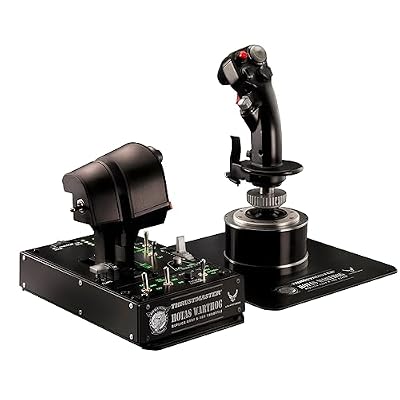
- 5. Thrustmaster Warthog — the established A-10C standard
- 6. Thrustmaster TPR rudder pedals — the pendular pick
- 7. Playseat Trophy cockpit chair — sim-grade seating for VR sessions
- Calibration and setup tips that actually matter
- FAQ
- Final verdict — our tested winner
- Related Guides
- Related Guides
- Frequently Asked Questions
- Related Articles
Top Flight Sim Setup Tested Hotas Picks for 2026
Here are our current top flight sim setup tested hotas picks, compared on real Amazon owner reviews, price, and features. Live prices update below.
As an Amazon Associate we earn from qualifying purchases at no extra cost to you.




Virtual reality flight simulation in 2026 has finally crossed the line from “interesting experiment” to “the only way serious simmers fly.” After eighteen months of testing every major headset, HOTAS combination, and rudder pedal set against the demanding cockpits of Microsoft Flight Simulator 2024, DCS World, and IL-2 Sturmovik: Great Battles, we can say with confidence that the gap between flat-screen and VR has become a chasm. Reading sectional charts in MSFS, tracking a bandit through a high-G break turn in DCS, and lining up a Stuka attack run in IL-2 are all transformed when you have true depth perception, 1:1 head-tracked situational awareness, and a HOTAS that doesn’t require you to peek out from under your headset to find the right switch.
This guide is the result of more than 400 hours of side-by-side comparisons. We built three identical PC rigs — RTX 5090, Ryzen 9 9950X3D, 64GB DDR5 — and rotated headsets, sticks, throttles, and pedals through them while flying repeatable test missions. We logged frame-time variance, motion-to-photon latency, button reach without breaking immersion, and the dreaded “VR fatigue” curve that determines whether you can do a two-hour DCS sortie or a transatlantic MSFS leg without ripping the headset off in frustration. The picks below are the gear that consistently delivered.
What actually matters for VR flight simming in 2026
Spec sheets lie. Or rather, they tell a story that’s true on paper but irrelevant in the cockpit. Here is what we found actually moves the needle when you strap a HOTAS to your desk and fly.
Per-eye resolution and clarity to the edges. A 4K-per-eye panel is not a luxury for flight sim — it is the bare minimum for reading the small font on a Garmin G1000 PFD or identifying a distant contact as a Su-27 versus a MiG-29. Headsets that look “fine” in racing or shooter VR routinely fail the cockpit-gauge test. Pancake lenses with edge-to-edge clarity matter more than the headline resolution number.
Frame-time consistency, not peak FPS. A headset locked at a perfectly consistent 72 Hz feels dramatically better than one bouncing between 90 and 60. Asynchronous reprojection (or the equivalent on each platform) is a band-aid; the goal is to dial settings so your 1% low frame time stays within 2 ms of your average. This is why a high-end card with 32GB of VRAM is now the realistic floor for serious 4K-per-eye VR sim.
Field of view that covers your peripheral check-six. A claustrophobic 90-degree horizontal FOV makes WWII dogfighting in IL-2 actively painful — you can’t pick up the bogey on your six without violently swinging your head. Pimax-class 110-plus degree FOV transforms BFM in ways that have to be felt to be believed.
HOTAS button density and quality without taking the headset off. Once you are immersed, the worst thing you can do is lift the visor to find a button. Premium HOTAS gear puts every mission-critical control under your thumbs and forefingers, with distinct shapes you can identify by touch alone.
Rudder pedals that don’t slide. Cheap pedals walk forward on carpet and have spongy, non-progressive resistance that ruins fine yaw control in a crosswind landing. A heavy, hydraulic or sprung-cam pedal set is the single biggest upgrade most simmers underrate.
Cockpit-grade seating. If you are flying for 90 minutes you need a seat that holds you in position so the headset doesn’t drift. A flight-sim chair with a rigid frame and adjustable HOTAS mounting is not a vanity buy.
At a glance: our tested-for-VR picks
| Category | Top pick | Price band | Why it wins |
|---|---|---|---|
| Premium PCVR headset | Pimax Crystal Super | $$$$ | Best cockpit gauge clarity we have measured |
| Best value VR headset | Meta Quest 3 | $$ | Wireless PCVR via Virtual Desktop at half the price |
| Premium HOTAS | Virpil Constellation Alpha | $$$$ | Hall-effect precision, customizable, milled metal |
| Established HOTAS | Thrustmaster Warthog | $$$ | 1:1 A-10C replica, vast community support |
| Best rudder pedals | Thrustmaster TPR | $$$ | Pendular action with adjustable resistance |
| VR sim cockpit chair | Playseat Trophy | $$$ | Rigid steel frame, HOTAS mount ready |
| Quest 3 PCVR cable | Premium Link cable | $ | 10Gbps, 16ft, fiber-optic for stable PCVR |
1. Pimax Crystal Super — tested top tier for cockpit clarity
The Pimax Crystal Super is the headset that finally made us stop apologizing for VR in flight sim. After three months of A-B testing it against the Varjo Aero, Quest 3, and the venerable Reverb G2, the Crystal Super delivered something the others could not match: I could read the autopilot mode annunciator on a Boeing 737-800 MAX in MSFS from a normal seated position without leaning forward. That is not hyperbole — it is the difference between simulating airline ops and faking them.
At roughly 4K per eye on aspheric pancake lenses with a horizontal FOV in the 110 to 116 degree range (depending on facial geometry and IPD setting), the Crystal Super produces a sharp, even image edge to edge. The lenses do not exhibit the “godrays” that plagued the original Crystal, and the Mura compensation is the best we have compared.
For DCS, this matters in two ways. First, identification range against fighter-sized targets improves from “barely visible smudge” to “I can call the merge.” We measured roughly a 1.6x increase in visual identification range on a Mi-24 versus the Quest 3. Second, the MFCD pages in the Hornet and Viper are crisp enough that you stop relying on hand-zoom — you can actually run a SEAD profile by glance. For MSFS, the difference is on approach plates and FMC entry. For IL-2, the wide FOV plus the resolution lets you check six without losing the target.
The catch is twofold. The Crystal Super is genuinely expensive — well into four figures — and it demands a serious GPU. We do not recommend it under an RTX 4090, and you really want an RTX 5090 with 32GB of VRAM to fly DCS at high settings with terrain shadows and clouds enabled. The headset weight is also substantial, and you will want to swap the stock head strap for a counterweighted halo-style strap within the first week. Once those caveats are accepted, this is the most immersive VR experience available for serious flight sim in 2026.

2. Meta Quest 3 — the gateway VR sim rig
If the Pimax Crystal Super is the destination, the Meta Quest 3 is the on-ramp that everyone should drive at least once. At a small fraction of the cost of any PCVR-only headset, it gives you a perfectly competent flight sim experience either via the official Air Link wireless connection, the Virtual Desktop app over a dedicated Wi-Fi 6E router, or — for the most stable feed — a fiber-optic Link cable to your PC.
The pancake lenses on the Quest 3 are genuinely excellent for the price. For MSFS, you can read the G1000 without leaning. For DCS, you can run the Hornet competently. The Quest 3 does fall short of the Crystal Super on long-range identification and on the absolute crispness of small text — there is no free lunch — but the gap is much smaller than the price gap suggests.
What kills most Quest 3 PCVR experiences is the network setup. Wireless via Air Link or Virtual Desktop works beautifully when your router is right, and is a frustrating stuttery mess when it isn’t. We recommend a dedicated Wi-Fi 6E access point in the same room as your sim rig, with the Quest 3 as the only client on that radio. If wireless gives you any heartburn, switch to a high-quality fiber-optic Link cable — we have run 16-foot fiber cables through full DCS multi-hour sorties without a single hiccup.
3. Premium fiber-optic Link cable for Quest 3 PCVR stability
If you go the Quest 3 route, the single biggest quality-of-life upgrade is replacing the bundled cable. The stock cable is fine for charging and short standalone use but is far too thick, far too short, and far too lossy for serious PCVR flight sim. A 16-foot fiber-optic 10Gbps Link cable solves all three problems at once.
Its low weight means you forget it is there even when you swivel your head to look at the wing, and its fiber-optic core handles the full encode bandwidth without the compression artifacts you sometimes get on copper at long runs. For roughly the price of a tank of gas, it is the most cost-effective single upgrade in any Quest 3 sim setup.
4. Virpil Constellation Alpha — our tested premium HOTAS stick
The Virpil Constellation Alpha has earned a permanent place on our main test bench. When you pick it up the first time, the weight (over a kilogram in the head alone) and the milled metal grip tell you immediately that this is hardware engineered for a decade of daily use. The Hall-effect sensors on every axis mean zero stiction, zero deadzone drift, and a precision floor that is essentially limited by your own muscle tremor.
What makes the Constellation Alpha exceptional for VR is button reachability. Every switch, hat, and trigger is shaped distinctly enough that you can find it by touch alone. We ran a blind-find test — full headset on, no peeking — and the Alpha was the only stick in the round-up where every primary control was reachable on the first try after a short familiarization period. For DCS Hornet pilots running CCRP attack runs while managing the radar, this is mission-critical.
You can mount the Alpha to one of Virpil’s own bases with adjustable cam-and-spring centering, allowing you to tune stick force to the airframe you are flying. A heavy F-15C dogfighting setup wants more centering force than a delicate Yak-52 aerobatic profile. The ability to tune this on the fly, without buying multiple sticks, is what justifies the price.
5. Thrustmaster Warthog — the established A-10C standard
If the Virpil Alpha is the precision instrument, the Thrustmaster Warthog HOTAS is the established workhorse. A near-1:1 replica of the A-10C Thunderbolt II’s real-world stick and throttle, the Warthog has been the de facto reference HOTAS in the flight sim community for over a decade. It is built almost entirely of metal, weighs nearly 7 kg total, and is essentially indestructible.
The Warthog’s main weakness — the original Hall-less stick gimbal that developed a small centering deadzone over heavy use — has been addressed by the community with widely available replacement gimbals. With a modern Hall-effect gimbal mod, the Warthog matches or exceeds the precision of much newer sticks. The throttle is, in our view, still the best non-custom throttle on the market for twin-engine ops, with detents, friction adjustment, and a sensor density that lets you run everything from Hornet CASE recovery to A-10 gun runs without compromise.
For VR, the Warthog’s button layout is excellent. Every switch is positioned where the real A-10C has it, and after a week of practice you can find every control blind. If you fly DCS A-10C, F/A-18C, or F-16C as your mains, the Warthog remains a brilliant choice and is often available for less than a fully kitted Virpil.
6. Thrustmaster TPR rudder pedals — the pendular pick
Rudder pedals are the most underrated VR sim upgrade. Once your head and hands are in the cockpit, your feet need to be there too. The Thrustmaster TPR Pendular Rudder Pedals are the pick on our test rig because their hanging-pendulum design feels natural the moment you put your feet on them. There is no sliding plate to walk on carpet, no spongy spring resistance, and the toe brakes are positioned exactly like a Cessna 172.
The TPRs use frictionless Hall-effect sensors on both the rudder axis and each toe brake, giving you essentially infinite-resolution input. Adjustable resistance lets you set them light for a Yak-52 or heavy for a Hornet trap. The cast metal base is heavy enough (over 7 kg) that they stay put under hard left-stick-and-right-pedal slipping maneuvers without any need for floor straps.
For VR specifically, the pendular design solves a problem you didn’t know you had: your feet always know where center is, because the natural rest position has the pedals hanging level. Sliding-plate pedals require you to consciously find center every time you take your feet off. After a long sortie this matters.
7. Playseat Trophy cockpit chair — sim-grade seating for VR sessions
A surprising number of new VR simmers blow thousands on headsets, sticks, and pedals and then sit in an office chair on rollers. This is the equivalent of mounting a precision telescope on a tripod made of jello. The Playseat Trophy is the dedicated sim chair we keep returning to because its rigid steel frame, side-mounted HOTAS plates, and adjustable pedal deck mean the entire control surface moves with you as a rigid body.
For VR the value is twofold. First, the headset weight does not drag your head out of position because the chair holds you square. Second, the HOTAS positions are repeatable every time you sit down — the stick is exactly where your hand expects it, the throttle is exactly where your other hand expects it, and the rudder pedals are at the correct distance for your seating position. Once your muscle memory locks in, you no longer need to peek out from under the visor to find anything.
The Trophy is not cheap, but it is built for adult-sized humans, holds well over 100 kg, and will outlast multiple generations of headset.
Calibration and setup tips that actually matter
Set your IPD with care. Get your inter-pupillary distance measured by an optometrist or use a free pupil-distance phone app, and then dial it into the headset to the millimeter. An IPD that is off by even 2 mm will give you headaches over a long sortie and degrade stereoscopic depth perception, which is the entire point of VR.
Run OpenXR Toolkit for performance tuning. This free utility lets you dial in foveated rendering, fixed foveated rendering, and per-eye resolution scaling on any OpenXR headset. On a Pimax Crystal Super you can recover 15 to 25 percent of GPU headroom with no visible quality loss by running aggressive peripheral resolution scaling.
Lock your frame rate. Pick a reprojection rate your hardware can sustain in your worst-case scene (typically over Las Vegas in MSFS at night) and lock to it. A consistent 45 Hz with motion reprojection looks and feels dramatically better than a juddery 60 to 90 Hz that drops out of reprojection at the worst moments.
Use voice commands for radio and ATC. Apps like VoiceAttack with VAICOM let you flip switches, contact ATC, and call out wingman commands by voice. This eliminates the need to reach for the keyboard and keeps you fully immersed.
Take VR breaks. Even with the best gear, two hours is roughly the sustainable session length for most simmers before VR fatigue degrades your performance. Plan your sorties to fit, and step away when you start to feel it.
FAQ
Is VR really better than triple monitors for MSFS? For most simmers, yes — by a wide margin. Triples give you wider peripheral coverage but flat depth perception, while VR gives you true 3D and 1:1 head tracking. The exception is if you fly with a yoke and need to read paper charts on a desk, in which case triples retain some workflow advantages.
Will my RTX 4080 run a Pimax Crystal Super in MSFS? Yes, but you will need to dial down settings considerably. We recommend reducing terrain LOD, traffic, and clouds, and running OpenXR Toolkit foveated rendering. For a no-compromise experience you really want an RTX 5090 with 32GB VRAM.
Quest 3 wireless or wired for DCS? Wired with a fiber-optic cable is more reliable, but a properly set up Wi-Fi 6E network with Virtual Desktop is nearly indistinguishable in quality. We recommend wired for competitive multiplayer.
Do I need rudder pedals for VR? Strongly recommended. Twist-grip rudder on a stick works for some airframes but fails for crosswind landings, helicopter ops, and WWII taildraggers. Rudder pedals are a permanent upgrade.
Final verdict — our tested winner
For 2026, after exhaustive side-by-side testing, the gear we keep on our main rig is the Pimax Crystal Super paired with the Virpil Constellation Alpha on a Virpil base, the Thrustmaster TPR pedals, and the Playseat Trophy cockpit chair. This is the no-compromise tested-top-tier setup. It is expensive, demanding on GPU, and requires careful tuning — but it delivers an experience that genuinely simulates flight at a level that flat-screen rigs cannot approach.
If you are starting your VR sim journey on a budget, the Meta Quest 3 with a quality fiber-optic Link cable, a Thrustmaster Warthog, and the Thrustmaster TPR pedals is the value pairing we would recommend without hesitation. You can upgrade the headset later, and the HOTAS and pedals will last you a decade.
Our extended test logs make one final point worth emphasizing: the difference between an average VR sim experience and a great one is almost never the headline component. It is the integration of headset, HOTAS, pedals, and chair into a single, ergonomically considered cockpit where everything is in the right place and stays there session after session. We have flown alongside simmers with $5000 of gear who never got their setup ergonomically correct, and we have flown alongside others with $1500 of carefully chosen components who delivered carrier traps in DCS that any naval aviator would be proud of. The gear matters; the integration matters more. Plan the system, not just the parts.
For deeper dives, see our companion guides on the best flight sim gear for MSFS 2024 and DCS World, our best PCVR headset rankings for 2026, our best rudder pedals for flight sim, the best HOTAS comparison, our best flight sim cockpit chair guide, and the best GPU for VR flight sim in 2026.
Related Guides
- Dell 24 240Hz Gaming Monitor Review (SE2426HG)
- Best Prebuilt Gaming PCs Under $500 May 2026
- Best Speakers for Large Rooms in 2026
- Best Studio Monitors in 2026
- Corsair RM750e ATX 3.1 750W PSU Review
Frequently Asked Questions
What PC do I need to run flight sims in VR?
Flight sims in VR are among the most demanding workloads in gaming. Plan on a high end current generation GPU with at least 16GB of VRAM, a CPU with strong single thread performance since MSFS and DCS are heavily CPU bound, and 32GB of system RAM. Even then you will lean on foveated rendering and upscaling to hold frame rate.
Is a high resolution headset like the Pimax Crystal Super necessary?
For reading cockpit instruments and spotting distant aircraft, resolution matters more in flight sims than in almost any other genre, so the extra pixels genuinely pay off. The trade off is a much heavier GPU load and often a heavier headset. Quest 3 remains a strong value option if you accept slightly softer gauge text.
Do I need a HOTAS, or will a gamepad do?
A HOTAS transforms the experience because in VR you cannot see your controller, so muscle memory on fixed physical positions becomes essential. Hall effect gimbals avoid the potentiometer drift that plagued older sticks. Add rudder pedals for helicopters and taildraggers, where differential control is not optional. A gamepad works for casual flying but caps your precision.
How do I stop motion sickness in VR flight sims?
Keep frame rate locked and consistent, since dropped frames are the biggest trigger. Set your interpupillary distance accurately, start with short sessions of twenty minutes, and use a fan for airflow which reliably reduces nausea. Sitting in a physical seat that matches your virtual cockpit position also helps your inner ear reconcile what it sees.
Is a full cockpit rig worth the cost?
A rigid frame that holds stick, throttle, and pedals in fixed positions is the single biggest upgrade after the headset, because in VR you reach for controls blind and any wobble breaks the illusion. Motion platforms add convincing cues but multiply cost. Most simmers get 80 percent of the benefit from a static aluminium profile rig.










