Shopping for a 4K gaming monitor under $500 in 2026 means navigating a market that has finally matured — but also one crowded with panels that look identical on a spec sheet and feel completely different in practice. The frustrating part is that the specs buyers care most about, like refresh rate and response time, are the easiest for manufacturers to inflate. A “1ms” claim on a budget IPS panel rarely survives contact with a fast-moving scene, and a 160Hz panel paired with weak overdrive tuning can smear worse than a well-tuned 120Hz display.
This guide cuts through that. We’ve focused on 4K monitors that genuinely land under $500 at typical street prices, prioritizing panels with honest motion handling, usable HDR (or the good sense not to advertise it), and connectivity that won’t bottleneck a modern GPU or console. We also flag where a QHD panel makes more sense than 4K at this budget, because for a lot of gamers running mid-range hardware, it does. Below you’ll find our top picks, a buying framework, and answers to the questions that come up most often.
As an Amazon Associate we earn from qualifying purchases at no extra cost to you.





⚡ Save on Your Next PC — Amazon Prime
Prime members get fast free shipping on the systems above, plus early access to Prime Day & Black Friday PC deals. New members get a 30-day free trial.
Watch: Best 4K Monitor Under $500 — Video Review
How to Choose 4K Monitor Under $500
- Match the panel to your GPU: Native 4K at high refresh rates demands serious horsepower. If your card is a mid-range part, look for monitors with strong upscaling support or consider a high-refresh QHD panel instead — you’ll get smoother frametimes and sharper motion than a 4K display running at 45fps.
- Prioritize refresh rate honestly: A 120Hz 4K panel with clean overdrive tuning beats a 160Hz panel with heavy overshoot. Look for reviews that measure actual response times rather than trusting the marketing number, and treat any “1ms” claim on an IPS panel as aspirational.
- Check your ports before you buy: DisplayPort 1.4 with DSC handles 4K at high refresh comfortably, but HDMI 2.1 is essential for PS5 and Xbox Series X at 4K/120. USB-C with power delivery is a genuine convenience if you dock a laptop, and it’s increasingly common at this price.
- Set realistic HDR expectations: Under $500, HDR400 certification means the panel accepts an HDR signal, not that it displays one well. Without local dimming zones, HDR content will look washed out. Judge these monitors on their SDR performance and treat HDR as a bonus.
- Don’t overlook ergonomics and coating: A stand with height, tilt, and swivel adjustment matters more day-to-day than a marginal refresh rate difference. Check the panel coating too — aggressive matte finishes can make text look grainy on high-density 4K panels.
The Best Picks Reviewed
Acer Nitro VG270K V4
Acer’s dual-mode implementation is the standout here: a native 4K 160Hz IPS panel that switches to 1080p at 320Hz when you want maximum motion clarity in competitive shooters. It’s the most flexible option in this roundup, and the IPS panel delivers respectable colour accuracy out of the box for content work between sessions.
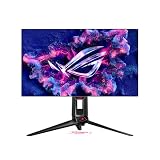
ASUS ROG XG27UCSR
The XG27UCSR is the enthusiast pick, pairing 4K at 162Hz with USB-C connectivity and proper G-SYNC compatibility that holds up across the full variable refresh range. ASUS has tuned the overdrive well — motion is genuinely clean at high refresh rates rather than trading blur for overshoot artefacts.
ASUS TUF Gaming VG27UQ1A
This is the value play in the ASUS lineup: 160Hz at 4K with 95% DCI-P3 coverage and Extreme Low Motion Blur Sync for players who prefer backlight strobing over VRR. The DisplayWidget software makes on-the-fly adjustments far less painful than fumbling through an OSD joystick, and the three-year warranty is reassuring at this price.
Dell S2725QS
Dell’s S2725QS is the sensible, well-built option for gamers who also work at their desk — a clean 4K IPS panel at 120Hz with FreeSync Premium and Dell’s typically excellent factory calibration. It won’t win refresh rate arguments, but 120Hz at 4K is plenty for single-player and console gaming, and the build quality is a clear step above most budget rivals.
Samsung Odyssey G7 (G75F) 37″
If desk space allows, the 37-inch curved G75F delivers the most immersive experience in this group, with 4K resolution stretched across a genuinely cinematic panel. The curve suits sim racing and single-player games particularly well, though the size makes it a poor fit for competitive shooters where you want the full screen in peripheral vision.
Frequently Asked Questions
Is 4K worth it under $500, or should I buy QHD?
It depends entirely on your GPU. If you’re running a current-generation upper-mid-range card or better, 4K is very achievable with upscaling enabled. On older or lower-tier hardware, a monitor like the Samsung Odyssey G5 (G51F) at QHD will give you higher, more consistent framerates and a better overall experience.
Do I need HDMI 2.1 for 4K gaming?
For PC gaming, DisplayPort 1.4 with DSC handles 4K at 160Hz without issue. HDMI 2.1 becomes essential if you’re connecting a PS5 or Xbox Series X and want 4K at 120Hz — without it, you’ll be capped at 60Hz on console.
Are high refresh rates actually noticeable at 4K?
Yes, though the benefit scales with the framerate you can actually sustain. Going from 60Hz to 120Hz is immediately obvious in mouse feel and motion clarity; the jump from 120Hz to 160Hz is subtler and mainly matters in fast competitive titles.
Should I buy an IPS or VA panel at this budget?
IPS is the safer choice for most people — better viewing angles, faster response times, and more consistent colour. VA panels offer deeper blacks and higher contrast, which suits dark atmospheric games, but budget VA implementations often suffer from dark-scene smearing.
Final Thoughts
For most gamers, the Acer Nitro VG270K V4 is the smartest buy in this roundup — the dual-mode 4K/160Hz and 1080p/320Hz combination gives you genuine flexibility that no single-mode panel can match at this price. If you want the cleanest motion handling and USB-C convenience, the ASUS ROG XG27UCSR is worth the small premium, while the Dell S2725QS remains the best choice for anyone splitting time between gaming and desk work who values build quality and colour accuracy over raw refresh rate.