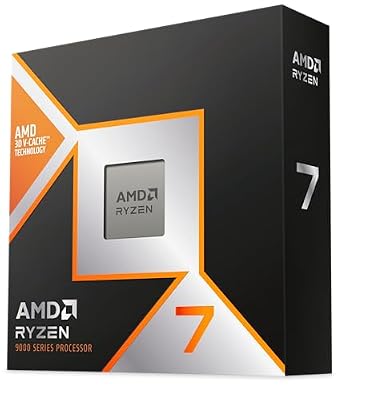
- Top Pick: AMD RYZEN 7 9800X3D 8-Core, 16-Thread Desktop Processor
- Best Value: STORMCRAFT Gaming Skyhawk PRO Desktop PC 9800X3D 9070 XT 32GB DDR5 2TB SSD
- Premium Choice: Andromeda Insights Galaxy V3 Gaming PC – AMD RX 9070XT 16GB GDDR6 | Ryzen 7 9800X3D 4.7 GHz (5.2 GHz Turbo Boost) | 32GB DDR5 6000 | 2TB Gen4 SSD | 850W Gold PSU | ARGB Fans | Wi-Fi + BT | Win 11
The AMD Ryzen 7 9800X3D is the current gaming flagship on AMD’s AM5 platform — Zen 5 cores combined with a second-generation 3D V-Cache implementation that places the cache underneath the core complex, enabling higher clocks than the 7800X3D could reach. With more than 5,400 Amazon reviews and AMD marketing it as the world’s fastest gaming processor, expectations are high. Priced around $420, this AMD Ryzen 7 9800X3D review covers architecture, performance, platform and value.
- AMD Ryzen 7 9800X3D at a Glance
- Architecture and Key Specifications
- Gaming and Productivity Performance
- Platform, Memory and Compatibility
- Cooling, Power and Build
- Who Is the AMD Ryzen 7 9800X3D For?
- Pros and Cons
- Is the AMD Ryzen 7 9800X3D Worth It?
- Frequently Asked Questions
- More CPU Reviews
- Related Articles
- Related Articles
- Related Guides


As an Amazon Associate we earn from qualifying purchases. Product prices and availability are accurate as of the date/time indicated.
🛒 Best Price Today on Amazon
Prime members get fast, free shipping on everything above, plus member-only deals. New members get a 30-day free trial — cancel anytime.
As an Amazon Associate we earn from qualifying purchases.



AMD Ryzen 7 9800X3D at a Glance
| Component | Specification |
|---|---|
| Cores / threads | 8 cores / 16 threads |
| Base / boost clock | 4.7 GHz base / up to 5.2 GHz boost |
| Cache | 96MB L3 with second-gen 3D V-Cache |
| Architecture | Zen 5 X3D |
| Socket | AM5 |
| TDP | 120W |
| Integrated graphics | Basic AMD Radeon Graphics (RDNA 2) |
| Cooler in box | Not included |
| Price | Around $420 |
Architecture and Key Specifications
The 9800X3D combines Zen 5 cores with AMD’s second-generation 3D V-Cache. The crucial change versus the 7800X3D is the cache placement: AMD now puts the V-Cache underneath the cores rather than above, which lets the CPU cores cool more effectively and clock higher. Total L3 stays at 96MB, but clocks now reach up to 5.2 GHz, with a 4.7 GHz base.
Eight cores, sixteen threads, a 120W TDP and a small RDNA 2 iGPU round out the specification. AMD’s positioning is straightforward: keep the cache advantage that makes X3D chips gaming legends, but lift the clock ceiling so the same chip is competitive in productivity and lightly threaded workloads too. The chip ships without a cooler.
Gaming and Productivity Performance
For gaming, the 9800X3D is the current AM5 flagship. The combination of Zen 5 IPC, higher boost clocks than the 7800X3D and the cache advantage of 3D V-Cache makes it the chip AMD itself markets as the world’s fastest gaming processor. It is best paired with high-end GPUs at 1080p and 1440p, where the cache advantage is most visible.
For productivity, the higher clocks of the second-gen design also help the 9800X3D pull noticeably ahead of the 7800X3D in single-threaded and lightly threaded workloads, narrowing the historic gap between X3D and non-X3D parts in everyday productivity. Heavy multi-threaded work still favours the 9950X or 9950X3D, but the 9800X3D is no longer a productivity slouch.
Platform, Memory and Compatibility
The 9800X3D uses Socket AM5 with B650, B650E, X670, X670E and X870 motherboards, with most existing AM5 boards adding support through a BIOS update. Memory is DDR5, with EXPO kits at DDR5-6000 CL30 the classic sweet spot, and the chip benefits from a quality kit even though the cache hides a lot of latency.
PCIe 5.0 support on the GPU slot and primary M.2 keeps the platform forward-looking, and AM5 remains AMD’s stated long-life socket. For an enthusiast gaming build this is one of the most future-proof platforms on the market today. See our best AM5 motherboard guide for matching boards.
Cooling, Power and Build
No cooler is included. The 120W TDP and concentrated heat from the cache stack mean the 9800X3D rewards strong cooling — a quality 240mm or 360mm AIO, or a top-tier dual-tower air cooler, is the natural pairing. The cooler-friendly V-Cache placement helps versus the 7800X3D, but the chip is still best treated as an enthusiast part.
Power draw under gaming load is reasonable for the performance delivered. A quality 750W power supply comfortably handles the 9800X3D plus a high-end GPU. The chip is engineered for buyers building a no-compromise gaming PC, and it is best paired with parts of similar calibre. Our best CPU coolers for Ryzen covers strong choices.
Who Is the AMD Ryzen 7 9800X3D For?
The 9800X3D is for the enthusiast gamer who wants the current AM5 gaming flagship. It is the natural pick for a high-end build paired with an RTX 4080 Super, RTX 4090 or RX 7900 XTX, especially at 1440p where the cache advantage shows most clearly and the GPU is unlikely to be the bottleneck.
It is less suited to two groups: budget-conscious buyers, who get better value from the 9600X or 7800X3D; and heavy productivity users, who should look at the 9950X or 9950X3D for sixteen cores. For the focused enthusiast gamer, however, the 9800X3D is the obvious choice.
Pros and Cons
Pros: Current AM5 gaming flagship; second-gen 3D V-Cache placement improves thermals and clocks; higher clocks than 7800X3D help productivity too; AM5 long upgrade path; strong consumer trust with 5,400+ reviews.
Cons: No cooler included; commands a premium over the 7800X3D for incremental gaming gains in many titles; high-end GPU recommended to fully exploit it.
Is the AMD Ryzen 7 9800X3D Worth It?
At around $420 the AMD Ryzen 7 9800X3D is the right pick for the buyer building a no-compromise gaming PC on AMD. It captures the current peak of gaming performance, fixes the cooling and clock limitations of the 7800X3D, and slots into AMD’s healthy AM5 ecosystem.
Buyers on a tighter budget will be very happy with the 7800X3D or 9600X; buyers who need heavy multi-thread throughput should look at the 9950X3D. But for the enthusiast gamer who wants the AM5 flagship, the 9800X3D earns a clear recommendation.
Frequently Asked Questions
Why is the Ryzen 7 9800X3D faster than the 7800X3D?
Second-gen 3D V-Cache placement under the cores allows higher boost clocks alongside the cache advantage, lifting both gaming and lightly threaded performance.
Does the Ryzen 7 9800X3D come with a cooler?
No. AMD does not include a cooler — a quality 240mm or 360mm AIO, or a strong dual-tower air cooler, is the natural pairing.
Is the Ryzen 7 9800X3D good for productivity?
It is more capable than the 7800X3D thanks to higher clocks, but heavy multi-threaded creator workloads still favour the 9950X or 9950X3D.
Will the Ryzen 7 9800X3D work in my existing AM5 motherboard?
Yes, in most cases. Existing AM5 boards typically support the 9800X3D with a current BIOS update.
Compared with the 7800X3D, the 9800X3D commands a premium for higher clocks, better thermals and Zen 5 IPC — gains that are most visible in CPU-bound 1080p scenarios with flagship GPUs. Compared with the 9950X3D, the 9800X3D’s single-CCD design avoids cross-CCD scheduling complexity that occasionally trips up dual-CCD X3D parts in some titles, which is why pure gamers often still prefer it. For the buyer building a no-compromise modern AM5 gaming PC paired with an RTX 4080 Super or RTX 4090, the 9800X3D is the natural CPU choice and the chip AMD is happy to call its gaming flagship.
One useful framing: the 9800X3D is the chip you pick when you want the current generation’s strongest pure-gaming experience and you intend to keep the system for several years. The cache-driven advantage in cache-sensitive games — simulation, strategy, open-world titles — pays off in frame-time consistency and minimum frame rates that pure-clock CPUs cannot match. Paired with a flagship GPU it produces one of the smoothest 1440p high-refresh experiences currently available on a consumer PC, and the AM5 platform commitment means the rest of the build is unlikely to feel out of date before the next major architectural shift arrives.
More CPU Reviews
- AMD Ryzen 9 9950X Review: 16-Core Productivity Flagship
- AMD Ryzen 9 9950X3D Review: 16-Core Gaming + Creator Hybrid
- Intel Core i5-13600K Review: Popular 14-Core Gaming Intel
- Intel Core Ultra 5 225 Review: Entry Arrow Lake Desktop CPU
- Intel Core Ultra 7 265KF Review: Mainstream Arrow Lake (No iGPU)
- Intel Core Ultra 9 285K Review: Flagship Arrow Lake Desktop CPU
- AMD Ryzen 5 5500 Review: Ultra-Budget AM4 Six-Core
- AMD Ryzen 5 7600X Review: Entry AM5 Six-Core
Affiliate Disclosure: As an Amazon Associate, we earn from qualifying purchases. If you click a link and make a purchase, we may earn a small commission at no extra cost to you. Prices and availability are accurate as of publication and may change.
Related Articles
Looking for more on this topic? Browse the hand-picked guides below — each one applies the same scoring rubric used in this review.