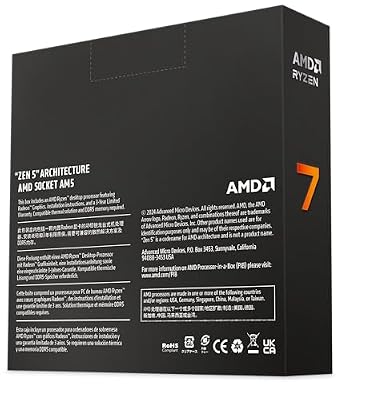
- Top Pick: AMD Ryzen™ 7 9700X 8-Core, 16-Thread Unlocked Desktop Processor
- Best Value: Build Redux Gaming Desktop PC – AMD Ryzen 7 9700X CPU, NVIDIA GeForce RTX 5070 GPU, 16GB DDR5 RAM, 1TB NVMe M.2 SSD, 240mm Liquid CPU Cooler, Windows 11 Home, High-Performance Computer
- Premium Choice: Skytech Gaming Shadow Gaming PC, AMD Ryzen 7 9700X 3.8GHz, NVIDIA RTX 5060 Ti 8GB VRAM, 1TB NVMe SSD, 32GB DDR5 RAM 5600, 650W Gold PSU, 360 ARGB AIO, Wi-Fi, Win 11, Desktop
The AMD Ryzen 7 9700X is the step-up Zen 5 part for buyers who want more cores than the 9600X but do not need the gaming-focused 3D V-Cache of the 9800X3D. Eight cores, sixteen threads, a 5.5 GHz boost and a 65W TDP at around $305 make it an efficient, well-balanced productivity-leaning chip. This AMD Ryzen 7 9700X review covers architecture, performance, platform and value.
- AMD Ryzen 7 9700X at a Glance
- Architecture and Key Specifications
- Gaming and Productivity Performance
- Platform, Memory and Compatibility
- Cooling, Power and Build
- Who Is the AMD Ryzen 7 9700X For?
- Pros and Cons
- Is the AMD Ryzen 7 9700X Worth It?
- Frequently Asked Questions
- More CPU Reviews
- Related Articles
- Related Articles
- Related Guides


As an Amazon Associate we earn from qualifying purchases. Product prices and availability are accurate as of the date/time indicated.
🛒 Best Price Today on Amazon
Prime members get fast, free shipping on everything above, plus member-only deals. New members get a 30-day free trial — cancel anytime.
As an Amazon Associate we earn from qualifying purchases at no extra cost to you.





AMD Ryzen 7 9700X at a Glance
| Component | Specification |
|---|---|
| Cores / threads | 8 cores / 16 threads |
| Base / boost clock | 3.8 GHz base / up to 5.5 GHz boost |
| Cache | 32MB L3 |
| Architecture | Zen 5 |
| Socket | AM5 |
| TDP | 65W |
| Integrated graphics | Basic AMD Radeon Graphics (RDNA 2) |
| Cooler in box | Not included |
| Price | Around $305 |
Architecture and Key Specifications
The 9700X is a Zen 5 chip with eight cores, sixteen threads, 32MB of L3 cache and a 5.5 GHz boost clock, all inside a tight 65W TDP. It is essentially the productivity-focused sibling of the 9800X3D, sharing the same architecture and core count but without the stacked 3D V-Cache.
Zen 5 brings IPC and execution-width improvements over Zen 4, and at eight cores the 9700X has enough parallelism to be genuinely useful for content workloads — code compilation, photo and video editing, virtualisation — while still clocking high enough for strong single-threaded responsiveness. A small RDNA 2 iGPU is included for display output.
Gaming and Productivity Performance
For productivity the 9700X is the standout: eight Zen 5 cores at high clocks make it noticeably faster than the 9600X in multi-threaded work like rendering, code builds and content creation, while staying within the very friendly 65W TDP envelope. It is the natural pick for buyers who push their PC outside gaming.
For gaming the 9700X is competitive at 1080p and 1440p, comfortably feeding any current GPU up to and including an RTX 4070 Ti or RTX 4080 in most titles. It is not the gaming flagship — buyers chasing the highest 1080p frame rates should look at the 9800X3D — but as a balanced gaming and creator chip it is hard to fault.
Platform, Memory and Compatibility
The 9700X uses Socket AM5 and is supported across B650, B650E, X670, X670E and X870 boards, with existing AM5 motherboards typically needing only a BIOS update to accept Zen 5. Memory is DDR5, with EXPO kits at DDR5-6000 CL30 remaining the well-known sweet spot.
AM5 has been confirmed by AMD as a long-life socket, so a 9700X build is well positioned for future CPU upgrades without a board swap. PCIe 5.0 support on the GPU slot and primary M.2 keeps the platform forward-looking. See our best DDR5 RAM for gaming for memory guidance.
Cooling, Power and Build
No cooler is included. The 65W TDP makes the 9700X very easy to cool — a quality dual-tower air cooler or a 240mm AIO is comfortably enough, even under sustained multi-threaded load. Smaller air coolers will work but may run noisier than ideal.
Lower power draw also relaxes power supply requirements; a quality 650W unit is plenty for a typical build with a mid-range or upper-mid-range GPU. For the level of performance on offer, the 9700X is unusually well-mannered as a content workhorse.
Who Is the AMD Ryzen 7 9700X For?
The 9700X is for the buyer whose PC has to do more than just game — coders, photographers, video editors, streamers and small content creators who also want strong gaming performance. Eight Zen 5 cores at 65W is a rare combination of speed, parallelism and efficiency at this price.
It is less suited to two groups: pure gamers who would prefer the 9800X3D’s gaming-focused 3D V-Cache; and heavy multi-threaded creators who should step up to the 9950X for sixteen cores. For mixed gaming and creator use, the 9700X is excellent.
Pros and Cons
Pros: Eight Zen 5 cores with 5.5 GHz boost; very efficient 65W TDP; strong productivity throughput; AM5 long upgrade path; small iGPU included; easy to cool quietly.
Cons: No cooler included; for pure gaming the 9800X3D is faster thanks to 3D V-Cache; higher price than the 9600X without huge gaming gains.
Is the AMD Ryzen 7 9700X Worth It?
At around $305 the AMD Ryzen 7 9700X is a strong pick for the mixed-use PC builder who values productivity throughput as much as gaming performance. Eight efficient cores, current-gen Zen 5 architecture and the long AM5 runway add up to a chip you can build around with confidence.
Pure gaming buyers should consider the 9800X3D, and creators chasing maximum throughput should look at the 9950X. But for the broad middle ground of capable, balanced builds, the 9700X earns a clear recommendation.
Frequently Asked Questions
Does the Ryzen 7 9700X come with a cooler?
No. AMD does not include a cooler with the 9700X, so plan to buy a quality air or AIO cooler.
Does the Ryzen 7 9700X have integrated graphics?
Yes. A small AMD Radeon RDNA 2 iGPU is included for display output.
Is the Ryzen 7 9700X better for gaming than the 9800X3D?
No. The 9800X3D has 3D V-Cache and is the better pure-gaming chip; the 9700X is better suited to mixed productivity and gaming use.
Will the Ryzen 7 9700X work in my existing AM5 motherboard?
In most cases yes — existing AM5 boards typically need only a BIOS update to support Zen 5 parts like the 9700X.
Compared with the older 7700X, the 9700X is more efficient at 65W TDP while delivering Zen 5 IPC gains in lightly threaded workloads. Compared with the 9800X3D, it trades the gaming-focused cache for a friendlier price and slightly better productivity scaling in throughput-bound tasks. The 9700X is also a sensible upgrade for owners of older Zen 3 chips who do creator work — the per-core speed uplift in build pipelines, photo editing and code compilation is genuinely meaningful. For a balanced build aimed at three to five years of serious productivity and capable gaming, it remains one of the most thoughtful current Ryzen choices.
One useful framing: the 9700X is the chip you pick when you genuinely use the productivity headroom — when you compile, render, encode or edit often enough to feel the difference between six and eight modern cores. For buyers who do not, the cheaper 9600X is enough and the saved budget is better spent on the GPU. That is the honest positioning. The 9700X earns its premium when the build actually does creator work alongside gaming, and the 65W TDP makes it unusually pleasant to live with for a chip in this performance class, especially in smaller cases or quieter builds where thermals and noise matter more than headline performance numbers, and where every watt saved translates to a calmer overall system that runs cooler, lasts longer and stays comfortable to work next to for hours at a stretch.
More CPU Reviews
- AMD Ryzen 7 7800X3D Review: Gaming Legend AM5 X3D
- AMD Ryzen 7 9800X3D Review: Current Gaming Flagship
- AMD Ryzen 9 9950X Review: 16-Core Productivity Flagship
- AMD Ryzen 9 9950X3D Review: 16-Core Gaming + Creator Hybrid
- Intel Core i5-13600K Review: Popular 14-Core Gaming Intel
- Intel Core Ultra 5 225 Review: Entry Arrow Lake Desktop CPU
- Intel Core Ultra 7 265KF Review: Mainstream Arrow Lake (No iGPU)
- Intel Core Ultra 9 285K Review: Flagship Arrow Lake Desktop CPU
Affiliate Disclosure: As an Amazon Associate, we earn from qualifying purchases. If you click a link and make a purchase, we may earn a small commission at no extra cost to you. Prices and availability are accurate as of publication and may change.
Related Articles
Looking for more on this topic? Browse the hand-picked guides below — each one applies the same scoring rubric used in this review.