Affiliate disclosure: As an Amazon Associate we earn from qualifying purchases. This post contains affiliate links — if you buy through them we may earn a small commission at no extra cost to you. This never affects our recommendations.
If you’re serious about gaming, your monitor is just as critical as your graphics card. The ASUS ROG Swift PG27UQM represents a paradigm shift in what gaming monitors can deliver—combining 4K resolution with a lightning-fast 144Hz refresh rate in a 27-inch panel that’s become the gold standard for professional esports players and competitive gamers worldwide. Whether you’re pushing frames in the latest AAA titles or competing at the highest levels of competitive FPS games, this monitor bridges the gap between raw performance and visual fidelity.
The monitor landscape has evolved dramatically over the past few years. Gone are the days when you had to choose between crisp, beautiful 4K visuals at 60Hz or blazingly fast 1440p gaming at 240Hz. The ASUS ROG Swift PG27UQM changes that equation entirely, offering a compelling middle ground that satisfies both visual quality enthusiasts and competitive gamers who demand responsive, fluid gameplay.
As an Amazon Associate we earn from qualifying purchases at no extra cost to you.


In a hurry? See the top-rated ASUS ROG Swift PG27UQM deals available right now:
🛒 Check Asus Rog Swift Pg27Uqm Prices on Amazon →🛒 Best Price Today on Amazon
Prime members get fast, free shipping on everything above, plus member-only deals. New members get a 30-day free trial — cancel anytime.
Start 30-Day Prime Free Trial →See Today’s Amazon DealsDisplay Technology and Specifications
At the heart of the ASUS ROG Swift PG27UQM lies a 27-inch LED-backlit display using VA panel technology, delivering exceptional contrast ratios that simply can’t be matched by traditional IPS panels. The native resolution is 3840 x 2160 pixels—true 4K—which means you’re looking at pixel density that eliminates virtually any jaggedness or loss of detail when gaming from a typical desk distance.
The 144Hz refresh rate is where this monitor truly shines. Running at a 1ms response time (gray-to-gray), this monitor delivers pixel-perfect responsiveness that transforms how fast-paced games feel. When you’re playing competitive shooters like Valorant or CS2, that fluid 144Hz presentation makes a tangible difference in reaction times and perceived smoothness compared to traditional 60Hz gaming. The adaptive sync technology—supporting both NVIDIA G-Sync and AMD FreeSync—eliminates screen tearing across the entire refresh range from 30Hz to 144Hz.
The color accuracy on this monitor is exceptional. The factory calibration delivers Delta E < 2.0, meaning colors are rendered with near-photographic accuracy straight out of the box. Gamers who also do creative work—streaming, video editing, or content creation—will appreciate that they don't need a separate monitor for professional color-critical work. The 99% Adobe RGB and 99% DCI-P3 color space coverage ensures that what you see on screen matches industry-standard color standards.

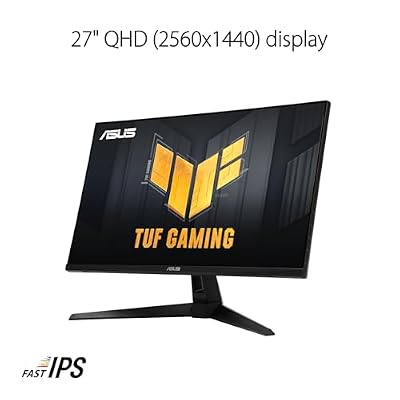
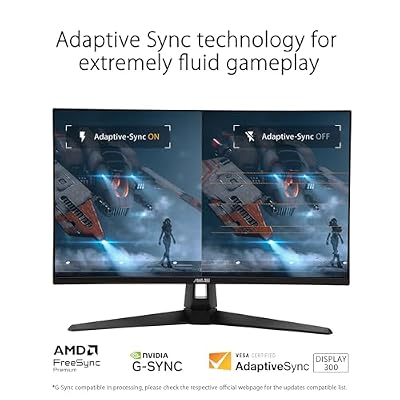
ASUS TUF Gaming VG27AQM5A 27 Inch 1440p 300Hz G-SYNC Gaming Monitor | Fast IPS,ELMB Sync, 95% DCI-P3, Built-In Speakers, Shadow Boost, DisplayWidget Center, 0.3ms, for PS5 and Xbox




As an Amazon Associate we earn from qualifying purchases. Product prices and availability are accurate as of the date/time indicated.
Gaming Performance and Visual Quality
The jump from 1440p to 4K is immediately noticeable in visually rich games. When you’re exploring sprawling open worlds in titles like Cyberpunk 2077 or Dragon’s Dogma 2, the increased resolution reveals fine details in textures, foliage, and distant architecture that simply don’t exist at lower resolutions. You can see individual leaves on trees, subtle variations in fabric textures, and facial expressions on NPCs with extraordinary clarity.
The HDR support (400 nits peak brightness) adds another dimension to the gaming experience. Games designed with HDR in mind—like Halo Infinite, Forza Horizon 5, and recent PlayStation exclusives—display dramatically more vibrant colors and superior contrast on this display. Sunlight glinting off metal surfaces, the glow of neon signs in a cyberpunk cityscape, and the realistic rendering of light sources all benefit tremendously from the extended brightness and color range.
For competitive gamers, the 144Hz refresh rate combined with 1ms response time means that mechanical responsiveness matches the visual quality. Your input lag remains minimal—typically 2-3ms end-to-end—ensuring that when you click to shoot or swipe to turn, your action registers on screen with imperceptible delay. To drive 4K at 144Hz consistently, you’ll need a high-end GPU like an RTX 4080, RTX 4090, or RX 7900 XTX, but the results justify the hardware investment.
Design, Build Quality, and Ergonomics
The ASUS ROG Swift PG27UQM features a robust military-grade aluminum frame with a matte black finish that resists fingerprints. The stand is rock-solid, offering full ergonomic adjustment—tilt (−5° to 25°), swivel (−30° to 30°), pivot (−90° to 90°), and height adjustment (up to 150mm). If you’re planning to use this monitor for 8+ hours daily, the adjustability ensures you can position it for optimal viewing angle and comfort.
Connectivity is comprehensive. You get two HDMI 2.1 ports (supporting 4K at 120Hz each), two DisplayPort 1.4 inputs (the optimal choice for 4K 144Hz gaming), and a USB 3.0 hub built into the stand. There’s also a 3.5mm audio jack and USB-C connection with 65W power delivery—useful if you’re connecting a laptop alongside your gaming PC.
The monitor includes an integrated KVM (Keyboard-Video-Mouse) switch, allowing you to seamlessly toggle between multiple computers—a feature appreciated by content creators and professionals who run multiple workstations. The on-screen display menu is intuitive, with quick-access buttons for gamma presets, color modes, and refresh rate configurations.

LG 32GS60QC-B Ultragear 32-inch Curved Gaming Monitor QHD (2560x1440) 180Hz 1ms 1000R AMD FreeSync HDR10 HDMIx2 DisplayPort Borderless Design Black Stabilizer DAS Crosshair FPS Counter - Black


As an Amazon Associate we earn from qualifying purchases. Product prices and availability are accurate as of the date/time indicated.
Comparison Table: 4K Gaming Monitors
| Monitor Model | Resolution | Refresh Rate | Panel Type | Response Time | HDR Peak Brightness |
|---|---|---|---|---|---|
| ASUS ROG Swift PG27UQM | 4K (3840×2160) | 144Hz | VA | 1ms | 400 nits |
| LG UltraGear 32UP550 | 4K (3840×2160) | 144Hz | IPS | 1ms | 350 nits |
| LG 27UP550 | 4K (3840×2160) | 60Hz | IPS | 5ms | 300 nits |
| OLED Gaming Alternatives | 4K (3840×2160) | 120Hz+ | OLED | 0.1ms | 200 nits |
CPU and GPU Requirements
Running 4K at 144Hz is no casual task. You’ll need a robust gaming PC setup to maximize this monitor’s potential. On the GPU side, NVIDIA’s RTX 40-series cards (RTX 4070 Ti or higher) or AMD’s RX 7900 series are recommended. With DLSS 3 or FSR 3 enabled, these cards can deliver consistent 100+ FPS in demanding AAA titles at the highest graphical settings.
Processor-wise, a modern high-end CPU like an Intel i9-13900K, i9-14900K, or AMD Ryzen 9 7950X ensures you won’t hit a CPU bottleneck when rendering 4K frames at high refresh rates. For more detailed guidance on CPU selection for 4K gaming, check our comprehensive CPU guide.
Having adequate bandwidth is critical too. Make sure you’re using DisplayPort 1.4 cables—HDMI 2.1 can work but DisplayPort is the more stable choice for 4K 144Hz. Quality DisplayPort cables are essential for maintaining signal integrity at these bandwidth-intensive resolutions and refresh rates.
Gaming Scenarios and Use Cases
The ASUS ROG Swift PG27UQM excels in diverse gaming scenarios. In single-player campaigns, the visual fidelity transforms exploration-focused games. Titles like Baldur’s Gate 3, Starfield, and The Witcher 3 become visual showcases when run at 4K with ultra settings. Character models display skin pores and cloth weave details, environmental lighting looks naturalistic, and distant vistas maintain clarity without pop-in.
Competitive esports players benefit from the 144Hz refresh rate even though they might not always push 4K framerates. By running at 1440p or 1800p with max settings and leveraging DLSS to boost performance, you get the visual quality bump while maintaining the competitive 144Hz responsiveness that matters in ranked matches.
Creative professionals—building a high-end gaming setup with streaming capability—appreciate the color accuracy and resolution. Recording gameplay footage at 4K for YouTube looks dramatically better than 1440p, and the color space coverage means streaming overlays and UI elements render accurately.
Frequently Asked Questions
Q: What’s the difference between 144Hz and 240Hz gaming monitors?
A: 240Hz monitors display twice as many frames per second as 144Hz displays, resulting in even smoother motion. However, the jump from 144Hz to 240Hz is less dramatic than from 60Hz to 144Hz. For 4K gaming specifically, achieving consistent 240FPS is nearly impossible without severe graphical compromises, making 144Hz a more practical sweet spot that balances smoothness with visual quality.
Q: Do I need a powerful GPU to use this monitor?
A: To fully utilize 4K 144Hz gaming, you need a high-end GPU like RTX 4080/4090 or RX 7900 XTX. However, you can still use this monitor at lower refresh rates (60-100Hz) with mid-range GPUs like RTX 4070 or RX 7700 XT, or leverage DLSS/FSR upscaling to maintain 100+ FPS.
Q: Is VA or IPS better for gaming?
A: VA panels offer superior contrast ratios and deeper blacks, making them excellent for single-player games and visual immersion. IPS panels have better color accuracy and wider viewing angles, making them better for creative work. For gaming-focused use, VA edges ahead due to the contrast advantage.
Q: How important is HDR for gaming?
A: HDR significantly enhances the visual experience in games designed to support it. You’ll see more vibrant colors, better representation of bright highlights, and improved overall visual impact. Games like Halo Infinite, Forza Horizon 5, and God of War Ragnarök really showcase what HDR can do.
Final Verdict
The ASUS ROG Swift PG27UQM represents the pinnacle of gaming monitor technology—it’s where cutting-edge monitor technology meets gaming performance. Yes, it demands a powerful PC to drive it effectively, and the price tag reflects its premium positioning. But if you’re serious about gaming and want a monitor that will remain relevant for the next 3-5 years, the combination of 4K clarity and 144Hz responsiveness is unmatched. Whether you’re building a high-end gaming PC or upgrading an existing system, this monitor deserves a place on your shortlist. For context on building a complete system around this monitor, see our guide to 2026 gaming builds.
If you prefer the sweet spot of 1440p gaming, or want to explore ultrawide alternatives, those options might better suit your needs. But for maximum visual impact and competitive responsiveness in a single package, the ASUS ROG Swift PG27UQM stands undefeated.
Related Articles
Looking for more on this topic? Browse the hand-picked guides below — each one applies the same scoring rubric used in this review.