

Affiliate disclosure: As an Amazon Associate we earn from qualifying purchases. This post contains affiliate links — if you buy through them we may earn a small commission at no extra cost to you. This never affects our recommendations.
- Displayport Cable 1: Next-Generation Gaming Display Connectivity
- Understanding DisplayPort Technology for Gaming
- Gaming Performance Specifications
- DisplayPort Cable Specifications Comparison
- Gaming Display Technology Integration
- Selecting the Right DisplayPort Cable
- Gaming Setup Integration
- DisplayPort Cable FAQs
- Recommendation and Conclusion
- More Gaming Gear Guides
- Related Articles
- Frequently Asked Questions
- Related Articles
🛒 Best Price Today on Amazon
Prime members get fast, free shipping on everything above, plus member-only deals. New members get a 30-day free trial — cancel anytime.
Start 30-Day Prime Free Trial →See Today’s Amazon DealsDisplayport Cable 1: Next-Generation Gaming Display Connectivity
DisplayPort cables have become the gold standard for high-performance gaming displays, delivering superior bandwidth and features compared to traditional HDMI connections. Whether you’re driving a single 4K 144Hz monitor or daisy-chaining multiple high-refresh displays, understanding DisplayPort technology helps you select the right cable for your gaming setup.
This comprehensive guide explores DisplayPort cable standards, gaming performance capabilities, and best practices for selecting cables that deliver reliable 4K gaming at high refresh rates. We’ll examine the differences between DisplayPort versions, compatibility considerations, and which cables work best for specific gaming scenarios—from competitive esports to ultra-high-definition gaming experiences.
In a hurry? See the top-rated DisplayPort 1.4 Cable deals available right now:
🛒 Check Displayport 1.4 Cable Prices on Amazon →Understanding DisplayPort Technology for Gaming
DisplayPort vs. HDMI: Gaming Perspective
While both DisplayPort and HDMI deliver video signals, DisplayPort offers significant advantages for gaming. DisplayPort 1.4 supports 8K resolution at 60Hz or 4K at 240Hz with full HDR support—capabilities well beyond HDMI 2.1’s 8K at 60Hz or 4K at 120Hz limitations. For competitive gaming, DisplayPort’s lower latency and superior refresh rate support make it the preferred choice for high-end gaming displays.
DisplayPort’s adaptive sync technology (supporting both G-Sync and FreeSync) integrates directly into the cable connection, eliminating screen tearing without the overhead required by HDMI implementations. Gamers investing in premium monitors appreciate DisplayPort’s feature set that’s specifically engineered for high-performance graphics applications.
DisplayPort Version Evolution
DisplayPort standards have evolved significantly. Version 1.2 introduced 4K support, but Version 1.4 represents the current generation for gaming enthusiasts. DisplayPort 2.0 and 2.1 standards promise even higher capabilities but remain relatively rare in consumer hardware as of early 2026.
For gaming applications, DisplayPort 1.4 provides all necessary bandwidth for virtually any consumer gaming scenario. Supporting 4K at 144Hz, 5K at 120Hz, and 8K at 60Hz, Version 1.4 cables future-proof your investment while eliminating unnecessary spending on exotic newer standards.
As an Amazon Associate we earn from qualifying purchases at no extra cost to you.
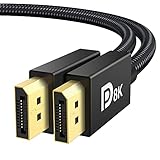
![Silkland Short 16K DisplayPort Cable 2.1, [VESA Certified] DP Cord 1.6FT](https://m.media-amazon.com/images/I/41uQSR28HnL._SL160_.jpg)


![Silkland 80Gbps DisplayPort Cable 2.1 [VESA Certified] 6.6FT/2M, DP80 HDR](https://m.media-amazon.com/images/I/41ZU3eQbhEL._SL160_.jpg)


Gaming Performance Specifications
Resolution and Refresh Rate Capabilities
DisplayPort 1.4 cables enable gaming at resolutions and refresh rates that were impossible with previous connection standards. At 1440p resolution—the sweet spot for competitive 144Hz+ gaming—DisplayPort cables handle refresh rates up to 240Hz, providing competitive gamers with ultra-smooth gameplay. For 4K gaming, DisplayPort 1.4 maintains 144Hz refresh rates, balancing visual quality with performance.
These specifications mean your cable will never be the limiting factor in your gaming setup. Modern graphics cards and displays reach their performance limits long before DisplayPort 1.4 bandwidth constraints become relevant. This future-proofs your investment against coming GPU and monitor generations.
HDR and Color Depth Support
Gaming increasingly embraces HDR—High Dynamic Range—for more vibrant, lifelike visuals. DisplayPort 1.4 cables support full 10-bit and even 12-bit color depth necessary for true HDR gaming experiences. HDMI 2.1, while capable of 4K 120Hz, often compromises color depth or refresh rate to stay within bandwidth limitations. DisplayPort’s superior bandwidth eliminates these compromises.
For next-generation gaming experiences leveraging techniques like ray tracing with tone mapping and advanced color grading, DisplayPort cables ensure your connection doesn’t limit visual quality. Graphics cards like the RTX 50-series and AMD’s latest offerings take full advantage of DisplayPort’s extended capabilities.
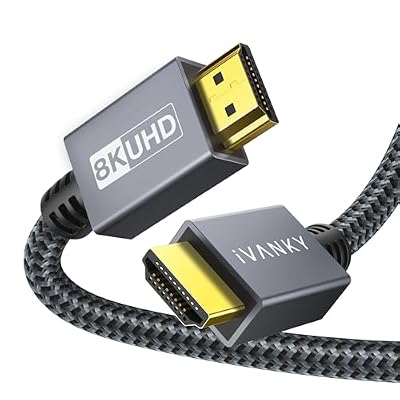
IVANKY 10K 8K HDMI Cable 10 ft, 48Gbps HDMI 2.1 Cable Ultra High Speed


As an Amazon Associate we earn from qualifying purchases. Product prices and availability are accurate as of the date/time indicated.
DisplayPort Cable Specifications Comparison
| Specification | DP 1.2 | DP 1.3 | DP 1.4 |
|---|---|---|---|
| Max Bandwidth | 21.6 Gbps | 32.4 Gbps | 32.4 Gbps |
| 4K @ 60Hz | Yes | Yes | Yes |
| 4K @ 120Hz | No | Yes | Yes |
| 4K @ 144Hz | No | No | Yes |
| 8K @ 60Hz | No | No | Yes |
| HDR Support | Yes (8-bit) | Yes (10-bit) | Yes (12-bit) |
Gaming Display Technology Integration
Adaptive Sync and Gaming Fluidity
DisplayPort cables integrate Adaptive Sync technology that works seamlessly with NVIDIA G-Sync and AMD FreeSync displays. This technology synchronizes your monitor’s refresh rate with your graphics card’s frame output, eliminating screen tearing and reducing input lag—critical for competitive gaming where every millisecond counts.
HDMI-based adaptive sync requires additional processing that introduces measurable latency. DisplayPort’s native implementation provides superior responsiveness, making DisplayPort-equipped monitors the choice of professional esports athletes and competitive gamers worldwide.
Daisy-Chaining Multiple Displays
DisplayPort’s daisy-chain capability allows connecting multiple monitors through a single cable connection, each running at full resolution and refresh rate. This feature benefits gamers using triple-monitor setups or content creators who require multiple high-resolution displays connected to a single GPU port.
HDMI lacks daisy-chaining capability, requiring a separate port for each display. For gaming setups with multiple monitors, DisplayPort’s daisy-chain support simplifies cable management and frees up additional GPU ports for other uses.

Ubluker 10K 8K 4K HDMI Cable 10FT Certified Passed, Ultra High Speed HDMI®


As an Amazon Associate we earn from qualifying purchases. Product prices and availability are accurate as of the date/time indicated.
Selecting the Right DisplayPort Cable
Cable Length Considerations
DisplayPort cables come in various lengths from 3 feet to 15+ feet, each serving different setup configurations. Shorter cables (3-6 feet) work best for desktop gaming rigs where monitors sit immediately above or beside the GPU. Longer cables (10-15 feet) suit setup configurations with distant display placement or competitive gaming tournaments where cable routing requires flexibility.
Cable length affects signal quality, though quality DisplayPort 1.4 cables maintain perfect integrity at lengths up to approximately 15 feet. Beyond 15 feet, consider active DisplayPort cables with built-in signal amplification to maintain reliable performance. For most gaming setups, 6-foot cables balance accessibility with adequate length for cable routing flexibility.
Cable Construction Quality
Premium DisplayPort cables feature robust shielding that prevents electromagnetic interference, critical in gaming setups with numerous high-frequency components. Look for cables with braided nylon sleeves that protect the cable jacket during frequent repositioning. Connectors matter too—gold-plated DisplayPort connectors resist corrosion and maintain contact quality even after numerous connect/disconnect cycles.
Avoid bargain DisplayPort cables that skimp on shielding or use cheap plastic connectors. These cost minimally less than quality alternatives but risk signal degradation that manifests as intermittent display issues during intense gaming sessions—exactly when you can’t afford connection failures.
Gaming Setup Integration
GPU and Monitor Compatibility
Virtually all modern graphics cards include at least one DisplayPort output, and high-end gaming monitors universally support DisplayPort. Before purchasing a DisplayPort cable, verify your specific card and monitor versions support at least DP 1.4. Older components may require DP 1.2 or DP 1.3 cables, though modern DP 1.4 cables maintain backward compatibility.
Check your monitor’s manual or specifications to confirm maximum supported refresh rate and resolution at DisplayPort—critical for validating that your cable supports your monitor’s full capabilities. Some budget monitors limit DisplayPort performance through design constraints, making cable quality less critical for those specific displays.
Multi-GPU Gaming Setups
Gaming rigs with multiple GPUs—such as competitive gaming towers with backup systems or streaming setups with dedicated capture cards—benefit from careful DisplayPort cable organization. Ensure each display connects to its designated GPU output, and consider color-coded cable sleeves to simplify troubleshooting when adjusting multi-GPU configurations.
DisplayPort Cable FAQs
Can I use an older DisplayPort cable with a DisplayPort 1.4 monitor?
Yes, DisplayPort cables are backward compatible. Older DP 1.2 or 1.3 cables work with DP 1.4 monitors, but they won’t deliver full DP 1.4 performance—you’ll be limited to the older cable’s maximum bandwidth. For a 4K 144Hz monitor, you need a minimum DP 1.4 cable. For older monitors, older cables suffice, though upgrading provides future flexibility for eventual monitor upgrades.
Does cable length affect gaming performance or latency?
Short cable runs (under 15 feet) have zero perceptible impact on gaming performance. DisplayPort signals travel at near-light speed, so even 15-foot cables introduce only microseconds of propagation delay—immeasurable for gaming applications. Longer cables (over 20 feet) may require active signal amplification to maintain quality, but performance characteristics remain unchanged for properly functioning cables.
Should I choose DisplayPort or HDMI for my gaming setup?
For high-refresh-rate gaming (144Hz+), choose DisplayPort—it supports higher refresh rates at 4K and integrates adaptive sync more efficiently. For single-monitor gaming at 60Hz to 100Hz, HDMI suffices but sacrifices future flexibility. Given the minimal cost difference between quality cables, DisplayPort is the future-proof choice for any gaming setup purchased in 2026.
What’s the difference between passive and active DisplayPort cables?
Passive DisplayPort cables rely purely on signal integrity at reasonable distances (under 15 feet). Active cables include built-in amplification electronics for longer runs or environments with heavy electromagnetic interference. For typical gaming setups, passive cables suffice. Active cables become necessary for specialized installations exceeding 15 feet or in industrial environments with significant electrical noise.
Recommendation and Conclusion
DisplayPort 1.4 cables represent the modern standard for gaming display connectivity, offering performance advantages that HDMI simply cannot match. Whether you’re building a competitive esports setup or a premium 4K gaming experience, a quality DisplayPort 1.4 cable future-proofs your investment across multiple GPU and monitor generations. Prioritize cable quality over cost—your gaming investment’s reliability depends on it.
Select a DisplayPort 1.4 cable that matches your required length and includes robust shielding and quality connectors. Combined with a compatible high-refresh monitor, your cable becomes transparent—it simply works reliably, enabling your gaming hardware to perform at full capacity. For additional setup optimization, explore our guide to best 4K gaming monitors and high-refresh 1440p displays that pair perfectly with DisplayPort connectivity. Learn more about gaming PC builds that leverage DisplayPort’s full potential.
More Gaming Gear Guides
- Best Displayport Cables Gaming
- Best Hdmi Cables Gaming
- Cable Management Gaming Desk
- Displayport Vs Hdmi Gaming
- Best Gaming Monitor Cables
- Best Gaming Setup Guide
Related Articles
Looking for more on this topic? Browse the hand-picked guides below — each one applies the same scoring rubric used in this review.
Frequently Asked Questions
What resolutions and refresh rates does DisplayPort 1.4 support?
With HBR3 at 32.4Gbps it comfortably handles 1440p at 240Hz, 4K at 120Hz uncompressed and 4K at 144Hz or higher when Display Stream Compression is enabled. It also supports HDR metadata and 10-bit colour, though enabling both HDR and very high refresh may force DSC on.
Does DisplayPort 1.4 support G-Sync and FreeSync?
Yes, adaptive sync runs over DisplayPort on both AMD and NVIDIA hardware, and monitors with hardware G-Sync modules require DisplayPort rather than HDMI. Make sure the feature is enabled both in the monitor on-screen menu and in the GPU control panel, since it is often off by default.
Why does my screen go black intermittently?
The most common causes are a poor-quality or overly long cable failing at HBR3, a loose latch, or DSC handshake issues after waking from sleep. Try a short certified cable directly between GPU and monitor, update GPU drivers and monitor firmware, and avoid unpowered adapters or hubs in the chain.
Can I convert DisplayPort to HDMI?
Yes, but direction matters. Passive DisplayPort to HDMI adapters work because DisplayPort sources can output HDMI signalling, while HDMI to DisplayPort requires an active converter. Conversion also caps you at the HDMI version the adapter supports, which frequently limits high refresh 4K modes.
Does mini DisplayPort perform the same?
Electrically it is identical, so a mini DisplayPort 1.4 connection carries the same bandwidth as a full-size one. The smaller connector is just less mechanically secure and lacks a latch, so it can loosen over time. USB-C ports with DisplayPort Alt Mode also carry the same signalling.


