

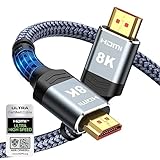
- Top Pick: Highwings 8K HDMI 2.1 Cable 2-Pack 6.6FT, Certified 48Gbps Ultra High Speed
- Best Value: Amazon Basics HDMI 2.0 Cable, 2-Pack, 6ft, 4K@60Hz, High-Speed 18Gbps, 2160p, 48 bit, Compatible with TV/PS5/Xbox/Roku/Blu-ray, Ethernet, Black
- Premium Choice: Highwings 8K 10K 4K HDMI Cable 48Gbps 6.6FT/2M, Certified Ultra High Speed
Affiliate disclosure: As an Amazon Associate we earn from qualifying purchases. This post contains affiliate links — if you buy through them we may earn a small commission at no extra cost to you. This never affects our recommendations.
- Hdmi Cable 2: Gaming-Grade HDMI 2.1 Connectivity Solutions
- Understanding HDMI 2.1 for Gaming
- HDMI 2.1 Gaming Capabilities
- HDMI Cable Specifications Comparison
- Console Gaming Integration
- Selecting Quality HDMI 2.1 Cables
- HDMI 2.1 Cable FAQs
- Recommendation and Conclusion
- More Gaming Gear Guides
- Related Articles
- Frequently Asked Questions
- Related Articles
🛒 Best Price Today on Amazon
Prime members get fast, free shipping on everything above, plus member-only deals. New members get a 30-day free trial — cancel anytime.
Start 30-Day Prime Free Trial →See Today’s Amazon DealsHdmi Cable 2: Gaming-Grade HDMI 2.1 Connectivity Solutions
HDMI cables have evolved significantly, and HDMI 2.1 represents the modern standard for gaming display connectivity. While DisplayPort dominates high-refresh competitive gaming, HDMI 2.1 cables provide excellent performance for console gaming, streaming setups, and gaming PCs connected to larger displays. Understanding HDMI 2.1 specifications helps you select cables that reliably deliver 4K gaming at high refresh rates.
This comprehensive guide examines HDMI 2.1 technology, gaming performance capabilities, and best practices for selecting cables that support modern gaming requirements. We’ll explore HDMI versions, bandwidth specifications, and compatibility with popular gaming platforms from PlayStation 5 to high-end gaming PCs.
In a hurry? See the top-rated HDMI 2.1 Cable deals available right now:
🛒 Check Hdmi 2.1 Cable Prices on Amazon →Understanding HDMI 2.1 for Gaming
HDMI 2.1 Gaming Performance Specifications
HDMI 2.1 cables support 4K resolution at 120Hz refresh rate with full HDR support—sufficient for console gaming on PlayStation 5, Xbox Series X, and modern gaming PCs. While not reaching DisplayPort 1.4’s capabilities at 4K 144Hz, HDMI 2.1 provides impressive bandwidth for gaming applications, supporting resolutions from 1080p to 8K.
For gaming, HDMI 2.1’s 120Hz capability at 4K represents a substantial improvement over previous HDMI standards capped at 60Hz. This enables next-generation consoles to deliver smooth 4K gameplay while eliminating the refresh rate compromise that plagued previous HDMI versions.
HDMI vs. DisplayPort: Gaming Context
HDMI 2.1 and DisplayPort 1.4 both serve gaming applications but with different strengths. HDMI 2.1’s advantage lies in universal compatibility across gaming platforms—nearly all displays, TVs, and streaming devices support HDMI. DisplayPort’s advantages include higher maximum refresh rates (240Hz at 4K) and native adaptive sync integration.
For PC gaming at competitive refresh rates, DisplayPort edges ahead. For console gaming and PC connections to TVs, HDMI 2.1 provides excellent performance. The choice between them depends on your specific hardware and use case rather than absolute capability differences.
As an Amazon Associate we earn from qualifying purchases at no extra cost to you.




HDMI 2.1 Gaming Capabilities
Resolution and Refresh Rate Support
HDMI 2.1 cables enable gaming at resolutions and refresh rates previously impossible with earlier standards. At 4K resolution, HDMI 2.1 supports 120Hz refresh rates—matching next-generation console gaming capabilities. For 1440p gaming, HDMI 2.1 supports up to 240Hz refresh rates, providing competitive gaming performance on HDMI-based displays.
These capabilities represent genuine improvements over HDMI 2.0 cables capped at 4K 60Hz. Gamers upgrading from older HDMI standards experience immediate benefits—smoother gameplay, faster responsiveness, and future compatibility with increasingly demanding gaming titles.
HDR and Color Depth Capabilities
HDMI 2.1 cables support 10-bit and 12-bit color depth necessary for true HDR gaming experiences. Gaming platforms increasingly leverage HDR for more vibrant, lifelike visuals—PlayStation 5 and Xbox Series X both support HDR gaming at their maximum refresh rates when connected via HDMI 2.1.
Full HDR support requires quality HDMI 2.1 cables capable of handling the increased bandwidth. Budget HDMI cables may negotiate down to 8-bit color to maintain connection stability, reducing visual quality compared to HDR-capable cables. Premium HDMI 2.1 cables ensure your console or gaming PC’s visual capabilities aren’t compromised by substandard connectivity.

BlueRigger 8K HDMI Cable 6FT - 8K 60Hz, 48Gbps, HDMI Cord, HDR10+, eARC


As an Amazon Associate we earn from qualifying purchases. Product prices and availability are accurate as of the date/time indicated.
HDMI Cable Specifications Comparison
| Standard | Bandwidth | 4K Support | Max Refresh @ 4K | HDR |
|---|---|---|---|---|
| HDMI 2.0 | 18 Gbps | Yes | 60Hz | Yes (8-bit) |
| HDMI 2.0b | 18 Gbps | Yes | 60Hz | Yes (10-bit) |
| HDMI 2.1 | 48 Gbps | Yes | 120Hz | Yes (12-bit) |
| HDMI 2.1a | 48 Gbps | Yes | 120Hz | Yes (12-bit) |
Console Gaming Integration
PlayStation 5 and Xbox Series X Optimization
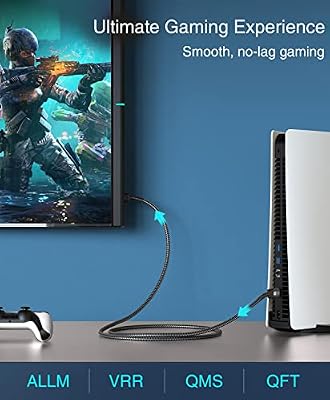
Next-generation consoles—PlayStation 5 and Xbox Series X—achieve their full gaming potential only with HDMI 2.1 cables. These consoles deliver 4K resolution at 120Hz when connected via quality HDMI 2.1 cables, enabling gaming experiences impossible with older HDMI standards. For console gamers, upgrading to HDMI 2.1 cables is essential to fully experience next-generation gaming capabilities.
Both PlayStation 5 and Xbox Series X support variable refresh rate technology (similar to PC’s adaptive sync) exclusively via HDMI 2.1. This smooths gameplay by synchronizing display refresh with console frame output, reducing input lag and eliminating screen tearing—critical benefits for competitive console gaming.
Gaming TV Compatibility
Modern gaming TVs increasingly support 4K 120Hz gaming when connected via HDMI 2.1. Premium gaming TVs from LG, Samsung, and other manufacturers feature HDMI 2.1 ports specifically for gaming applications. If your gaming setup uses a large TV instead of a traditional monitor, HDMI 2.1 cables are essential to unlock the TV’s gaming capabilities.
Note that not all TV HDMI ports support HDMI 2.1—typically only one or two ports feature the full specification. Consult your TV’s manual to identify which ports support HDMI 2.1, and connect your gaming console or PC to those specific ports to ensure maximum performance.
![Snowkids 8K HDMI Cable 10ft, Certified 2.1 UHD [4K & Ethernet Support]](https://m.media-amazon.com/images/I/410dwFcEWOL._SL400_.jpg)
Snowkids 8K HDMI Cable 10ft, Certified 2.1 UHD [4K & Ethernet Support]


As an Amazon Associate we earn from qualifying purchases. Product prices and availability are accurate as of the date/time indicated.
Selecting Quality HDMI 2.1 Cables
Cable Length and Signal Quality
HDMI 2.1’s 48 Gbps bandwidth places demands on cable quality over extended distances. Shorter runs (under 10 feet) maintain signal integrity easily. Longer runs (15+ feet) require premium cables with robust shielding to prevent signal degradation that manifests as intermittent display issues or dropped connections.
For cable runs exceeding 20 feet, consider HDMI 2.1 active cables with built-in signal amplification. While more expensive than passive cables, active cables guarantee signal quality regardless of distance—important for fixed installations where cable rerouting isn’t feasible.
Connector Quality and Durability
Premium HDMI 2.1 cables feature gold-plated connectors that resist corrosion and maintain contact quality through repeated connect/disconnect cycles. Braided nylon sleeves protect the cable jacket from daily wear. Look for cables with strain relief at connectors—flexible tubing near connector bases prevents damage from sharp bends that can break internal conductors.
Avoid ultra-cheap HDMI cables that skimp on connector quality or shielding. These cost minimally less than quality alternatives but risk signal problems that emerge precisely during important gaming sessions. Premium HDMI 2.1 cables cost $15-$30, reasonable insurance against connectivity frustrations.
PC Gaming via HDMI 2.1GPU HDMI 2.1 Support
Modern graphics cards increasingly feature HDMI 2.1 ports. NVIDIA’s recent cards include HDMI 2.1 alongside DisplayPort outputs, as do AMD’s latest offerings. For PC gamers connecting to HDMI displays or TVs, HDMI 2.1 cables enable full resolution and refresh rate support matching DisplayPort capabilities.
If upgrading your gaming PC with a new GPU, verify that your target card includes HDMI 2.1 ports if you plan HDMI connectivity. Older GPUs may feature only HDMI 2.0 ports, limiting performance to 4K 60Hz. For future-proof PC gaming via HDMI, select GPUs with HDMI 2.1 support.
Mixed Resolution Gaming Setups
Gaming PCs often connect to multiple displays—a high-refresh monitor via DisplayPort and a secondary display via HDMI. This setup distributes the GPU’s outputs efficiently while enabling different gaming modes. Ensure your HDMI 2.1 cables support your secondary display’s maximum resolution and refresh rate to prevent bottlenecking high-performance gaming across multiple displays.
HDMI 2.1 Cable FAQs
Can HDMI 2.1 cables work with older HDMI devices?
Yes, HDMI 2.1 cables are backward compatible with all older HDMI devices. However, performance is limited to the older device’s capabilities—connecting an HDMI 2.1 cable to an HDMI 2.0 display won’t improve performance beyond HDMI 2.0 limits. For future-proofing your gaming setup, HDMI 2.1 cables are smart investments even if your current display is older.
Do I need expensive HDMI 2.1 cables or will cheap cables work?
Quality matters for HDMI 2.1 cables due to high bandwidth requirements. Budget cables risk signal degradation that manifests as intermittent connection drops, especially over longer cable runs. Premium HDMI 2.1 cables ($15-$30) cost minimally more than budget options but provide reliability necessary for gaming. Don’t scrimp on this component—gaming frustrations from cable issues vastly exceed the cable’s cost.
Should I choose HDMI 2.1 or DisplayPort for my gaming PC?
For PC gaming at competitive refresh rates (144Hz+ at 4K), DisplayPort 1.4 offers superior performance and is typically the better choice. For console gaming, large TV connections, or secondary gaming displays, HDMI 2.1 provides excellent performance with universal compatibility. The choice depends on your specific display and performance targets.
What’s the difference between HDMI 2.1 and HDMI 2.1a?
HDMI 2.1a represents a minor update to HDMI 2.1 with enhanced dynamic HDR support and display refresh rate compensation. For gaming purposes, HDMI 2.1 and 2.1a cables are functionally equivalent—either serves gaming applications admirably. Don’t overpay specifically for HDMI 2.1a cables unless you plan HDR content creation or professional display work.
Recommendation and Conclusion
HDMI 2.1 cables represent the modern standard for console gaming and TV-based gaming setups, enabling 4K 120Hz gaming on next-generation consoles and compatible gaming PCs. For PlayStation 5, Xbox Series X, or gaming TVs, quality HDMI 2.1 cables are essential to fully experience your hardware’s capabilities. Select cables with robust connectors, quality shielding, and appropriate length for your setup configuration.
Whether you’re upgrading your console gaming setup or connecting a gaming PC to a large display, HDMI 2.1 cables provide reliable performance at reasonable cost. Paired with compatible display hardware, your cable becomes transparent—enabling seamless gaming without performance compromises. For additional gaming setup optimization, explore our guide to best gaming TVs for console gaming and gaming monitors that pair perfectly with quality HDMI connectivity. Learn more about gaming PC configurations that leverage HDMI 2.1’s full potential for TV-based gaming experiences.
More Gaming Gear Guides
- Best Displayport Cables Gaming
- Best Hdmi Cables Gaming
- Cable Management Gaming Desk
- Displayport Vs Hdmi Gaming
- Best Gaming Monitor Cables
Related Articles
Looking for more on this topic? Browse the hand-picked guides below — each one applies the same scoring rubric used in this review.
Frequently Asked Questions
Do I really need an HDMI 2.1 cable for PS5 or Xbox Series X?
Yes, if you want 4K at 120Hz, variable refresh rate or 8K output. Those modes need the 48Gbps bandwidth of an Ultra High Speed cable. For 4K at 60Hz a good High Speed cable is sufficient, but since certified 2.1 cables cost only a few dollars more, buying one removes any future doubt.
How can I tell a genuine Ultra High Speed cable from a fake?
Look for the official Ultra High Speed HDMI certification label with a scannable QR code, which validates against the HDMI Licensing Administrator database. Marketing terms like 8K ready or 2.1 compatible mean nothing on their own. Certification is the only reliable indicator that the cable passed 48Gbps testing.
Does cable length affect 4K 120Hz performance?
It does. Passive copper cables reliably carry full 48Gbps up to about two to three metres. Beyond that, signal loss causes sparkles, black screen flicker or silent fallback to a lower mode. For runs of five metres or more, use an active or fibre optic HDMI cable and connect it in the correct source and display direction.
Will an expensive cable improve picture quality?
No. HDMI is a digital signal, so a compliant cable either delivers the full data or fails visibly with dropouts. A twenty-dollar certified cable and a two-hundred-dollar boutique cable produce identical images at the same length. Spend on build quality and certification, not on claims about clarity or colour.
Why does my console keep dropping to 60Hz?
Common causes are an uncertified cable, plugging into a TV port that is not the 2.1-capable one, or leaving enhanced HDMI signal format disabled in the TV menu. Soundbars and older AV receivers in the chain also cap bandwidth. Test the console connected directly to the display with a certified cable to isolate the culprit.


