Affiliate disclosure: As an Amazon Associate we earn from qualifying purchases. This post contains affiliate links — if you buy through them we may earn a small commission at no extra cost to you. This never affects our recommendations.
- HDMI 2.1: The Gaming Revolution Explained
- Bandwidth & Resolution Specifications: What 48 Gbps Really Means
- Ultra High Speed Certification: The Reliability Standard
- Connector Quality & Durability for Long-Term Gaming Use
- Braided Construction vs. Standard Cable Jackets
- 8K @ 120Hz Gaming: Tomorrow’s Gaming Today
- Cable Length Considerations & Signal Integrity
- Gaming Monitor & Console Compatibility
- HDMI 2.1 Cable Specifications Comparison
- Frequently Asked Questions About Gaming HDMI 2.1 Cables
- Conclusion: Invest in Certified Quality
- Related Articles
- Related Articles
HDMI 2.1 cables represent the evolution of consumer video transmission technology, delivering capabilities previously reserved for professional broadcast equipment. For gamers connecting gaming PCs, PlayStation 5, Xbox Series X, or next-generation consoles to high-end displays, HDMI 2.1 cables enable experiences that standard HDMI cables simply cannot deliver. This comprehensive guide explains HDMI 2.1 specifications, bandwidth requirements, construction quality, and how to select the perfect cable for your gaming setup.
In a hurry? See the top-rated HDMI 2.1 Gaming Cable deals available right now:
🛒 Check Hdmi 2.1 Gaming Cable Prices on Amazon →🛒 Best Price Today on Amazon
Prime members get fast, free shipping on everything above, plus member-only deals. New members get a 30-day free trial — cancel anytime.
Start 30-Day Prime Free Trial →See Today’s Amazon DealsHDMI 2.1: The Gaming Revolution Explained
HDMI 2.0 cables, the previous standard, delivered 18 Gbps bandwidth—adequate for 4K at 60Hz but insufficient for high-refresh-rate gaming. HDMI 2.1 quadruples this capability to 48 Gbps, opening possibilities for 4K gaming at 120Hz, 8K at 60Hz, and even 10K at 24Hz for future-proofing.
This bandwidth increase translated to real gaming benefits: PlayStation 5 owners can now play supported titles at 4K @ 120Hz instead of locked 60Hz. PC gamers with high-end graphics cards finally have a single-cable solution matching DisplayPort performance. Console gamers experience responsiveness and visual fidelity previously restricted to PC gaming.
The HDMI 2.1 standard introduced “Ultra High Speed” certification, a VESA program ensuring cables meet strict bandwidth, shielding, and construction standards. Not all cables labeled “HDMI 2.1” achieve Ultra High Speed certification—this distinction critically separates genuine 48 Gbps cables from marketing overstatement.

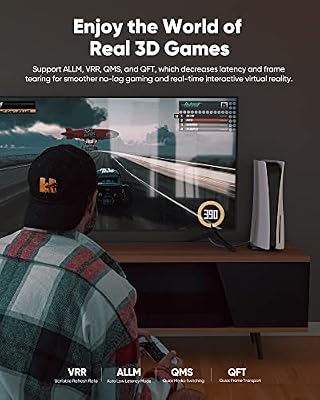
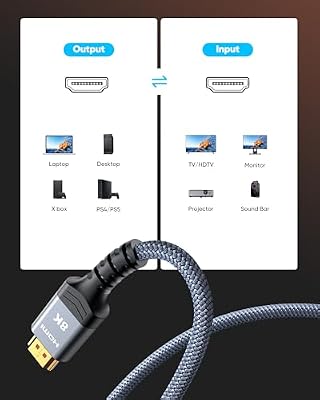
Highwings 8K 10K 4K HDMI Cable 48Gbps 6.6FT/2M, Certified Ultra High Speed





As an Amazon Associate we earn from qualifying purchases. Product prices and availability are accurate as of the date/time indicated.
Bandwidth & Resolution Specifications: What 48 Gbps Really Means
Understanding HDMI 2.1’s 48 Gbps bandwidth specification helps you make informed purchase decisions and prevents costly mistakes. This bandwidth supports unprecedented resolution and refresh rate combinations.
Bandwidth-Supported Resolutions:
- 4K (3840×2160) @ 120Hz with full 10-bit color and HDR
- 5K (5120×2880) @ 60Hz with HDR support
- 8K (7680×4320) @ 60Hz with HDR (future-proofing)
- 1440p @ 240Hz for competitive gaming
- 1080p @ 480Hz (for extreme competitive esports)
Compared to HDMI 2.0, which maxes out at 4K @ 60Hz without premium features, HDMI 2.1 doubles the refresh rate at maximum resolution while maintaining color depth and dynamic range. This advancement proves crucial for gamers upgrading from console-generation displays to modern 120Hz gaming monitors.
Ultra High Speed certification guarantees a cable reliably transmits 48 Gbps across various environmental conditions and cable routing scenarios. Uncertified cables may perform adequately in ideal conditions but fail under real-world stress—heat, EMI interference, or slightly damaged connectors cause intermittent dropouts and frustration.
Ultra High Speed Certification: The Reliability Standard
VESA’s Ultra High Speed certification program represents gaming cables’ most important quality gate. Manufacturers submit cables to rigorous testing ensuring compliance with bandwidth, shielding, and durability standards before earning certification status.
What Ultra High Speed certification guarantees:
- Reliable 48 Gbps transmission under real-world conditions
- Shielding adequate for modern consumer electronics environments
- Connector durability through 10,000+ insertion/removal cycles
- Performance consistency across cable lengths 3-50 feet
- Compatibility with the full HDMI 2.1 feature set
Cables lacking certification may support 48 Gbps under perfect laboratory conditions but fail in typical gaming setups. A cable running 6 feet near a graphics card and power supply experiences EMI that uncertified cables simply cannot handle. Choose only Ultra High Speed certified cables for gaming—the cost difference ($5-15) pales against the frustration of signal dropouts or complete connection failure.

Highwings 8K@60 Long HDMI Cable 15FT, 48Gbps High Speed HDMI to HDMI 2.1


As an Amazon Associate we earn from qualifying purchases. Product prices and availability are accurate as of the date/time indicated.
Connector Quality & Durability for Long-Term Gaming Use
HDMI connectors experience physical stress every time you disconnect and reconnect your cable. Inferior connector construction leads to loose connections, intermittent signal loss, and eventual complete failure. Premium gaming cables invest in connector durability because gamers upgrade systems frequently.
Premium connector features:
- Gold-plated contact pins resist corrosion and maintain low resistance
- Reinforced strain relief prevents internal wire breakage at the connector
- Tighter mechanical tolerances ensure snug connection without excessive force
- Heat-resistant connector housing withstands GPU thermal output
Standard HDMI connectors tolerate maybe 500-1,000 connection cycles before performance degradation. Premium connectors rated for 10,000+ cycles prove essential for gaming setups upgraded frequently. When you routinely swap cables between TV, monitor, and portable display, connector durability directly determines your cable’s lifespan.
Braided Construction vs. Standard Cable Jackets
HDMI cable durability extends beyond connectors to the outer jacket protecting internal conductors. Braided cable construction using woven nylon or polyester offers superior protection compared to standard PVC.
Braided cable advantages in gaming scenarios:
- Resists abrasion from cable management routing and repositioning
- Maintains flexibility in cold environments (gaming room temperatures)
- Withstands accidental pinching and cable stress better
- Dissipates heat more effectively than solid PVC
- Lasts 2-3x longer under identical use conditions
PVC cables cost slightly less but deteriorate noticeably within 12-18 months if frequently moved or routed near heat sources. Braided cables often outlast gaming monitor lifecycles (3-5 years), providing genuine long-term value. For a cable carrying video signals worth $300+ in display hardware, investing $20-30 in braided construction represents sensible economics.
8K @ 120Hz Gaming: Tomorrow’s Gaming Today
8K gaming displays remain expensive and rare in 2026, but HDMI 2.1’s 8K @ 60Hz capability proves important for future-proofing. Gaming technology advances every 3-5 years—selecting cables rated for tomorrow’s standard ensures compatibility when you upgrade displays.
8K @ 120Hz requirements:
- Full 48 Gbps bandwidth utilization
- Ultra High Speed VESA certification
- Premium shielding handling next-generation graphics card EMI
- Quality connectors rated for extended lifecycle
Console manufacturers (Sony, Microsoft) already support 8K output specifications for future games. PC manufacturers include 8K-capable HDMI 2.1 ports on premium graphics cards. Selecting an 8K-capable cable today costs virtually identical to 4K-only cables, making future-proofing an obvious choice for gaming installations.
As an Amazon Associate we earn from qualifying purchases at no extra cost to you.


Cable Length Considerations & Signal Integrity
HDMI 2.1’s 48 Gbps bandwidth makes cable length more critical than previous standards. Longer cables require better shielding and construction to maintain signal integrity across the distance.
Recommended cable lengths by application:
- 3-6 feet: Optimal for compact gaming setups, minimal signal loss even with standard shielding
- 6-10 feet: Suitable for living room setups, requires quality shielding and certification
- 10-15 feet: Long runs demand premium construction and multi-layer shielding
- 15+ feet: Rarely recommended; consider DisplayPort or ethernet-based solutions instead
Signal attenuation increases exponentially with length. A poorly constructed 15-foot cable may only deliver effective HDMI 2.0 performance due to signal degradation. Always select the shortest cable adequate for your setup and use cable management sleeves for organization rather than compensating with excessive length.
Gaming Monitor & Console Compatibility
HDMI 2.1 cables work with all HDMI-equipped devices, but full 48 Gbps capability requires both cable and display support. Connecting an HDMI 2.1 cable to a HDMI 2.0 monitor limits performance to 18 Gbps (standard HDMI 2.0 speeds), but the cable itself functions perfectly for future upgrades.
Gaming device compatibility:
- PlayStation 5: Requires HDMI 2.1 for 4K @ 120Hz gaming modes
- Xbox Series X: Supports 4K @ 120Hz with HDMI 2.1 cables
- Gaming PCs: RTX 4070 and newer support full 48 Gbps output
- High-refresh monitors: 4K @ 120Hz displays mandate HDMI 2.1 cables for peak performance
Check your specific monitor or display manual for HDMI 2.1 support before purchasing. If you own a HDMI 2.0 display, upgrading to HDMI 2.1 cables now provides seamless compatibility when you upgrade displays—no need to rebuy cables.
HDMI 2.1 Cable Specifications Comparison
| Specification | HDMI 2.0 Standard | HDMI 2.1 Standard | Cable Matters B08PFXZPFX | Premium Alternative |
|---|---|---|---|---|
| Bandwidth | 18 Gbps | 48 Gbps | 48 Gbps | 48 Gbps |
| Max 4K Resolution | 4K @ 60Hz | 4K @ 120Hz | 4K @ 120Hz | 4K @ 120Hz |
| 8K Support | No | Yes (@ 60Hz) | Yes (@ 60Hz) | Yes (@ 60Hz) |
| Ultra High Speed Cert | N/A | Required | Yes | Yes |
| Connector Type | Standard HDMI | Standard HDMI | Gold-plated | Gold-plated premium |
| Jacket Type | Standard PVC | Braided preferred | Braided nylon | Braided nylon |
| Available Lengths | 3-25 feet | 3-15 feet | 3, 6, 10 feet | 3, 6, 10, 15 feet |
Frequently Asked Questions About Gaming HDMI 2.1 Cables
Q: Can I use HDMI 2.0 cable with HDMI 2.1 devices?
A: Yes, the cables are physically compatible, but you’ll be severely bottlenecked. HDMI 2.0 maxes out at 18 Gbps—less than 40% of HDMI 2.1 capacity. Your PS5 or high-refresh gaming monitor won’t achieve advertised performance. Invest in HDMI 2.1 cables to avoid wasting expensive hardware capabilities.
Q: Does cable length actually affect gaming performance?
A: Absolutely. Beyond 10 feet, inadequate shielding causes signal attenuation, reducing effective bandwidth. You might think you’re getting 48 Gbps but only receiving 30 Gbps due to signal loss. Always verify Ultra High Speed certification and select the shortest cable adequate for your setup.
Q: What’s the difference between Ultra High Speed and regular HDMI 2.1?
A: Ultra High Speed is VESA’s certification guarantee that a cable reliably delivers 48 Gbps under real conditions. Non-certified “HDMI 2.1” cables may not perform to specification. Always purchase Ultra High Speed certified cables—it’s the only objective quality standard.
Q: Why does my PS5 show “HDMI device not responding” intermittently?
A: Most likely causes: (1) Non-certified cable failing under thermal stress near the console; (2) cable connections loose from poor connector quality; (3) cable damaged from repositioning. Test with a certified Ultra High Speed cable to isolate whether the cable is the culprit.
Conclusion: Invest in Certified Quality
Your HDMI 2.1 cable directly determines whether your gaming hardware delivers advertised performance. A $20 certified Ultra High Speed cable ensures stable, high-bandwidth video transmission for years. An uncertified $5 cable causes intermittent failures, signal dropouts, and frustration.
For gaming setups where displays cost $300-1000+, investing in certified cables proves economically obvious. The cable becomes the limiting factor if not properly selected—premium hardware deserves premium connections.
Explore related gaming infrastructure: Learn about complete setup optimization in our 2026 gaming setup guide and gaming PC building guide. For network connectivity, check our guide to ethernet cables for gaming. Also see our complete gaming PC build recommendations and budget gaming PC options.
Related Articles
Looking for more on this topic? Browse the hand-picked guides below — each one applies the same scoring rubric used in this review.