- Top Pick: UGREEN USB 3.0 Switch Selector 2 Computers Share 4 USB Ports USB Switcher USB for PC Laptop Keyboard Mouse Printer Scanner One Button Switch Adapter with 2 Pack USB 3.0 Cables
- Best Value: UGREEN USB Switch Selector 2 Computers Sharing 4 USB Devices USB 2.0 Peripheral Switcher Box Hub for Mouse Keyboard Scanner Printer PCs with One-Button Swapping and 2 Pack USB A to A Cable
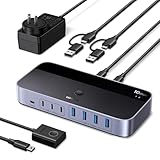
- Premium Choice: UGREEN 2-in 7-Out USB 3.2 Switch, 10 Gbps Switcher for A or C Computers Sharing All Devices(4 A+3 C) Keyboard Mouse Switch with Type C Converter Adapter,Power Adapter
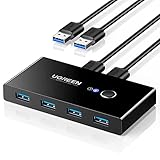
The UGREEN USB 3.0 Switch is a four-port USB 3.0 peripheral switch that lets two computers share the same keyboard, mouse, external SSD, webcam and printer through a button-press selector. As with its USB 2.0 sibling, this is a USB switch, not a KVM — it does not route video signals — but the USB 3.0 uplink raises the bandwidth ceiling from 480 Mbps to 5 Gbps, which is the headline reason to choose it over the cheaper USB 2.0 version. This UGREEN USB 3.0 Switch review covers the switching performance, USB pass-through, build quality and value at around $30.
- UGREEN USB 3.0 Switch at a Glance
- Switching Performance & Latency
- Display Compatibility — Single / Dual / Triple
- USB Pass-Through & Peripherals
- Build Quality & Switching Method
- Use Cases — Gaming + Streaming, Home Office
- Verdict
- Frequently Asked Questions
- More KVM Switch Reviews
- Related Articles
- Related Articles
- Related Guides
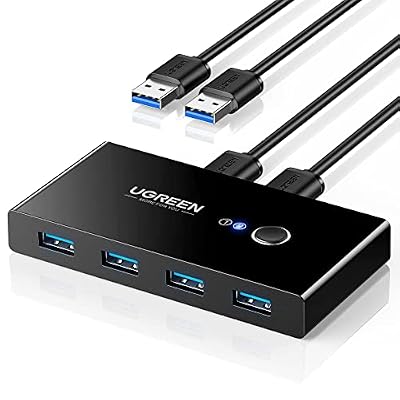
UGREEN USB 3.0 Switch Selector 2 Computers Share 4 USB Ports USB Switcher USB for PC Laptop Keyboard Mouse Printer Scanner One Button Switch Adapter with 2 Pack USB 3.0 Cables


As an Amazon Associate we earn from qualifying purchases. Product prices and availability are accurate as of the date/time indicated.
🛒 Best Price Today on Amazon
Prime members get fast, free shipping on everything above, plus member-only deals. New members get a 30-day free trial — cancel anytime.
As an Amazon Associate we earn from qualifying purchases.



UGREEN USB 3.0 Switch at a Glance
| Component | Specification |
|---|---|
| Type | USB switch (peripheral sharing, no video) |
| Computer count supported | 2 PCs |
| Monitor count | 0 (USB switch only — no video routing) |
| Display resolution support | N/A (peripheral switch, video handled separately) |
| USB peripheral count | 4 USB-A 3.0 ports |
| USB version | USB 3.0 (5 Gbps) |
| Hot-key switching | No — button-press selector only |
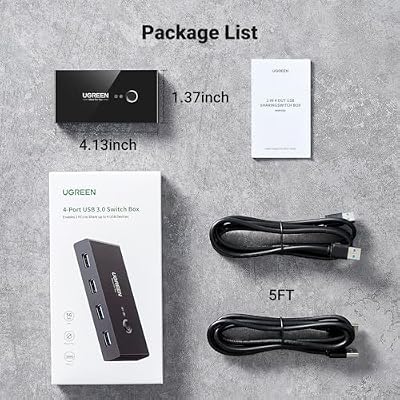
| Cables included | 2x USB-A to USB-B 3.0 uplink cables |
| Approx price | around $30 |
Switching Performance & Latency
The UGREEN USB 3.0 Switch uses a single physical button to toggle the four downstream USB ports between the two host computers. The switching mechanic itself is identical to the USB 2.0 model: press the button, the peripherals re-enumerate on the newly active host, and you are typing on the other machine within about half a second to a full second. That delay is the USB device-discovery handshake — it is the same time you would wait if you unplugged your keyboard from one PC and plugged it into another by hand. There is no hot-key support, no software, and no programmable scripts; the button is the only control. For desk users who switch a handful of times a day between a work PC and a personal one, the button is a pleasant tactile action. Heavy switchers may prefer a hotkey-capable HDMI KVM further down our reviews.
Where the USB 3.0 model earns its premium is the reliability of the re-enumeration with high-bandwidth devices. Plug a USB 3.0 external SSD into the hub and it survives the toggle cleanly, mounting on the second computer in seconds rather than failing to negotiate as some cheaper switches do. That makes it the right choice if your shared peripheral pool includes an external SSD or a 4K webcam.
Display Compatibility — Single / Dual / Triple
This switch does not handle video signals at all. The expected setup is either two computers each with their own monitor — where the switch ferries the keyboard and mouse between them — or a single multi-input monitor whose own input button you press to follow the USB switch. If you need the same monitor to follow the keyboard, mouse and external SSD with a single press, you need a true HDMI KVM and not this product. For dual-monitor productivity rigs with two computers, this switch fits perfectly into the gap a KVM would otherwise fill, sharing peripherals while each PC keeps driving its own panel. Pair the dual-display side with cables from our best HDMI cables guide.
USB Pass-Through & Peripherals
The headline upgrade over the USB 2.0 model is the 5 Gbps USB 3.0 uplink. With a single fast NVMe-based external SSD on a downstream port, you will see throughput in the 350 to 450 MB/s region, which is roughly ten times the speed possible on USB 2.0. For users whose two computers share an external drive — a freelancer editing video on a personal machine and reviewing on a work laptop, for instance — that bandwidth makes a real practical difference. Webcams operate at higher bitrates (1440p and 4K USB webcams demand more than USB 2.0 can comfortably carry), and high-speed flash drives saturate USB 2.0 instantly, so even non-SSD users benefit from the headroom.
The four ports share the upstream USB 3.0 bandwidth, the same as any hub. Parallel SSD copies between two ports will halve the per-port throughput, but the overall switch ceiling remains far above USB 2.0. For typical mouse and keyboard plus an SSD and a webcam, the bandwidth is more than enough.
Build Quality & Switching Method
UGREEN’s housing follows the same compact, brushed-top design as the USB 2.0 model, with the two USB-B 3.0 uplinks on one edge and the four downstream USB-A 3.0 ports on the other. The USB 3.0 connectors are coloured blue to the USB-IF convention, which is a small but useful visual cue when cabling under a desk. The bundled cables are USB 3.0-rated, which matters — using a USB 2.0 cable on the uplink would silently downgrade every downstream port to 480 Mbps. The selector is the same single button on the top of the housing, with a host LED to show which computer is active. The switching method is strictly button-press: no hot-keys, no driver, no automation.
Use Cases — Gaming + Streaming, Home Office
For home offices the USB 3.0 Switch is the sweet spot if any of your shared peripherals exceed USB 2.0 — modern webcams, external SSDs, USB-3.0 docking devices or fast card readers all benefit from the upgrade. For two-PC streaming setups it routes the same keyboard, mouse and capture device between gaming PC and streaming PC without bottlenecking 4K capture cards or fast scratch drives. It is also a sensible buy if you currently use the USB 2.0 model but plan to add a fast external SSD to your peripheral pool. For the gaming side of a dual-PC stream, our best RTX 5070 gaming laptops guide covers the typical hardware.
Verdict
The UGREEN USB 3.0 Switch is the version most readers should buy. The roughly $10 premium over the USB 2.0 model unlocks five-to-ten times the bandwidth and survives the addition of fast SSDs and 4K webcams to the peripheral pool without any negotiation issues. The button-press switching is reliable, the included USB 3.0 cables are correct out of the box, and the build is as tidy as UGREEN’s mature switch range deserves. As with the USB 2.0 model, the one thing it does not do is switch video — if that matters, an HDMI KVM is the right product. As a pure USB 3.0 peripheral switch for two computers, it is very hard to fault.
Frequently Asked Questions
Is this a KVM switch?
No — like all USB switches, it shares USB peripherals (keyboard, mouse, external storage) between two computers but does not switch the video signal. For shared video, look at the HDMI KVMs reviewed on this site.
How fast is it compared with the USB 2.0 model?
About 10 times the peak bandwidth — 5 Gbps versus 480 Mbps. In practice a single fast external SSD will read at 350 to 450 MB/s through this switch instead of 35 MB/s.
Does it support hot-key switching?
No — the only way to switch is the single button on top of the housing. There is no software, no hotkey and no remote selector.
Will it work with USB 3.0 webcams and external SSDs?
Yes — the USB 3.0 uplink and bundled USB 3.0 cables carry the full 5 Gbps to the downstream ports, so 4K webcams and fast external SSDs work at their advertised speeds.
More KVM Switch Reviews
- Sabrent USB 2.0 Sharing Switch Review: Share Up to 4 PCs
- UGREEN USB 3.0 4-Port KVM Review: USB-C + USB-A Switch
- IOGEAR 2-Port USB VGA KVM Switch Review (GCS22U)
- BENFEI USB 3.0 Switch Review: 4 Ports, 2 PC Selector
- TRENDnet TK-209K 2-Port KVM Review with Audio Pass-Through
- UGREEN HDMI KVM Switch Review: 4K@60Hz + 4 USB 3.0
- UGREEN 4K@60Hz HDMI KVM Switch Review: 2 PC, 4 USB
- MLEEDA Dual Monitor HDMI KVM Review: 4K@60Hz, 2 PCs
Affiliate Disclosure: As an Amazon Associate, we earn from qualifying purchases. If you click a link and make a purchase, we may earn a small commission at no extra cost to you. Prices and availability are accurate as of publication and may change.
Related Articles
Looking for more on this topic? Browse the hand-picked guides below — each one applies the same scoring rubric used in this review.