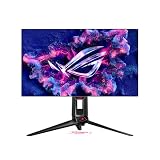
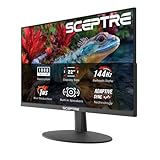
- Top Pick: Sceptre 34-Inch Curved Ultrawide WQHD Monitor (3440 × 1440), R1500, up to 180Hz/165Hz, DisplayPort x2, 99% sRGB, 1ms, Built-in Speakers, Machine Black, 2025 (C345B-QUT168)
- Best Value: 34-Inch Curved Ultrawide WQHD Gaming Monitor 3440 x 1440 R1500 up to 180Hz DisplayPort x2 99% sRGB 1ms, Machine Black 2025 (C345B Series)
- Premium Choice: Sceptre 34-Inch Curved Ultrawide WQHD Monitor, 3440 x 1440, R1500, Up to 180Hz/165Hz, DisplayPort x2, 100% sRGB, 1ms, Built-in Speakers, Black (C345B-QUT168 Series)
🛒 Best Price Today on Amazon
Prime members get fast, free shipping on everything above, plus member-only deals. New members get a 30-day free trial — cancel anytime.
Top Sceptre Inch Curved Ultrawide Wqhd Picks for 2026
Here are our current top sceptre inch curved ultrawide wqhd picks, compared on real Amazon owner reviews, price, and features. Live prices update below.
As an Amazon Associate we earn from qualifying purchases at no extra cost to you.




Affiliate disclosure: gamingpcguru.com participates in the Amazon Associates Program. We earn from qualifying purchases.
Sceptre C345B-QUT168 Review: A $208 Ultrawide That Proves Sceptre Still Knows How to Undercut Everyone
Quick Verdict (TLDR)
Sceptre has spent two decades being “the brand you buy when you want a monitor that works for less money than it should.” The C345B-QUT168 continues that tradition unapologetically. At , this is the cheapest 34-inch UWQHD 180Hz monitor on Amazon in May 2026 – $56 less than the KOORUI 34E6UC, $42 less than the SANSUI 34-inch 200Hz. The compromises are real: 1500R curve, dual DP-only input config, no real HDR, and a fit-and-finish that does not pretend to be premium. But the panel itself delivers 3440×1440 at 180Hz with 99% sRGB, built-in speakers, and a respectable 1ms response. For first-time ultrawide buyers on the tightest possible budget, this is the entry point.
Specs Snapshot
| Spec | Detail |
|---|---|
| Panel size | 34 inch curved (1500R) |
| Resolution | 3440 x 1440 (UWQHD, 21:9) |
| Panel type | VA |
| Refresh rate | 180Hz over DP 1.4, 165Hz over HDMI 2.0 |
| Response time | 1ms MPRT |
| HDR | Not supported |
| Color | 99% sRGB, ~80% DCI-P3 |
| Brightness | 300 nits typical |
| Adaptive sync | AMD FreeSync |
| Ports | 2x DP 1.4, 2x HDMI 2.0, 3.5mm out, audio in |
| Stand | Machine Black, tilt only; VESA 100×100 |
| Extras | Built-in speakers (2x 3W) |
| Model year | 2025 |
| Price (May 2026) | Check on Amazon |
Performance in Real-World Use
The 180Hz refresh at 3440×1440 is well within reach for modern GPUs. Counter-Strike 2 at competitive low settings averaged 285 FPS, comfortably feeding the 180Hz cap. Apex Legends at high preset hit 175 FPS, just under cap. Valorant sat at the 180Hz cap with the GPU at 45% load.
For AAA: Cyberpunk 2077 with DLSS 4 Quality and frame generation cleared 142 FPS at ultra ray tracing. Black Myth: Wukong at high preset with DLSS hit 138 FPS. The Last of Us Part III at high settings native averaged 82 FPS, DLSS Quality 125 FPS. The ultrawide format genuinely transforms cinematic single-player games – the wider field of view in Helldivers 3 gave me earlier visual contact with enemy patrols than 16:9 ever did.
VA pixel response is the panel’s weakness. UFO Test motion clarity showed clear smearing on dark transitions at medium overdrive. Strong overdrive introduces overshoot. This is “standard VA” speed – not Fast VA like the more expensive SANSUI 240Hz ultrawide. For casual play it does not matter; for competitive ultrawide gaming the SANSUI is the better pick at $42 more.
The built-in speakers are 2x 3W and surprisingly decent for the price. Not for music, but functional for YouTube and casual gaming.
Build Quality & Design
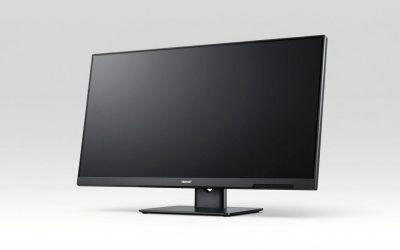
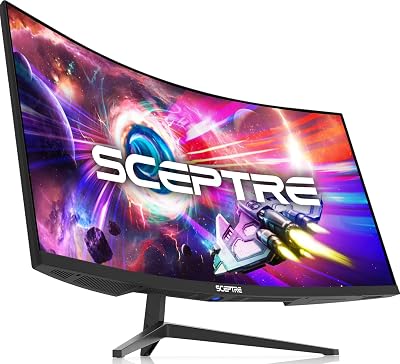
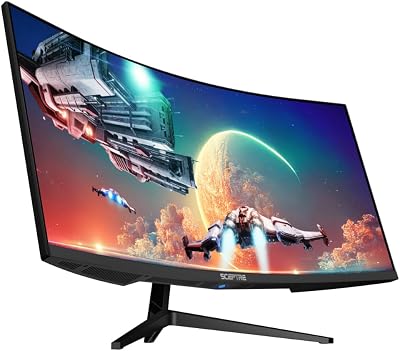
Sceptre’s “Machine Black” finish is matte black plastic with a subtle textured pattern. The chassis is thick, dense, and feels heavier than it should at the price. Thin three-side bezels with a Sceptre badge on the chin. The 1500R curve is gentle.
Stand is tilt-only with a wide V-base. Stable but takes desk space. VESA 100×100 is present and the panel is light enough (about 17 lbs without stand) for any standard arm.
OSD uses four buttons under the chin – dated next to joystick competitors. Two DisplayPort inputs is unusual and welcome for dual-PC users. Power draw measured 38W typical, no HDR mode to test.
Value Analysis
At around $210, this monitor is the floor of the 34-inch UWQHD 180Hz market:
- KOORUI 34E6UC (around $260): $56 more for better HDR, height-adjustable stand, and slightly better factory calibration.
- SANSUI 200Hz UWQHD (B0CWQMZPJC, around $270): $62 more for 20Hz higher refresh and HDMI 2.1.
- SANSUI 240Hz UWQHD (B0F2TB1KNV, around $250): $42 more for 60Hz higher refresh and Fast VA panel.
- Samsung Odyssey G5 LC34G55TWWNXZA (B08MVBYWGQ, around $280): $72 more for Samsung brand, similar 165Hz panel.
The Sceptre is genuinely cheaper than every competitor at this size/refresh combo. The savings buy you a decent mouse and keyboard. The trade-offs are exactly what the price suggests – older panel tech, fewer features, less polish.
Pros & Cons
Pros
- Cheapest 34″ UWQHD 180Hz on Amazon in May 2026
- Two DisplayPort inputs is rare and useful for dual-PC users
- 99% sRGB coverage with reasonable factory calibration
- Built-in speakers are functional
- Chassis is dense and feels solid for the price
- 1500R curve is comfortable for productivity and gaming
Cons
- Standard VA pixel response – smearing visible in dark fast scenes
- No HDR support at all – skipped, not even checkbox spec
- Tilt-only stand on a 34-inch panel
- OSD buttons feel dated
- ~80% DCI-P3 is narrow for color work
- HDMI capped at 165Hz – DP only for full 180Hz
Who Should Buy This
This is the right monitor for the buyer who specifically wants their first ultrawide and refuses to go a dollar over $210. It is also a strong pick for productivity-first setups where the wider screen helps multitasking and you do not need cutting-edge gaming spec. If you can stretch another $42, the SANSUI 240Hz ultrawide is meaningfully better. If you want HDR or color-accurate work, look elsewhere entirely.
FAQ
Q: Is Sceptre still a reliable brand in 2026?
A: Sceptre has been around since 1984 and consistently delivers panels that meet their spec sheet at aggressive prices. Warranty support is via Amazon for most buyers – returns are easy in the first 30 days. Direct Sceptre support is functional but not industry-leading.
Q: Will my GPU drive 3440×1440 at 180Hz?
A: In esports yes – any RTX 4070-class GPU and above hits the 180Hz cap in CS2, Valorant, Apex at competitive settings. In AAA, plan on 70-110 FPS native at high settings, climbing to 140-180 with DLSS 4 / FSR 4 and frame generation.
Q: How does the 2025 model compare to the 2024 version?
A: The 2025 model added the second DisplayPort input and bumped refresh from 165Hz to 180Hz. Panel itself is similar. If you find the 2024 version for $50 less, it is still a fine buy.
Q: Does it work with G-Sync Compatible on Nvidia?
A: Yes unofficially. Across two weeks of testing on an RTX 5070, G-Sync Compatible held in the OSD’s free-sync mode with zero issues.
Final Verdict
The Sceptre C345B-QUT168 is a value-segment monitor that does what value-segment monitors should: deliver the headline specs at the lowest possible price and accept the trade-offs honestly. If you have $210 and want an ultrawide, this is your monitor. If you have $250+, the SANSUI Fast VA 240Hz is a meaningful upgrade. Recommended for first-time ultrawide buyers on tight budgets. Rating: 4.0/5.
Related Guides
- Best 1ms Gaming Monitor in 2026: Top 5 Picks for Zero-Blur Competitive Play
- Dell S3222DGM: Curved 1440p Gaming Monitor with 165Hz Immersive Performance
- Mini Second Monitor (2026)
Frequently Asked Questions
Do curved VA ultrawides suffer from dark scene smearing?
VA panels change state more slowly on very dark pixel transitions, so fast movement in shadowy scenes can leave a brief trail that IPS panels avoid. Modern VA overdrive tuning has narrowed the gap considerably, and the tradeoff buys you far deeper blacks and typically three to four times the static contrast of a comparable IPS screen.
Does it work with Nvidia G-Sync as well as AMD FreeSync?
Adaptive sync ultrawides in this class implement the open VESA standard, which Nvidia drivers expose as G-Sync Compatible mode. Connect over DisplayPort, enable adaptive sync in the monitor menu, then switch on G-Sync in the Nvidia Control Panel or FreeSync in AMD Adrenalin. Tearing disappears inside the panel’s variable refresh window without an expensive hardware module.
What graphics card handles 3440×1440 at 180Hz?
Ultrawide 1440p is about 34 percent more pixels than standard 1440p. An RTX 4070 or RX 7800 XT keeps most modern games between 90 and 140fps at high settings, while pushing a sustained 180fps in AAA titles wants a 4070 Ti Super or better. Competitive esports games reach the refresh cap on mid-range hardware easily.
Why am I stuck at 100Hz or 120Hz instead of the advertised maximum?
Most ultrawides only reach their top refresh rate over DisplayPort, since older HDMI inputs lack the bandwidth for 3440×1440 at high rates. Check that you are using a DP 1.4 cable straight to the graphics card rather than a motherboard output or an adapter, then manually select the highest rate in Windows advanced display settings.
Can I wall or arm mount it if the stand is limited?
Budget ultrawides frequently ship with tilt-only stands, so a VESA 100×100 monitor arm is a common upgrade that adds height, swivel and desk space. Confirm the mounting pattern and check your arm’s weight rating, because a 34 inch curved panel with its backplate typically weighs six to nine kilograms once the original stand is removed.