- Top Pick: NETGEAR Nighthawk Tri-Band WiFi 6E Router (RAXE300) – Security Features, AXE7800 Wireless Gigabit Speed (Up to 7.8Gbps), New 6GHz Band, 8-Streams Cover up to 2,500 sq. ft., 40 Devices
- Best Value: NETGEAR Nighthawk WiFi 6E Router (RAXE300) | AXE7800 Tri-Band Wireless Gigabit Speed (Up to 7.8Gbps) | New 6GHz Band | 8-Streams Cover up to 2,500 sq. ft, 40 Devices (Renewed)
- Premium Choice: NETGEAR Nighthawk WiFi 6 Router (RAX120) 12-Stream Dual-Band Gigabit Router, AX6000 Wireless Speed (Up to 6 Gbps), Coverage Up to 3,500 sq.ft. and 30 Devices
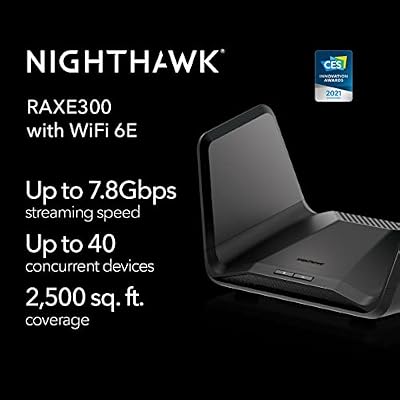
The NETGEAR Nighthawk RAXE300 is a tri-band WiFi 6E router built around an AXE7800 class, NETGEAR Armor security and multi-gig wired networking, at an asking price around $289. It sits above the dual-band RAX120 in NETGEAR’s range by adding the 6 GHz band, and is aimed at households with newer WiFi 6E-capable client devices that can take advantage of the extra spectrum. This Nighthawk RAXE300 review covers the WiFi standard, range, ports, gaming features and overall value, and explains how it compares with the WiFi 7 routers also covered in this guide.
- NETGEAR Nighthawk RAXE300 at a Glance
- WiFi Standard and Speed Class
- Range, Coverage and Mesh Capability
- Ports, USB and Wired Backhaul
- Gaming Latency, QoS and Security Features
- Who Is the Nighthawk RAXE300 For?
- Pros and Cons
- Is the Nighthawk RAXE300 Worth It?
- Frequently Asked Questions
- More Gaming Router Reviews
- Related Articles
- Related Articles
- Related Guides

NETGEAR Nighthawk Tri-Band WiFi 6E Router (RAXE300) - Security Features, AXE7800 Wireless Gigabit Speed (Up to 7.8Gbps), New 6GHz Band, 8-Streams Cover up to 2,500 sq. ft., 40 Devices




As an Amazon Associate we earn from qualifying purchases. Product prices and availability are accurate as of the date/time indicated.
🛒 Best Price Today on Amazon
Prime members get fast, free shipping on everything above, plus member-only deals. New members get a 30-day free trial — cancel anytime.
As an Amazon Associate we earn from qualifying purchases.


NETGEAR Nighthawk RAXE300 at a Glance
| Component | Specification |
|---|---|
| WiFi standard | WiFi 6E (802.11ax with 6 GHz) |
| Band class | AXE7800 |
| Bands | Tri-band (2.4 GHz + 5 GHz + 6 GHz) |
| Coverage | Large homes |
| WAN port | Multi-Gig |
| LAN ports | Gigabit |
| USB | Yes |
| Mesh-capable | Yes |
| Price | Around $289 |
WiFi Standard and Speed Class
The Nighthawk RAXE300 is a WiFi 6E router, which means it adds the 6 GHz band on top of the familiar 2.4 GHz and 5 GHz radios found on standard WiFi 6 hardware. Its AXE7800 class pools roughly 7.8 Gbps of theoretical throughput across the three radios, with the 6 GHz band carrying a substantial share. With more than 2,990 customer reviews on Amazon, the RAXE300 is one of the best-vetted WiFi 6E routers from NETGEAR — buyers can be confident the hardware is well supported.
The practical benefit of 6 GHz is reduced airtime contention because the band is largely free of older WiFi 4 and WiFi 5 traffic, which improves real-world latency for compatible WiFi 6E client devices. That airtime headroom is especially relevant in dense apartment buildings, where neighbours’ WiFi networks can crowd the 2.4 GHz and 5 GHz bands and raise the noise floor. For households with newer WiFi 6E phones, laptops or handhelds the RAXE300 is a meaningful step up over a dual-band WiFi 6 router such as the RAX120 covered earlier in this guide — see also our best WiFi 6E routers guide.
Range, Coverage and Mesh Capability
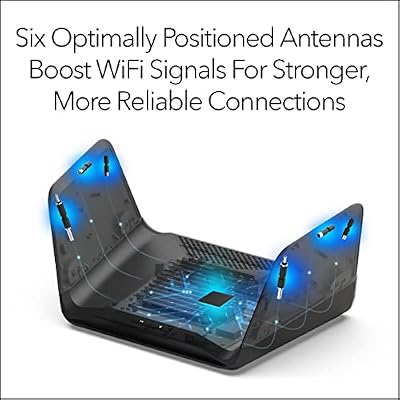
The RAXE300 is built for large homes, with internal antennas and amplifiers tuned for whole-home coverage. As with all WiFi 6E hardware, the 6 GHz band has a slightly shorter effective range than 5 GHz in the same conditions, so it is best understood as a clean band for nearby compatible devices — typical home use mixes 6 GHz for those devices with 5 GHz for the rest of the network.
The internal-antenna design also keeps the router visually tidier than older Nighthawk models with the familiar angular external-antenna look. The RAXE300 supports NETGEAR’s mesh ecosystem to extend coverage further. For very large multi-floor homes a dedicated mesh kit remains the cleaner starting point — see our best mesh WiFi systems guide.
Ports, USB and Wired Backhaul
The wired layout on the RAXE300 includes a multi-gig WAN port for modern broadband plans and Gigabit LAN ports for wired clients, plus USB connectivity for shared storage and printer use. The multi-gig WAN is the key practical detail: it means the router does not bottleneck a 2.5 Gbps or faster broadband plan on the way in, even if individual LAN clients are limited to Gigabit.
For gamers, a wired Gigabit LAN connection between the router and a gaming PC or console remains the most effective way to keep latency low and consistent, even on a WiFi 6E router. The combination of multi-gig WAN plus Gigabit LAN is a sensible compromise at this price: most home gaming devices still ship with Gigabit Ethernet ports, so the LAN-side Gigabit limit is rarely felt in practice.
Gaming Latency, QoS and Security Features
WiFi 6E reduces wireless latency for compatible client devices because the 6 GHz band is far less crowded than the legacy 2.4 GHz and 5 GHz radios. The Nighthawk RAXE300 pairs that with NETGEAR’s Nighthawk app, QoS controls and the NETGEAR Armor security feature set, which is one of the more comprehensive consumer security offerings in the router market.
Combined with multi-gig WAN that is a strong networking package for a household where gaming sits alongside heavy streaming, work-from-home and smart-home traffic. Some NETGEAR Armor advanced features require a subscription, but the base security monitoring and parental controls are included with the router and are enough for most households. For wider context, see our low-latency gaming network guide.
Who Is the Nighthawk RAXE300 For?
The Nighthawk RAXE300 is for the buyer who wants tri-band WiFi 6E hardware from NETGEAR with strong security software, multi-gig WAN and a mature management app. If you live in a larger home, you have new WiFi 6E-capable client devices, and you value NETGEAR Armor and the Nighthawk app, the RAXE300 is squarely your router.
Versus the dual-band RAX120 reviewed earlier, the RAXE300 trades the 12-stream design for a true tri-band radio and 6 GHz spectrum — the better deal for households with WiFi 6E client devices, but a sideways move for households still on WiFi 6 hardware. It is not the right pick if you specifically need WiFi 7 features such as MLO and 320 MHz channels — for those buyers, see the BE550 or BE400 reviews earlier in this guide, or our best WiFi 7 routers guide.
Pros and Cons
Pros: True tri-band WiFi 6E with 6 GHz spectrum; AXE7800 class; multi-gig WAN port; USB for storage and printer sharing; NETGEAR Armor security; mature Nighthawk app; large body of positive customer reviews.
Cons: Not WiFi 7 — no MLO or 320 MHz channels; LAN ports remain Gigabit; premium price; some NETGEAR security features may require a subscription.
Is the Nighthawk RAXE300 Worth It?
At around $289 the NETGEAR Nighthawk RAXE300 is a strong choice for buyers who want a tri-band WiFi 6E router from NETGEAR with comprehensive security and management software. The combination of AXE7800 WiFi 6E, multi-gig WAN, USB and NETGEAR Armor covers the needs of a large modern household well, especially in homes with WiFi 6E-capable phones, laptops and consoles that can take advantage of the 6 GHz band for low-latency wireless connections.
Buyers who specifically need WiFi 7 should step up to a BE-class router; for everyone else who values the NETGEAR ecosystem it earns a recommendation. Versus the RAX120 above, the RAXE300 trades the 12-stream dual-band radio for true tri-band WiFi 6E — for households with WiFi 6E client devices that is usually the better deal. See also our best gaming routers guide.
Frequently Asked Questions
Is WiFi 6E worth it on a NETGEAR Nighthawk router?
Yes, on compatible devices. The 6 GHz band is far less congested than 2.4 GHz and 5 GHz, which lowers wireless latency and raises real-world throughput on WiFi 6E client devices.
Does the Nighthawk RAXE300 include security software?
Yes. It supports the NETGEAR Armor security feature set, which monitors connected devices for threats. Advanced features may require a subscription.
Does the RAXE300 have a multi-gig WAN port?
Yes. It includes a multi-gig WAN port for modern broadband plans, although individual LAN ports remain Gigabit.
Does the RAXE300 support WiFi 7?
No. The RAXE300 is a WiFi 6E router and does not include WiFi 7 features such as MLO or 320 MHz channels.
More Gaming Router Reviews
- NETGEAR Nighthawk RS90 WiFi 7 Router Review (BE3600)
- Amazon eero Pro 6E Mesh WiFi Router Review
- Amazon eero 7 Dual-Band Mesh WiFi 7 Router Review
- ASUS RT-AX82U Gaming Router Review (AX5400)
- TP-Link Archer AX21 WiFi 6 Router Review (AX1800)
- TP-Link Archer AX55 WiFi 6 Router Review (AX3000)
- TP-Link Archer AXE75 WiFi 6E Router Review (AXE5400)
- TP-Link Archer BE550 WiFi 7 Router Review (BE9300)
Affiliate Disclosure: As an Amazon Associate, we earn from qualifying purchases. If you click a link and make a purchase, we may earn a small commission at no extra cost to you. Prices and availability are accurate as of publication and may change.
Related Articles
Looking for more on this topic? Browse the hand-picked guides below — each one applies the same scoring rubric used in this review.