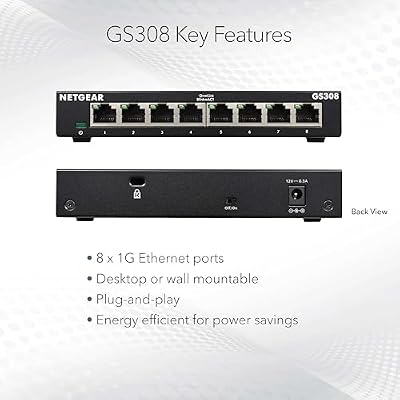
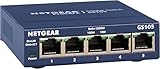
The NETGEAR GS308 is NETGEAR’s 8-port unmanaged gigabit switch — the direct counterpart to TP-Link’s TL-SG108 and one of the most popular small switches on the market. At around $35 it is genuinely affordable, and it brings NETGEAR’s networking pedigree into a sturdy steel-cased, silent, plug-and-play box. This NETGEAR GS308 review covers the specifications, real-world performance and value.

NETGEAR 8-Port Gigabit Ethernet Unmanaged Network Switch (GS308) | Home Network Hub, Office Ethernet Splitter, Plug-and-Play, Silent Operation, Desktop or Wall Mount, Essentials Model



As an Amazon Associate we earn from qualifying purchases. Product prices and availability are accurate as of the date/time indicated.
🛒 Best Price Today on Amazon
Prime members get fast, free shipping on everything above, plus member-only deals. New members get a 30-day free trial — cancel anytime.
As an Amazon Associate we earn from qualifying purchases.



NETGEAR GS308 at a Glance
| Component | Specification |
|---|---|
| Port count | 8 ports |
| Port speed | 10/100/1000 Mbps (Gigabit Ethernet) |
| Switching capacity | 16 Gbps non-blocking |
| Management | Unmanaged (plug-and-play) |
| PoE support | No |
| SFP uplinks | None |
| Form factor | Desktop / wall-mount, steel case |
| Cooling | Fanless (silent) |
| Approx price | around $35 |
Throughput & Real-World Speed
The GS308 is a true gigabit switch — every one of its eight ports runs at 1 Gbps full-duplex, with a 16 Gbps non-blocking switching fabric so every port can run at full gigabit simultaneously without internal bottlenecks. In real-world use, gigabit is more than enough for online gaming (a few megabits per second) and is the practical ceiling for typical NAS file transfers at about 117 MB/s, or roughly seven seconds per gigabyte. For households with a gaming PC, a console, a smart TV, a streaming box, a NAS and a couple of other wired devices, the GS308 simply works: every device gets its own wired port and the latency-sensitive ones get the stable, predictable connection that WiFi cannot guarantee. Port-to-port latency on a switch like this is sub-millisecond, which is a fundamentally different experience to even a strong WiFi link where retransmissions and roaming events can introduce visible jitter in competitive games. For the wider network basics, see our low-latency gaming network guide.
Managed vs Unmanaged Capabilities
The GS308 is fully unmanaged — no web interface, no VLAN, no QoS, no monitoring. That is the point: at $35 it is the simplest possible eight-port network upgrade, and there is nothing to learn, nothing to configure and nothing that can break on first power-on. NETGEAR’s GS308E adds basic web management for the user who needs VLANs or QoS, and the GS308T is the fully managed step up with a richer L2 feature set. For most homes and small offices that simply need more wired ports, the unmanaged GS308 is the right answer — there is nothing to configure or break, and the higher-tier features are useful only if you actually plan to use them.
PoE Power for IP Cameras / APs
The base GS308 does not provide PoE. For powering access points or IP cameras you need either an inline PoE injector each, or a PoE-capable switch. NETGEAR’s GS308P and GS308PP variants add PoE+ on selected ports — those are the right choices for a small camera or AP install, since a single PoE switch is tidier than retrofitting injectors. For the typical home network of PCs, consoles, smart TVs and a NAS, the base GS308’s lack of PoE is not a concern, but it is worth considering whether any future device (a ceiling-mounted WiFi access point, for example) might want PoE before settling on the non-PoE model.
Build Quality, Heat & Noise
NETGEAR uses a sturdy steel case for the GS308, the same construction philosophy as the smaller GS305 — it helps with heat dissipation, gives the unit weight to stay put on a desk, and feels durable in the hand. The switch is completely fanless and silent, which is ideal for a desk install in a home office, bedroom or living room where any fan noise would be intrusive. Even when several ports are pushing gigabit traffic simultaneously the switch runs only mildly warm to the touch. The chassis includes wall-mount holes for tidy installations behind a desk or in a media cabinet, keeping cable runs neat. The GS308 has been on the market a long time and has built a very large positive buyer-review base behind it. For matching the right cable, see our best Ethernet cables for gaming guide.
Best For – Gaming Home / SMB / Pro
The GS308 is a near-universal home switch. For the gamer with multiple PCs, consoles and streaming devices it is the obvious choice — eight reliable wired ports for the latency-sensitive devices in the household, eliminating WiFi variability for the connections that matter most. For a small office of a few desks plus a printer and a NAS, it is equally suitable. It is not for environments that need VLAN segmentation, monitoring or PoE, but at $35 it was never built for that role. Buyers who need only four wired ports should consider the GS305; those who need more should look at the GS316; those who need managed features should step up to the GS308E or GS308T variants. For the wider network, see our best gaming routers and best mesh WiFi systems guides.
Verdict
At around $35 the NETGEAR GS308 is an excellent value 8-port unmanaged gigabit switch and a default pick at this size. It is sturdy, silent, fully gigabit and plug-and-play, from a brand with deep networking roots — the natural rival to TP-Link’s TL-SG108 at near-identical price. Either is a sound choice; aesthetics, brand loyalty and local availability are usually the deciding factors. NETGEAR’s wider range gives easy upgrade paths to PoE or managed variants if needs grow over time. For the typical buyer who simply wants seven extra wired ports behind a router, the GS308 is the default answer and it does exactly what is asked of it. For the wireless side of the network, see our best WiFi 7 routers guide.
Frequently Asked Questions
How many ports does the NETGEAR GS308 have?
It has 8 gigabit Ethernet ports, all running at 10/100/1000 Mbps with a 16 Gbps non-blocking switching fabric.
Is the GS308 a managed switch?
No. The base GS308 is unmanaged. NETGEAR offers the GS308E (web-managed) and GS308T (fully managed) variants for users who need management.
Does the NETGEAR GS308 have a fan?
No. The GS308 is fully fanless and silent — well suited to a home office, bedroom or living room desk install.
Should I buy the NETGEAR GS308 or the TP-Link TL-SG108?
Both are excellent at the same price. Performance and reliability are very similar; aesthetic, brand loyalty and local stock are usually the deciding factors.
More Network Switch Reviews
- NETGEAR GS316 Review: 16-Port Gigabit Switch (2026)
- TP-Link TL-SG105E Review: 5-Port Easy Smart Switch (2026)
- D-Link DGS-105 Review: 5-Port Gigabit Switch (2026)
- TP-Link SG2428LP Review: 24-Port PoE+ Gigabit Switch (2026)
- Tenda 8-Port 2.5G Switch Review: Multi-Gigabit Network (2026)
- TP-Link TL-SG108 Review: 8-Port Gigabit Switch (2026)
- TP-Link TL-SG105 Review: 5-Port Gigabit Switch (2026)
- TP-Link TL-SG116 Review: 16-Port Gigabit Switch (2026)
Affiliate Disclosure: As an Amazon Associate, we earn from qualifying purchases. If you click a link and make a purchase, we may earn a small commission at no extra cost to you. Prices and availability are accurate as of publication and may change.
Related Articles
Looking for more on this topic? Browse the hand-picked guides below — each one applies the same scoring rubric used in this review.