

- Top Pick: Tenda 5 Port PoE Switch, Ethernet Switch 4 Port PoE+@63W & Gigabit Uplink
- Best Value: Tenda 5 Port Gigabit Ethernet Switch, Desktop Ethernet Splitter Plug & Play
- Premium Choice: 5 Port 10Gb RJ45 Web Managed Ethernet Network Switch, 5 x 10 Gigabit Base-T Port | 10Gbps Multi-Gig Swicth Support 5G-2.5G-1G-100M | 19 Inch Rack Mount | 100G Bandwidth | Metal Casing | Built-in Fan
The Tenda 8-Port 2.5G Ethernet Switch is a budget-friendly entry into multi-gigabit networking — an unmanaged eight-port switch with every port running at up to 2.5 Gbps. Tenda undercuts the well-known names by a meaningful margin on this category, which makes the switch interesting for buyers upgrading from gigabit on a tight budget. This Tenda 8-port 2.5G review covers the specifications, performance and value.

Tenda 2.5Gb Switch, 8 Port Multi-Gigabit Unmanaged Ethernet Switch 2.5Gb


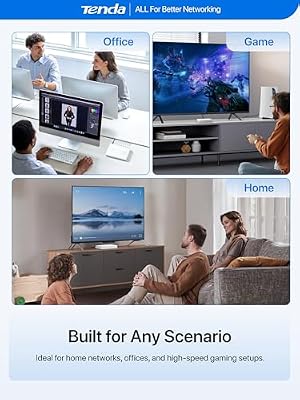


As an Amazon Associate we earn from qualifying purchases. Product prices and availability are accurate as of the date/time indicated.
🛒 Best Price Today on Amazon
Prime members get fast, free shipping on everything above, plus member-only deals. New members get a 30-day free trial — cancel anytime.
As an Amazon Associate we earn from qualifying purchases.


Tenda 8-Port 2.5G at a Glance
| Component | Specification |
|---|---|
| Port count | 8 ports |
| Port speed | 100M / 1G / 2.5G Multi-Gigabit |
| Switching capacity | 40 Gbps non-blocking |
| Management | Unmanaged (plug-and-play) |
| PoE support | No |
| SFP uplinks | None |
| Form factor | Desktop / wall-mount, steel case |
| Cooling | Fanless (silent) |
| Approx price | around $80 (budget alternative) |
Throughput & Real-World Speed
Every port on the Tenda 8-port 2.5G switch runs at up to 2.5 Gbps, which is 2.5x the gigabit Ethernet ceiling and translates to roughly 280 MB/s of sustained transfer on a 2.5G end-to-end link. The 40 Gbps non-blocking switching fabric means every port can run at 2.5G simultaneously without internal bottlenecks. To achieve those speeds in the real world the rest of the chain must keep up: a 2.5G-capable NIC, a 2.5G NAS port or 2.5G access point uplink, and a CAT5e or CAT6 cable in good condition. The switch auto-negotiates each port to the best common speed, so mixed-speed deployments of 2.5G clients and legacy gigabit ones work fine, with legacy devices simply dropping to 1G. For the network basics, see our low-latency gaming network guide.
Managed vs Unmanaged Capabilities
The Tenda 2.5G switch is fully unmanaged — no web interface, no VLAN, no QoS. That keeps the cost down, which is the main selling point at this price. For most home users upgrading from gigabit, an unmanaged 2.5G switch is the right answer: you want more speed without learning a new management interface. If the deployment needs VLAN segmentation or QoS, the buyer has to step up to a managed 2.5G switch, which is markedly more expensive across all brands. For straightforward home use, the Tenda’s simplicity is a strength.
PoE Power for IP Cameras / APs
The Tenda 8-port 2.5G switch does not include PoE. For powering a Wi-Fi 7 access point or 2.5G IP camera over the Ethernet cable you would need an inline PoE injector each, or a PoE-capable 2.5G switch. As with the TP-Link SG108S-M2, this is a known limitation of basic multi-gigabit switches at this price — PoE multi-gigabit switches cost notably more. For a desk install of a 2.5G PC, a 2.5G NAS and a 2.5G uplink to the router, the unmanaged non-PoE Tenda is the right tool.
Build Quality, Heat & Noise
Tenda houses the switch in a steel case, the appropriate choice for a multi-gigabit unit — the higher port speeds run noticeably warmer than gigabit silicon, and the metal shell aids heat dissipation. The switch is fanless and silent. Tenda is less well-known internationally than TP-Link or NETGEAR but has been a reliable budget network-equipment brand for many years; buyer feedback on this model is generally favourable on the value-versus-name-brand trade. As with any 2.5G install, pair the switch with CAT5e or CAT6 in good condition — see our best Ethernet cables for gaming guide for cable choice.
Best For – Gaming Home / SMB / Pro
The Tenda 8-port 2.5G is for the home user who wants multi-gigabit speed at the lowest credible price. For a setup with a 2.5G NAS, a 2.5G NIC and a 2.5G WiFi 7 access point, the Tenda delivers identical raw capability to a TP-Link SG108S-M2 at a lower price. For gaming specifically, the upgrade from gigabit is more about future-proofing than necessity — online games don’t need 2.5G. For a small office on a budget it is a reasonable pick. It is not suitable for environments that need PoE or VLAN segmentation. For pairing gear, see our best NAS for home and small office.
Verdict
At around $80 (and often less) the Tenda 8-port 2.5G switch is a strong budget option for the home user moving beyond gigabit. It delivers the same core capability — 8 ports of 2.5GbE, non-blocking fabric, unmanaged simplicity, fanless silent operation — as the name-brand rivals at a meaningfully lower price. The trade-off is the less-known brand name; buyers who prefer TP-Link or NETGEAR will spend a little more for that comfort. For the price-conscious upgrader, it is an easy recommendation. For the wireless side of the upgrade, see our best WiFi 7 routers guide.
Frequently Asked Questions
Is the Tenda 8-port 2.5G switch reliable?
Yes, Tenda has been a reliable budget network equipment brand for many years and this model has generally favourable buyer feedback. The brand is less well-known than TP-Link or NETGEAR internationally but performs well.
Does it support PoE?
No. The Tenda 8-port 2.5G switch does not provide PoE. For PoE-required devices, choose a PoE-capable multi-gigabit switch or use inline PoE injectors.
Do I need new cables to use 2.5G?
Usually no. CAT5e in good condition is sufficient for 2.5GbE at typical home distances; CAT6 or CAT6a is the future-proof choice.
How does the Tenda compare to the TP-Link TL-SG108S-M2?
Raw capability is essentially identical — 8 ports of 2.5GbE, unmanaged, fanless. The Tenda is meaningfully cheaper, while the TP-Link offers a more established international brand and support network.
More Network Switch Reviews
- TP-Link TL-SG108 Review: 8-Port Gigabit Switch (2026)
- TP-Link TL-SG105 Review: 5-Port Gigabit Switch (2026)
- TP-Link TL-SG116 Review: 16-Port Gigabit Switch (2026)
- TP-Link TL-SG105S-M2 Review: 5-Port 2.5G Switch (2026)
- TP-Link TL-SG108S-M2 Review: 8-Port 2.5G Switch (2026)
- NETGEAR GS305 Review: 5-Port Gigabit Switch (2026)
- NETGEAR GS308 Review: 8-Port Gigabit Switch (2026)
- NETGEAR GS316 Review: 16-Port Gigabit Switch (2026)
Affiliate Disclosure: As an Amazon Associate, we earn from qualifying purchases. If you click a link and make a purchase, we may earn a small commission at no extra cost to you. Prices and availability are accurate as of publication and may change.
Related Articles
Looking for more on this topic? Browse the hand-picked guides below — each one applies the same scoring rubric used in this review.
Ready to decide? Our #1 pick for 2026 is the Port count.
Live price & availability on Amazon.


