- Top Pick: GAMINJA Ai Mouse with Voice Typing & ChatGPT Assistant,Smart Mouse Multi Language Voice to Text Recorder Ergonomic Wireless BT Mouse 600mAH for Computer,PC,Laptop,2026 Upgraded (Upgrade BK)
- Best Value: GAMINJA Ai Mouse with Voice Typing & ChatGPT Assistant,Smart Mouse Multi Language Voice to Text Recorder Ergonomic Silent Wireless BT Mouse 600mAH for Computer,PC,Laptop,2026 Upgraded(Grey)
- Premium Choice: Virtusx Jethro Wireless AI Mouse with Voice Typing & Meeting Recording
Building with AI is mostly a desk-bound endurance sport. You spend hours iterating on prompts, wiring up APIs, reading documentation, scrolling through long generations and tweaking code in an IDE — and the mouse is the tool your hand rests on the entire time. There is no such thing as a dedicated ‘AI mouse,’ and any honest guide should say so up front: what AI developers actually need is a comfortable, accurate, programmable everyday mouse that holds up over marathon experimentation sessions. This guide rounds up the best mouse for AI work in 2026 with exactly that in mind.
- Best Mouse for AI at a Glance
- 1. Amazon Basics 3-Button USB Wired Mouse with Responsive Tracking
- 2. TECKNET 2.4G Ergonomic Optical Wireless Mouse for Laptop
- 3. Uiosmuph G12 Slim Rechargeable Silent Wireless Mouse
- 4. Logitech G502 Hero High Performance Wired Gaming Mouse
- 5. Logitech M185 Wireless Mouse with USB Mini Receiver
- 6. Logitech G305 Lightspeed Wireless Gaming Mouse, 12,000 DPI HERO
- How to Choose a Mouse for AI Work
- Frequently Asked Questions
- Related Guides
- Related Articles
Our picks were chosen on the things that genuinely help an AI workflow: all-day comfort, the kind of quiet clicking that does not annoy a shared office or a video call, programmable buttons you can map to IDE and notebook shortcuts, and accurate tracking across multiple monitors as you flip between a prompt window, a terminal and a docs tab. We have included a deliberate spread — from an around $7 plug-and-play wired mouse to an around $36 lightweight wireless gaming mouse with a top-tier sensor — because the best mouse for AI is the one that fits your hand, your desk and your budget. Below is an at-a-glance comparison of all six, then a closer look at each and a buyer’s guide built around comfort, buttons, noise and precision.
As an Amazon Associate we earn from qualifying purchases at no extra cost to you.


🛒 Best Price Today on Amazon
Prime members get fast, free shipping on everything above, plus member-only deals. New members get a 30-day free trial — cancel anytime.
Best Mouse for AI at a Glance
| Mouse | Best For | Standout Spec | Approx Price |
|---|---|---|---|
| Amazon Basics 3-Button USB Wired Mouse | Plug-and-play reliability | Wired USB, responsive tracking | around $7 |
| TECKNET 2.4G Ergonomic Wireless Mouse | All-day comfort on a budget | Ergonomic shape, 2.4G wireless | around $10 |
| Uiosmuph G12 Slim Silent Rechargeable | Quiet shared-office clicks | Silent clicks, rechargeable | around $10 |
| Logitech G502 Hero | IDE & notebook shortcuts | 11 programmable buttons, HERO 25K | around $32 |
| Logitech M185 Wireless Mouse | Simple wireless workhorse | 12-month battery, plug-and-play | around $14 |
| Logitech G305 Lightspeed | Precise multi-monitor wireless | LIGHTSPEED, 12,000 DPI HERO | around $36 |
1. Amazon Basics 3-Button USB Wired Mouse with Responsive Tracking
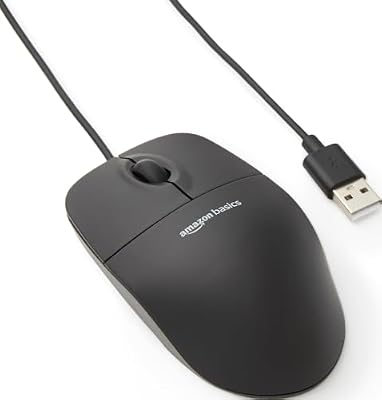
Amazon Basics 3-Button USB Wired Mouse with Responsive Tracking, Plug & Play, Compatible with Windows and Mac, Black


As an Amazon Associate we earn from qualifying purchases. Product prices and availability are accurate as of the date/time indicated.
The Amazon Basics 3-Button wired mouse is the plug-and-play starting point for an AI workstation. It is exactly what it sounds like: a simple corded USB mouse with responsive optical tracking, left and right buttons and a clickable scroll wheel. At around $7 it is the cheapest pick here, and for a developer who just wants a dependable pointer that never needs charging or pairing, that simplicity is the whole appeal.
This is the mouse to choose when reliability beats features. AI experimentation often happens on a machine you leave running for hours, and a wired mouse means zero latency, no batteries to die mid-session, and instant recognition on any computer you plug it into. The three-button layout covers scrolling through long model outputs and documentation comfortably. It will not map macros or fly across three monitors, but as a no-fuss default for a focused dev desk, it does its job without ever getting in the way.
Pros: Wired and instant, never needs charging, responsive tracking, rock-bottom price.
Cons: No extra buttons or macros; basic shape for very long sessions.
2. TECKNET 2.4G Ergonomic Optical Wireless Mouse for Laptop

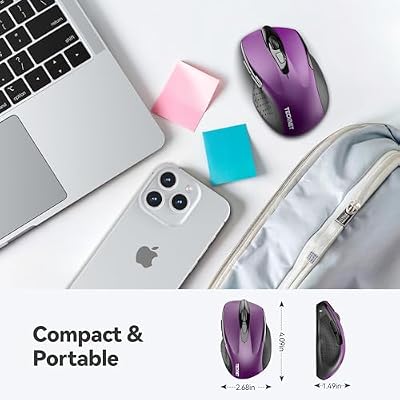
TECKNET Wireless Mouse, 2.4G Ergonomic Computer Mouse, 2600 DPI, Purple | Ergonomic Design with Side Grips, Adjustable DPI, 2-Year Battery, Compact Size, USB-A Plug & Play, Wide OS Compatibility


As an Amazon Associate we earn from qualifying purchases. Product prices and availability are accurate as of the date/time indicated.
The TECKNET 2.4G wireless mouse is the budget comfort pick for AI work. It wraps an optical sensor in a contoured, ergonomic shell designed to support the hand, connects over a tidy 2.4G nano receiver, and offers adjustable DPI for a cursor speed that suits dense code and documentation. At around $10 it delivers genuine all-day comfort without stretching the budget.
This is the mouse for the developer who spends long, continuous hours prompting, reading and lightly coding, and wants a shape that stays comfortable rather than the bare minimum. The ergonomic contour eases wrist and palm strain over marathon experimentation sessions, the wireless receiver keeps the desk clean, and the adjustable DPI lets you slow the cursor for precise edits or speed it up to cross a wide display. For affordable, comfortable, cable-free AI work, the TECKNET is a smart, low-cost choice.
Pros: Ergonomic comfort for long sessions, 2.4G wireless, adjustable DPI, very affordable.
Cons: Basic sensor; not built for high-precision gaming-style tracking.
3. Uiosmuph G12 Slim Rechargeable Silent Wireless Mouse

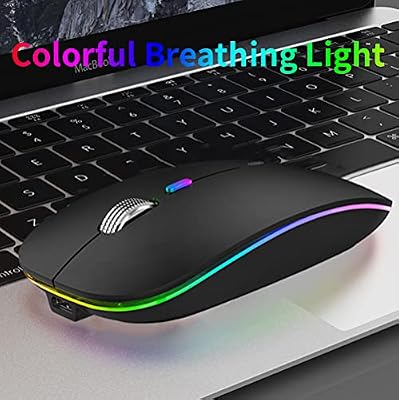
Uiosmuph LED Wireless Mouse, G12 Slim Rechargeable Silent Mouse Matte Black | 2.4GHz Optical, USB C Charging, Quiet Click, LED,Portable,1600DPI, USB Receiver,Type C Adapter, Compatible with PC,Laptop,Mac


As an Amazon Associate we earn from qualifying purchases. Product prices and availability are accurate as of the date/time indicated.
The Uiosmuph G12 is the quiet-office pick, and for AI developers who share a workspace or spend a lot of time on video calls, that matters more than it sounds. It is a slim, rechargeable 2.4G wireless mouse built around silent clicking — the buttons are noticeably muted compared with a standard mouse — with adjustable DPI and a built-in battery you top up over USB. At around $10 it makes peaceful clicking affordable.
This is the mouse to choose when you do not want every click broadcast to the room or picked up by your microphone during a meeting. AI work involves a lot of clicking — re-running cells, regenerating prompts, scrubbing through outputs — and silent switches keep that quiet in an open office or a recorded call. The rechargeable battery removes the hassle of swapping cells, the slim shape travels easily, and adjustable DPI handles multi-monitor cursor speed. For a quiet, tidy, rechargeable everyday mouse, the G12 fits an AI desk well.
Pros: Silent clicks for shared offices and calls, rechargeable, slim, adjustable DPI.
Cons: Slim profile suits lighter grips; sensor is everyday rather than elite.
4. Logitech G502 Hero High Performance Wired Gaming Mouse

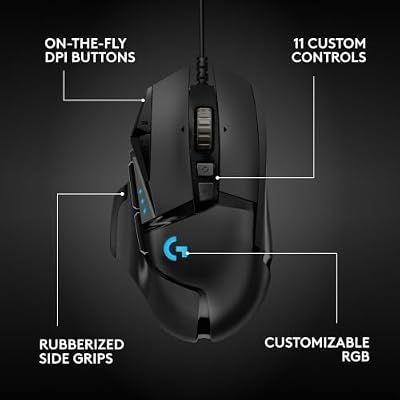
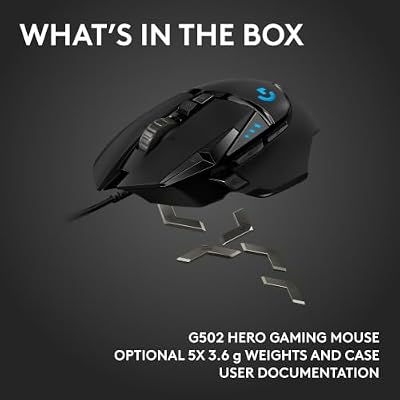
Logitech G502 Hero Wired Gaming Mouse - Black | High performance, 25,600 DPI, RGB, adjustable weights, 11 programmable buttons, on-board memory, PC/Mac





As an Amazon Associate we earn from qualifying purchases. Product prices and availability are accurate as of the date/time indicated.
The Logitech G502 Hero is the productivity-power pick for AI developers, and the reason is its eleven programmable buttons. While it is sold as a gaming mouse, that generous button bank is exactly what you want for mapping the IDE and notebook shortcuts you repeat all day — run cell, restart kernel, comment block, switch tab, copy, paste. Paired with the excellent HERO 25K sensor and tunable weights, at around $32 it is a serious workflow tool.
This is the mouse for the developer who wants to drive their editor and notebooks faster with the hand already on the mouse. Logitech’s G HUB software lets you bind those eleven buttons to keystrokes and macros and store profiles per application, so a single thumb press can run a notebook cell or trigger a build. The precise HERO sensor keeps the cursor exact across multiple monitors, and the wired link means no charging during a long session. For shortcut-heavy AI experimentation, the G502 Hero turns the mouse into a genuine productivity accelerator.
Pros: Eleven programmable buttons for IDE shortcuts, precise HERO 25K sensor, tunable weights.
Cons: Heavier and gamer-styled; wired only and overkill for light use.
5. Logitech M185 Wireless Mouse with USB Mini Receiver

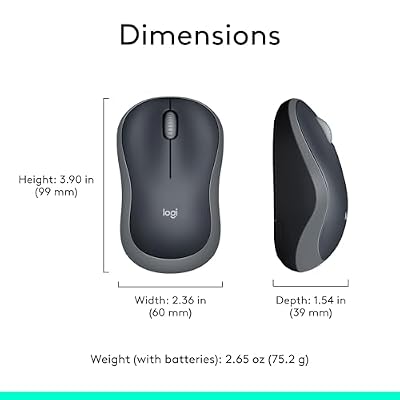
Logitech M185 Compact Ambidextrous 2.4 GHz Wireless Mouse - Swift Grey | Ambidextrous mouse with 2.4 GHz USB-A Nano Receiver, Optical Tracking, 12-Months Battery Life, PC, Mac, Laptop compatible




As an Amazon Associate we earn from qualifying purchases. Product prices and availability are accurate as of the date/time indicated.
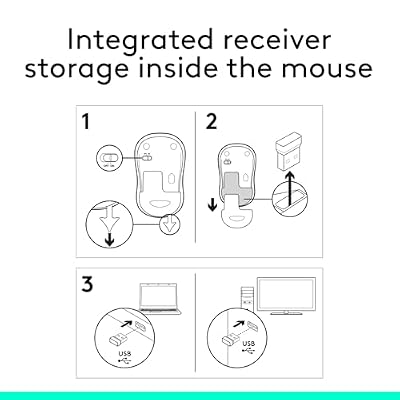
The Logitech M185 is the simple wireless workhorse of this list. It is a compact, dependable 2.4GHz wireless mouse with a USB mini receiver and a 12-month battery life on a single AA, from a brand known for reliable connections. At around $14 it is the no-drama wireless pick for an AI developer who wants something that just works and stays out of the way.
This is the mouse to choose when you want cable-free convenience without thinking about it. The year-long battery means you can forget about power for months at a time, the tiny receiver lives permanently in a USB port, and Logitech’s wireless is stable and snappy enough for code, documentation and prompt work. It has no programmable macro bank, but for a tidy, reliable everyday mouse that pairs instantly and runs for a year, the M185 is a trusted, sensible default for any dev desk.
Pros: Reliable Logitech wireless, year-long battery, tiny receiver, plug-and-play simplicity.
Cons: No programmable buttons; compact size suits smaller hands best.
6. Logitech G305 Lightspeed Wireless Gaming Mouse, 12,000 DPI HERO

Logitech G305 Lightspeed Wireless Gaming Mouse - Black | 12,000 DPI, Lightweight, 6 Programmable Buttons, 250h Battery, On-Board Memory, Compatible with PC and Mac


As an Amazon Associate we earn from qualifying purchases. Product prices and availability are accurate as of the date/time indicated.
Rounding out the list is the Logitech G305 Lightspeed, the precise wireless pick for a multi-monitor AI setup. It pairs Logitech’s LIGHTSPEED wireless — engineered to rival wired response — with the accurate HERO sensor (up to 12,000 DPI) in a light, clean shell. At around $36 it is the premium option here, and the one to pick when you want gaming-grade precision without a cable.
This is the mouse for the developer running two or three displays who wants the cursor to land exactly where they expect, every time, as they sweep between a prompt window, a terminal and a browser. The HERO sensor tracks precisely with no smoothing, LIGHTSPEED keeps that input fast and reliable without a tether, and the light weight makes long sessions of moving across a wide desktop effortless. Long battery life seals the convenience. For accurate, cable-free multi-monitor AI work, the G305 is the standout.
Pros: LIGHTSPEED wireless rivals wired, precise HERO sensor, lightweight, great multi-monitor accuracy.
Cons: Higher price here; minimal extra buttons compared with the G502.
How to Choose a Mouse for AI Work
Start with comfort, because AI work is long and continuous. Whether you are iterating on prompts, reading generations or wiring up code, your hand is on the mouse for hours, so an ergonomic, well-contoured shape like the TECKNET’s or a shell that fits your grip matters more than any spec sheet. A mouse that causes wrist or palm strain will sabotage a marathon experimentation session no matter how capable it is, so choose the shape your hand is happiest holding all day.
Programmable buttons are the feature that turns a mouse into an AI productivity tool. If you live in an IDE or a notebook, a mouse like the G502 Hero — with eleven buttons you can bind through G HUB — lets you run cells, restart kernels, switch tabs and fire macros without reaching for the keyboard. Decide honestly how many shortcuts you would actually use: a heavily mapped mouse is a real accelerator for repetitive dev actions, while a clean two- or three-button mouse is plenty if you mostly scroll and click.
Noise and connection are easy to overlook until they bite. If you share an office or spend time on calls, silent switches like the Uiosmuph G12’s keep your constant clicking from being broadcast to the room or your microphone. On connection, a wired mouse such as the Amazon Basics never needs charging and is instantly recognised, while modern wireless — the M185 for simple reliability or the G305’s LIGHTSPEED for precision — frees the desk; pick based on whether you value zero-maintenance or a clean, cable-free workspace.
Finally, weigh precision and budget against how you actually work. If you run multiple monitors and want the cursor to land exactly where you expect as you sweep across displays, an accurate sensor like the HERO units in the G305 and G502 earns its keep. If your workflow is lighter, an affordable, comfortable everyday mouse covers it for a fraction of the price. Be realistic — these are general productivity and gaming mice fit to an AI workflow, not specialised hardware — and pick the one on this list whose comfort, buttons, quietness or precision matches the way you build with AI.
Frequently Asked Questions
Is there such a thing as a dedicated AI mouse?
No, and any guide claiming otherwise is overselling. There is no special hardware that helps you build AI faster. What helps is a comfortable, accurate, programmable everyday mouse that holds up over long experimentation sessions. Every mouse in this guide is a general productivity or gaming mouse chosen for how well its comfort, buttons and tracking suit an AI developer’s desk, not for any AI-specific feature.
Why do programmable buttons matter for AI development?
Because AI work involves a lot of repeated actions — running notebook cells, restarting kernels, switching between a prompt window and an editor, copying outputs. A mouse like the Logitech G502 Hero lets you bind those to its eleven buttons through G HUB, so a single thumb press does what would otherwise be a keyboard reach or a menu dig. For shortcut-heavy experimentation, that adds up to real time saved across a day.
Are silent mice worth it for AI work?
If you share an office or spend time on video calls, yes. AI iteration means constant clicking — regenerating prompts, scrubbing outputs, re-running code — and a silent mouse like the Uiosmuph G12 keeps that from being broadcast to colleagues or picked up by your microphone. If you work alone in a quiet room, it is a nice-to-have rather than a necessity.
Wired or wireless for an AI workstation?
Both work well. A wired mouse like the Amazon Basics never needs charging and is recognised instantly on any machine, which suits an always-on dev box. Wireless keeps the desk tidy — the Logitech M185 for simple, year-long-battery reliability, or the G305 with LIGHTSPEED when you want precise tracking across monitors without a cable. Choose based on whether you prefer zero maintenance or a clean, cable-free workspace.
Related Guides
- Best Wireless Gaming Mouse
- Best Ergonomic Mouse
- Best Mouse for Programming
- Best Silent Mouse
- Best Mouse for CAD
- Best Budget Gaming Setup
Affiliate Disclosure: As an Amazon Associate, we earn from qualifying purchases. If you click a link and make a purchase, we may earn a small commission at no extra cost to you. Prices and availability are accurate as of publication and may change.