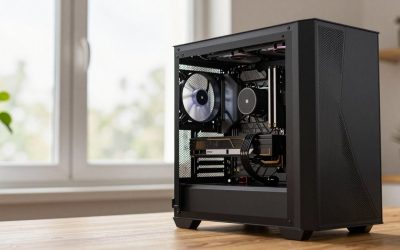
- Top Pick: ZOTAC MEK Gaming PC Desktop, GeForce RTX 5070 Ti 16GB, AMD Ryzen 7 9700X
- Best Value: GIGABYTE GeForce RTX 5070 Gaming OC 12G Graphics Card, 12GB 192-bit GDDR7, PCIe 5.0, WINDFORCE Cooling System, GV-N5070GAMING OC-12GD Video Card
- Premium Choice: ASUS SFF-Ready Prime NVIDIA GeForce RTX 5070 Ti 16GB GDDR7 OC Edition 16GB GDDR7 Graphics Card (PCIe 5.0, HDMI/DP 2.1, 2.5-Slot, Axial-tech Fans, Dual BIOS), 3 Year Warranty
As we navigate the ever-evolving landscape of PC gaming, the pursuit of flawless 4K performance remains a primary goal for many enthusiasts. With the release of NVIDIA’s latest generation of GPUs, the question on everyone’s mind is: can the RTX 5070 series truly deliver the high-fidelity, buttery-smooth 4K gaming experience we crave? This guide will break down the capabilities of the RTX 5070 and its Ti variant, helping you determine if it’s the right choice for your 4K gaming ambitions in 2026.
We’ll delve into the architectural advancements, VRAM considerations, and real-world performance benchmarks to provide a clear, trustworthy assessment. Whether you’re building a new rig or upgrading an existing one, understanding the RTX 5070’s place in the 4K gaming hierarchy is crucial for making an informed decision. Get ready to discover if this GPU is your ticket to a visually stunning and responsive 4K gaming future.
As an Amazon Associate we earn from qualifying purchases at no extra cost to you.





🎮 Get More From Your Setup — Free
Prime Gaming gives you free PC games every month, in-game loot, and a free Twitch sub — plus fast free shipping on the gear above. New members get a 30-day free trial.
RTX 5070 vs. RTX 5070 Ti: Understanding the Difference
The primary distinction between the RTX 5070 and the RTX 5070 Ti lies in their core counts, clock speeds, and, crucially, VRAM. The RTX 5070 Ti generally features more CUDA cores and higher boost clocks, translating to a noticeable performance uplift. Furthermore, the RTX 5070 Ti often comes with 16GB of GDDR7 memory, while the standard RTX 5070 is typically equipped with 12GB. For 4K gaming, where higher resolutions demand more texture data and memory bandwidth, the 16GB of VRAM on the RTX 5070 Ti becomes a significant advantage, especially in demanding titles and at higher graphical settings. This extra VRAM can prevent performance bottlenecks and ensure smoother gameplay in complex environments.
Performance Expectations at 4K
In 2026, the RTX 5070 is positioned as a strong contender for high-refresh-rate 1080p and solid 1440p gaming. For 4K gaming, it will offer a good experience in many titles, particularly with DLSS 4 technology enabled. Expect to achieve playable frame rates (often 60+ FPS) in a wide range of modern games at 4K with medium to high settings, especially when leveraging DLSS. The RTX 5070 Ti, with its increased VRAM and core count, will push these numbers further, often delivering consistent 60+ FPS at 4K with high to ultra settings in many games, and potentially even higher with optimized DLSS settings. However, for consistently maxed-out settings in the most graphically intensive AAA titles at 4K, you might still be looking at the higher-tier RTX 5080 or 5090 series for absolute peak performance.
The Role of DLSS 4
Deep Learning Super Sampling (DLSS) 4 is a game-changer for 4K gaming, and its importance cannot be overstated when evaluating the RTX 5070 series. DLSS 4 utilizes AI to intelligently upscale lower-resolution images, providing a near-native 4K visual experience with significantly improved performance. For the RTX 5070 and 5070 Ti, DLSS 4 is almost essential for achieving smooth, high frame rates at 4K in many demanding titles. The AI reconstruction and frame generation capabilities of DLSS 4 can often turn a 30-40 FPS experience into a fluid 60+ FPS one, making otherwise unplayable scenarios smooth and enjoyable. Always check if your favorite games support DLSS 4 for the best possible 4K experience with these GPUs.
System Requirements and Considerations
To truly unlock the potential of an RTX 5070 or RTX 5070 Ti at 4K, a balanced system is crucial. This means pairing your GPU with a capable CPU; for example, an AMD Ryzen 7 9700X or a comparable Intel processor is recommended to avoid CPU bottlenecks. Sufficient RAM is also key; 16GB is the minimum, but 32GB is preferable for demanding 4K gaming and multitasking. A fast NVMe SSD is essential for quick game loading times. Lastly, ensure your power supply unit (PSU) can adequately handle the GPU’s power draw, typically recommending a 750W or higher unit for the RTX 5070 Ti and a slightly lower wattage for the standard 5070, though always check the manufacturer’s specifications. A motherboard with PCIe 5.0 support will also ensure you’re getting the most out of the GPU’s bandwidth.
Cooling and Form Factor
The RTX 5070 series, especially the Ti variants, can be power-hungry and generate significant heat. Effective cooling solutions are paramount for sustained performance and longevity. Look for cards with robust cooling systems, such as GIGABYTE’s WINDFORCE Cooling System or ASUS’s Axial-tech Fans, as seen on models like the GIGABYTE GeForce RTX 5070 Gaming OC 12G or the ASUS SFF-Ready Prime NVIDIA GeForce RTX 5070 Ti. If you’re building in a compact case, be mindful of the GPU’s physical dimensions. Cards like the ASUS SFF-Ready Prime NVIDIA GeForce RTX 5070 Ti are designed for smaller form factor builds, but always double-check clearance. The PNY NVIDIA GeForce RTX™ 5070 Ti OC Triple Fan, for instance, is a 2.98-slot card, which might require more space than anticipated.
Tips
- Always check game-specific benchmarks for the RTX 5070 and 5070 Ti to gauge expected performance in titles you play most.
- Prioritize games that support DLSS 4 for the best 4K experience with these GPUs.
- Consider a monitor with adaptive sync technology (G-Sync or FreeSync) to further enhance visual smoothness.
- Don’t neglect driver updates; NVIDIA frequently releases optimizations that can boost performance.
Frequently Asked Questions
Is the RTX 5070 good enough for 4K gaming in 2026?
Yes, the RTX 5070 is capable of good 4K gaming, especially with DLSS 4. For consistently high frame rates and ultra settings in the most demanding titles, the RTX 5070 Ti or higher-tier cards would be preferable.
What is the VRAM advantage of the RTX 5070 Ti for 4K?
The 16GB of GDDR7 VRAM on the RTX 5070 Ti is a significant advantage for 4K gaming, allowing for higher texture quality and reducing performance issues in memory-intensive games.
How much of a difference does DLSS 4 make for 4K gaming with the RTX 5070?
DLSS 4 makes a substantial difference, often enabling playable frame rates at 4K that would otherwise be unachievable. It’s a critical technology for maximizing the performance of the RTX 5070 series.
Can I use an RTX 5070 or 5070 Ti in a laptop for 4K gaming?
Yes, laptops like the Acer Nitro 16S AI Copilot+ PC Gaming Laptop feature the RTX 5070 Ti Laptop GPU, offering a portable 4K gaming solution, though performance will generally be lower than their desktop counterparts due to thermal and power constraints.
Conclusion
The NVIDIA GeForce RTX 5070 and its Ti variant represent a compelling option for 4K gaming in 2026. While the RTX 5070 provides a solid entry into 4K with the aid of DLSS 4, the RTX 5070 Ti, with its increased VRAM and performance, is the more robust choice for those seeking higher fidelity and smoother frame rates at this demanding resolution. By carefully considering your gaming habits, system configuration, and the benefits of DLSS 4, you can confidently determine if the RTX 5070 series is the right GPU to elevate your 4K gaming experience.