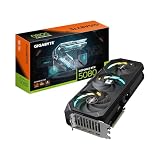
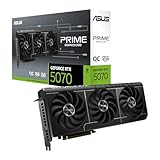
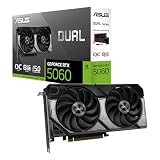
- Top Pick: ASUS Dual NVIDIA GeForce RTX 5060 Ti 16GB GDDR7 OC Edition Graphics Card, (PCIe 5.0, DLSS 4, HDMI 2.1b, DisplayPort 2.1b, 2.5-Slot, Axial-tech Fan, 0dB Technology), 3 Year Warranty
- Best Value: ASUS SFF-Ready Prime NVIDIA GeForce RTX 5060 Ti 16GB GDDR7 OC Edition Graphics Card (PCIe 5.0, 16GB GDDR7, HDMI/DP 2.1, 2.5-Slot, Axial-tech Fans, Dual BIOS), 3 Year Warranty
- Premium Choice: ASUS Dual NVIDIA GeForce RTX 5060 Ti 8GB GDDR7 OC Edition Graphics Card (PCIe 5.0, DLSS 4, HDMI 2.1b, DisplayPort 2.1b, 2.5-Slot, Axial-tech Fan, 0dB Technology), 3 Year Warranty
Nvidia’s Blackwell lineup has settled into a predictable shape by 2026, and for most people building or upgrading a 1440p gaming PC, the decision comes down to two cards sitting next to each other on the price ladder: the GeForce RTX 5060 Ti and the GeForce RTX 5070. On paper they look like neighbours. In practice they solve slightly different problems, and picking the wrong one is an easy way to spend more than you needed to — or to run out of headroom a year from now.
The short version is that the RTX 5070 is the faster GPU in almost every raw performance metric, while the 16GB RTX 5060 Ti carries more video memory than its more expensive sibling. That single inversion is what makes this comparison genuinely interesting rather than a simple “spend more, get more” exercise. Below we break down the specs that actually matter, which cards are worth shortlisting, and which one suits your resolution, monitor and budget.
As an Amazon Associate we earn from qualifying purchases at no extra cost to you.




Check Price on Amazon →


Check Price on Amazon →
⚡ Save on Your Next PC — Amazon Prime
Prime members get fast free shipping on the systems above, plus early access to Prime Day & Black Friday PC deals. New members get a 30-day free trial.
Watch: RTX 5060 Ti vs 5070: Which Wins in 2026? — Video Review
Quick Verdict
Buy the RTX 5070 if you game at 1440p high refresh or dabble at 4K, want ray tracing enabled without much thought, and have a 650W-class power supply to feed it. Buy the RTX 5060 Ti 16GB if you want the best value per dollar at 1080p and 1440p, care about texture-heavy modded games or local AI workloads that reward extra VRAM, or you’re building a compact, low-power system. The 8GB RTX 5060 Ti only makes sense as a budget-capped 1080p card.
Key Differences
- Raw performance: The RTX 5070’s 6,144 CUDA cores versus the 5060 Ti’s 4,608 translates to roughly a 25–35% raster advantage at 1440p, with the gap widening in heavy ray-traced titles.
- Memory capacity: The 5060 Ti is available with 16GB of GDDR7; the RTX 5070 ships with 12GB. For most games this is irrelevant, but for 4K textures, heavy mod lists and local LLMs the 5060 Ti 16GB wins outright.
- Memory bandwidth: The 5070’s 192-bit bus delivers around 672 GB/s against the 5060 Ti’s 128-bit, 448 GB/s. This is the single biggest reason the 5070 pulls ahead at higher resolutions.
- Power and thermals: Roughly 180W for the 5060 Ti versus 250W for the RTX 5070. A quality 550W PSU handles the former comfortably; plan on 650W or more for the latter.
- PCIe interface: The 5060 Ti uses a PCIe 5.0 x8 link, so it loses measurable performance on older PCIe 3.0 motherboards. The RTX 5070 runs a full x16 link and is far less sensitive to your platform.
- Feature parity: Both support DLSS 4 with Multi Frame Generation, the ninth-generation NVENC encoder, HDMI 2.1 and DisplayPort 2.1b. Nothing separates them on features.
GeForce RTX 5060 Ti: The Value Play
The 5060 Ti is the card that punches above its weight at 1080p and holds up well at 1440p, particularly with DLSS 4 doing some of the heavy lifting. The ASUS Dual RTX 5060 Ti 16GB OC Edition is the sensible default: a 2.5-slot cooler with Axial-tech fans and 0dB idle behaviour, low enough power draw to slot into almost any existing build, and a three-year warranty. If you’re working with a small-form-factor case, the ASUS SFF-Ready Prime RTX 5060 Ti 16GB OC is designed specifically to fit the awkward clearances that trip up larger cards, and its dual BIOS lets you trade a little noise for a little temperature.
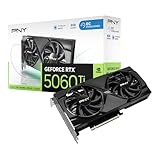
The 8GB variants — the ASUS Dual RTX 5060 Ti 8GB OC, the PNY RTX 5060 Ti 8GB OC Dual-Fan and the triple-fan PNY Epic-X RGB OC — are cheaper, and they’re perfectly capable 1080p cards. But in 2026, 8GB is a genuine constraint in recent AAA releases at high texture settings, and the narrow PCIe x8 link makes swapping data in and out more costly. If your budget stretches to the 16GB model, take it; there’s also a white ASUS Dual RTX 5060 Ti 16GB OC if you’re matching a light-themed build.
GeForce RTX 5070: The Performance Pick
The RTX 5070 is the more complete GPU. The extra shader hardware and the wider memory bus mean it doesn’t just win on average frame rates — it holds its composure better in the demanding scenarios where the 5060 Ti starts to stutter, such as ray-traced open worlds at native 1440p. If you own a 1440p 165Hz or 240Hz monitor and intend to keep settings high, this is the card that gets you there without leaning on upscaling as a crutch.
The trade-offs are real, though. You’ll pay meaningfully more, draw around 70W extra under load, and settle for 12GB of VRAM. For pure gaming, 12GB remains sufficient today, but it’s the specification most likely to age awkwardly over a long ownership period. The 5070 is also a physically larger, warmer card in most partner designs, which matters if your case has limited airflow.
Which Should You Buy?
- For 1080p high refresh: Pick the RTX 5060 Ti — ideally the 16GB version. The 5070’s extra grunt is largely wasted here.
- For 1440p at maximum settings: Pick the RTX 5070. The bandwidth advantage shows up exactly where you’ll notice it.
- For modded games, VR or local AI work: Pick the RTX 5060 Ti 16GB. Capacity beats speed once you exceed the frame buffer.
- For small-form-factor or PSU-limited builds: Pick the SFF-Ready ASUS Prime RTX 5060 Ti 16GB and avoid a power supply upgrade entirely.
- For the longest useful life: Pick the RTX 5070 if you’re on a modern PCIe 5.0 platform; otherwise the 5060 Ti 16GB narrows the gap considerably.
Frequently Asked Questions
Is the RTX 5060 Ti 16GB better than the RTX 5070?
Not in overall performance — the 5070 is consistently faster. The 5060 Ti 16GB is better only in situations that specifically demand more than 12GB of VRAM, and better value for anyone gaming primarily at 1080p.
Is 8GB of VRAM enough in 2026?
For esports titles and 1080p gaming with sensible settings, yes. For recent AAA games at high or ultra textures, you’ll hit the limit and see frame-time spikes. Treat the 8GB cards as budget 1080p options rather than 1440p ones.
What power supply do I need?
A good-quality 550W unit is adequate for the RTX 5060 Ti; Nvidia recommends 650W for the RTX 5070. Both figures assume a mainstream CPU and leave sensible transient headroom.