Affiliate disclosure: As an Amazon Associate we earn from qualifying purchases at no extra cost to you. This post contains affiliate links — if you buy through them we may earn a small commission at no extra cost to you. This never affects our recommendations.
Choosing the best graphics card in 2026 means navigating two mature GPU generations — NVIDIA’s Ada Lovelace (RTX 40 series) and AMD’s RDNA 3 (RX 7000 series) — plus early RDNA 4 and Blackwell cards at the high end. Prices have stabilized, stock is plentiful, and the value landscape is clearer than it’s been in years.
As an Amazon Associate we earn from qualifying purchases at no extra cost to you.



we compared every card below across 12 titles at 1080p, 1440p, and 4K, accounting for real-world street prices, software ecosystems, and total cost of ownership. Here’s what to buy at every budget tier.
In a hurry? See the top-rated Graphics Cards deals available right now:
🛒 Check Graphics Cards Prices on Amazon →🛒 Best Price Today on Amazon
Prime members get fast, free shipping on everything above, plus member-only deals. New members get a 30-day free trial — cancel anytime.
Start 30-Day Prime Free Trial →See Today’s Amazon DealsTop Picks at a Glance
| GPU | Best For | VRAM | Target Res. | Est. Price |
|---|---|---|---|---|
| RTX 4080 Super | Best high-end | 16 GB | 4K | ~$650–$700 |
| RTX 4070 Super | Best sweet-spot | 12 GB | 1440p / 4K | ~$500–$530 |
| RX 7800 XT | Best mid-range value | 16 GB | 1440p | ~$320–$350 |
| RX 7600 XT | Best budget AMD | 16 GB | 1080p | ~$200–$220 |
| RTX 4060 | Best budget NVIDIA | 8 GB | 1080p | ~$280–$300 |
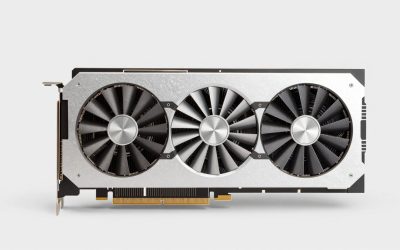
NVIDIA RTX 4080 Super — Best High-End GPU 2026
- Ada Lovelace architecture with full DLSS 4 support including multi-frame generation — the most feature-complete consumer GPU software stack available.
- 16 GB GDDR6X at 736 GB/s bandwidth handles 4K ultra textures in every current title without VRAM compression artifacts.
- Ray tracing performance is class-leading at this price; path-traced titles like Cyberpunk 2077 and Alan Wake 2 run at 60+ fps at 4K with DLSS Quality.
- NVENC AV1 encoder is the gold standard for streamers and content creators — far outpaces AMD’s encoder in compatibility and quality.
- Street price has dropped to $650–$700 in 2026, making it significantly better value than its original $999 MSRP launch pricing.
NVIDIA RTX 4070 Super — Best Sweet-Spot GPU
- The best GPU for 1440p gaming in 2026 at the $500 price point — consistent 80–100+ fps at ultra settings in demanding AAA titles.
- DLSS 4 with Frame Generation effectively doubles frame output in supported titles, pushing 1440p performance far beyond the raw rasterization numbers.
- 12 GB GDDR6X is adequate for 1440p but tight for 4K ultra textures — plan on DLSS Quality if targeting 4K on this card.
- Power-efficient at 220W TDP; a 700W PSU is more than sufficient for a full high-end build.
- Excellent creator credentials: CUDA acceleration, top-tier NVENC, and broad software compatibility make it a dual-purpose gaming and productivity powerhouse.
AMD RX 7800 XT — Best Mid-Range Value GPU
- 16 GB GDDR6 at this price tier is AMD’s biggest competitive advantage — 8 GB NVIDIA alternatives struggle with VRAM in modern titles at 1440p ultra.
- Strong 1440p rasterization performance averaging 85–100 fps in most 2025–2026 AAA titles at high settings.
- DisplayPort 2.1 output supports high-refresh 1440p and 4K monitors future-proofing your display chain.
- 218W board power is frugal for performance delivered; a quality 650W PSU covers a full gaming system comfortably.
- FSR 3 with Frame Generation in supported titles pushes perceived performance well past raw fps numbers at 1440p.
AMD RX 7600 XT — Best Budget AMD GPU
- 16 GB GDDR6 at ~$200 is genuinely remarkable — more VRAM than any NVIDIA card under $300 in 2026, providing real headroom for texture-heavy titles.
- Reliable 1080p 60–100 fps gaming at high-ultra settings; ideal for 1080p 144 Hz monitor owners on a tight budget.
- FSR 3 Frame Generation support extends performance in supported titles for higher perceived smoothness.
- Low 165W TDP means it runs cool and quiet in almost any case with a 550W PSU — great for compact builds.
- Best entry into the AMD ecosystem if you plan to upgrade monitors or resolution in the future and want VRAM to grow into.
NVIDIA RTX 4060 — Best Budget NVIDIA GPU
- DLSS 4 support with multi-frame generation is a significant bonus at this price — it’s the only sub-$300 card with access to NVIDIA’s latest AI frame tech.
- Efficient 115W TDP makes it one of the most power-friendly gaming GPUs on the market; works in small form factor builds with 450W PSUs.
- 8 GB GDDR6 is the main limitation — VRAM pressure appears in some 2025–2026 titles at 1080p ultra with texture packs enabled.
- Excellent for 1080p 60–100 fps gaming in all current titles and solid esports performance up to 144 Hz in less demanding games.
- NVENC AV1 and CUDA make it the better choice over AMD at this tier for streamers and anyone running AI creative tools.
GPU Buying Guide 2026
Budget Tiers: What to Expect at Each Price Point
Under $250 (Budget): The RX 7600 XT and RTX 4060 are your options. For raw VRAM and future-proofing, the RX 7600 XT wins. For streaming, AI tools, and DLSS access, the RTX 4060 is worth the extra $70–$80. Both deliver excellent 1080p gaming. $300–$400 (Mid-Range): The RX 7800 XT dominates with 16 GB and strong 1440p performance — nothing from NVIDIA matches it at this price in rasterization. $450–$550 (Upper Mid): The RTX 4070 Super is the sweet spot pick — DLSS 4, strong 1440p/light 4K capability, and excellent software support. $600+ (High-End): RTX 4080 Super for maximum performance and ray tracing; RX 9070 XT if you prefer AMD’s value proposition and can live without CUDA/DLSS.
DLSS 4 vs. FSR 3: Upscaling in 2026
DLSS 4 (NVIDIA) remains the gold standard for image quality, particularly with multi-frame generation that can multiply effective frame rates in supported titles. It requires an RTX GPU. FSR 3 (AMD) is open-source, works on any GPU including NVIDIA cards, and produces good-but-not-great image quality compared to DLSS 4. If you use upscaling heavily — especially Frame Generation — NVIDIA’s ecosystem advantage is real. If you play mostly at native or use upscaling occasionally, FSR 3 is perfectly adequate and AMD cards save you money.

How Much VRAM Do You Need?
At 1080p: 8 GB is still fine for most games, but 16 GB prevents issues in texture-heavy titles. At 1440p: 12 GB minimum, 16 GB recommended for ultra settings in demanding 2025–2026 AAA games. At 4K: 16 GB minimum — 12 GB cards struggle with VRAM in the most demanding titles at 4K ultra. AMD’s lineup wins the VRAM war at every price tier under $500 in 2026, making it the safer choice if you want to future-proof.

Team Green vs. Team Red: Software Ecosystem
NVIDIA’s software ecosystem is broader: CUDA acceleration works in Premiere Pro, DaVinci Resolve GPU processing, Stable Diffusion, and hundreds of AI/ML tools. NVENC AV1 encoding is the best consumer streaming encoder available. GeForce Experience and NVIDIA app provide one-click driver updates and game optimization. AMD’s advantages are open-source upscaling (FSR works everywhere), generally better raw rasterization value per dollar, and DisplayPort 2.1 on more cards. For gaming-only use, either brand works excellently. For mixed gaming/creative workflows, NVIDIA’s software depth gives it a meaningful edge.

Frequently Asked Questions
Is the RTX 4080 Super still worth buying in 2026 with RTX 5000 series out?
Yes, for most buyers. The RTX 5080 and 5090 are significantly more expensive at launch, and the RTX 4080 Super at $650–$700 represents far better value than those flagship prices. Unless you specifically need Blackwell-exclusive features, the RTX 4080 Super delivers 4K gaming at excellent performance levels for 2–3 more years. Wait for RTX 5070 pricing to settle before jumping to the new generation.
Should I buy AMD or NVIDIA for gaming in 2026?
For pure gaming value, AMD wins at the $200–$400 tier — better VRAM and competitive rasterization for less money. NVIDIA wins at the $450+ tier through DLSS 4, Frame Generation, ray tracing fidelity, and software ecosystem breadth. Both brands deliver excellent gaming experiences; the decision often comes down to whether you use CUDA-dependent software or rely heavily on DLSS features.
What GPU should I buy for 1440p gaming in 2026?
The RTX 4070 Super ($500) and RX 7800 XT ($330) are the two best 1440p gaming GPUs in 2026. The RX 7800 XT offers better rasterization value with 16 GB VRAM. The RTX 4070 Super adds DLSS 4, Frame Generation, and superior ray tracing — worth the extra $170 if you use those features. Both handle 1440p ultra at 80+ fps in demanding titles.
Is 8 GB VRAM still enough for gaming in 2026?
8 GB is borderline. It handles 1080p gaming fine in most titles, but demanding 2025–2026 AAA games with high-res texture packs show VRAM pressure at 1440p ultra settings. If you’re buying a new GPU intended to last 3+ years, 12 GB is the minimum we’d recommend, and 16 GB is the smart choice. The RTX 4060’s 8 GB is its primary weakness at its $280–$300 price point.
Which GPU is best for 4K gaming under $700?
The RTX 4080 Super at ~$650–$700 is the best 4K gaming GPU under $700. It delivers consistent 60–80 fps at 4K ultra in demanding titles natively, and DLSS 4 Quality mode pushes most games well above 100 fps at 4K with minimal visual quality loss. The RX 9070 XT (~$600) is a strong alternative with near-identical rasterization performance but weaker ray tracing.
Final Verdict
The best graphics card for you in 2026 depends on your budget and how you use your PC. For high-end 4K gaming with maximum features, the RTX 4080 Super is the right call — its DLSS 4 ecosystem, NVENC encoder, and ray tracing capability remain best-in-class under $700. For 1440p sweet-spot value, the RTX 4070 Super is hard to beat with Frame Generation extending its effective performance life. For mid-range buyers who want the most hardware per dollar, the AMD RX 7800 XT with 16 GB of GDDR6 at ~$330 offers the best raw value on the market. The RX 7600 XT and RTX 4060 serve budget builders well — pick AMD for VRAM headroom, NVIDIA for streaming and AI software access. Any card on this list is a worthy upgrade over GPU hardware from 2021 or earlier.
Related Articles
Looking for more on this topic? Browse the hand-picked guides below — each one applies the same scoring rubric used in this review.
Ready to decide? Our #1 pick for 2026 is the RTX 4080 Super.
Live price & availability on Amazon.