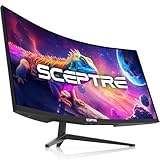
- Top Pick: Sceptre 34-inch Curved ultrawide WQHD Monitor (3440 × 1440), R1500, up to 180Hz/165Hz, DisplayPort x2, 99% sRGB, 1ms, Built-in Speakers, Machine Black, 2025 (C345B-QUT168)
- Best Value: SAMSUNG 34" ViewFinity S50GC Series Ultra-WQHD Monitor, 100Hz, 5ms, HDR10, AMD FreeSync, Eye Care, Borderless Design, PIP, PBP, LS34C502GANXZA, 2023, Black
- Premium Choice: LG 34U530A-W 34-inch UltraWide WFHD (2560 x 1080) IPS Wide Computer Monitor, 100Hz, VESA DisplayHDR 400, HDMI, DisplayPort, USB Type-C, Tilt/Height/Swivel Stand, White
A 34-inch ultrawide sits in an awkward but useful spot: wide enough to replace two side-by-side windows, narrow enough to fit on a normal desk without a wall-mounted arm. The decision this keyword implies is not “big or small” but “which flavor of 34 inches.” Resolution, curvature, refresh rate and the ports on the back separate the models more than the panel size does.
This guide is for gamers who want an immersive racing or open-world screen, and for desk workers who live in spreadsheets and video timelines. In 2026 the field runs from basic 100Hz office panels to curved 240Hz gaming screens. Every pick below is judged only on the specs in its listing title, so use it to shortlist, then confirm the remaining details on the product page before you buy.
Quick Picks
As an Amazon Associate we earn from qualifying purchases at no extra cost to you.




| Product | Best for | Key spec from the title |
|---|---|---|
| Sceptre C345B-QUT168 (99% sRGB) | Budget curved gaming | 3440 x 1440, up to 180Hz |
| Samsung ViewFinity S50GC | Everyday desk work | Ultra-WQHD, 100Hz, HDR10 |
| LG 34U530A-W | Entry-level ultrawide | 2560 x 1080 IPS, USB-C |
| LG 34U60ZB-B | Smooth mixed use | WQHD, 120Hz, 1800R |
| Dell S3425DW | Single-cable laptop desks | USB-C 65W Power Delivery |
| LG 34WR55QK-B | Work-first curved screen | 100Hz, USB-C, Reader Mode |
| Sceptre C345B-QUT168 (100% sRGB) | Color-minded gamers | 100% sRGB, 1ms |
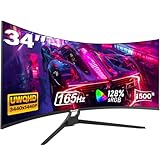
| Gawfolk 34-inch UWQHD | Value-first gaming | 165Hz, 128% sRGB, PIP/PBP |
| Sceptre Prime C345B-QU240T | Fast-paced shooters | Up to 240Hz, HDMI x2 |
| Samsung Odyssey G5 (LC34G55T) | Deep-curve immersion | 1000R, 165Hz, FreeSync Premium |
How to Choose
Resolution first: 3440 x 1440 or 2560 x 1080
Most 34-inch ultrawides use 3440 x 1440, which keeps text sharp at this width. The older 2560 x 1080 format stretches fewer pixels across the same area, so letters look coarser, though a mid-range graphics card has an easier job. If you edit video or code all day, lean toward 3440 x 1440. If the screen mainly plays games on a modest GPU, a 1080-class panel can be enough.
Refresh rate and the graphics card behind it
A 100Hz panel is already smoother than the 60Hz standard for scrolling and cursor movement. For games, 144Hz to 180Hz is the common sweet spot, and 240Hz is only worthwhile if your PC can push that many frames at 3440 x 1440, which asks a lot of mid-range graphics cards in recent titles. Look for FreeSync or a similar variable refresh feature in the title, and match the cable: DisplayPort usually carries the highest refresh rate on these screens, while some HDMI ports cap lower.
Curvature numbers and what they mean
Curvature is written as a radius, such as 1000R, 1500R or 1800R, with the number describing the circle in millimeters. A smaller number means a tighter curve. A 1000R screen wraps around you more and suits close desks, while 1800R is gentler for shared workspaces. If you do precise layout or straight-line photo work, a milder curve is easier to live with.
Ports, color and where budget models cut corners
If you connect a laptop, look for USB-C, and check whether the title lists Power Delivery wattage. Color claims such as 99% sRGB or 95% DCI-P3 matter for creative work. Budget units usually trim stand adjustment down to tilt only, skip USB hubs, and rely on small built-in speakers. Ignore HDR labels on entry panels: HDR10 support alone does not guarantee a bright, true HDR image.
The 10 Best Options
Sceptre C345B-QUT168 (99% sRGB)
This curved 34-inch screen lists 3440 x 1440, an R1500 curve, up to 180Hz or 165Hz depending on the input, and two DisplayPort inputs. It is aimed at players who want a high refresh rate without stepping up to a premium brand, and it lists 99% sRGB coverage along with built-in speakers.
- Strength: dual DisplayPort inputs and a 1ms response figure suit fast games.
- Strength: built-in speakers cover casual audio.
- Trade-off: the title lists no HDMI port, so consoles are harder to connect.
Skip it if you need USB-C for a laptop or a console input.
Samsung ViewFinity S50GC
The ViewFinity is an Ultra-WQHD 34-inch monitor with 100Hz, 5ms, HDR10 and AMD FreeSync. The listing also names Eye Care, a borderless design, and both PIP and PBP modes for showing two sources at once. It reads as a work-and-play display rather than an esports screen.
- Strength: PIP and PBP help when you run a desktop and a laptop together.
- Strength: the borderless look suits clean multi-monitor desks.
- Trade-off: 100Hz and 5ms are calmer numbers than the gaming-focused screens here.
Skip it if fast shooters are your main use.
LG 34U530A-W
LG pairs a 34-inch 2560 x 1080 IPS panel with 100Hz, VESA DisplayHDR 400, HDMI, DisplayPort and USB Type-C. The stand tilts, adjusts in height and swivels, and the finish is white, which stands out from the usual black cabinets.
- Strength: USB-C is a welcome feature at this entry level and simplifies laptop use.
- Strength: a fully adjustable stand helps ergonomics.
- Trade-off: the lower 1080-class resolution means softer text than 3440 x 1440 models.
Skip it if you want sharp text for long coding days.
LG 34U60ZB-B
A WQHD 3440 x 1440 21:9 monitor with 120Hz, HDR10, a gentle 1800R curve and 99% sRGB (typical). LG Switch, Reader Mode and flicker-safe technology are all named in the listing, which points to a screen meant for hours of mixed work and play.
- Strength: 120Hz is a clear step beyond 100Hz for scrolling and casual games.
- Strength: Reader Mode and flicker-safe design target long sessions.
- Trade-off: the title lists HDMI and DisplayPort only, with no USB-C.
Skip it if you want a single-cable laptop dock.
Dell S3425DW
Dell uses a WQHD VA panel with 120Hz, FreeSync Premium, HDR10, anti-glare coating and 300 cd/m2 brightness. It cites a 3,000:1 contrast ratio, 95% DCI-P3 coverage, 2x10W speakers and USB-C with 65W Power Delivery, so the spec sheet leans toward office and creative use.
- Strength: 65W USB-C charging keeps many laptops powered over one cable.
- Strength: 95% DCI-P3 suits color-aware work.
- Trade-off: the listing shows no 1ms figure, so competitive players may prefer a Sceptre.
Skip it if you only need a gaming screen and never plug in a laptop, since several of its features would sit unused.
LG 34WR55QK-B
This curved 3440 x 1440 monitor lists 100Hz, 5ms, HDR10, Reader Mode, HDMI, DisplayPort and USB-C, with a tilt and height adjustable stand. It suits someone who splits time between a laptop for work and a console or desktop for downtime.
- Strength: USB-C plus two other inputs gives flexible connections.
- Strength: a height-adjustable stand fits different desk setups.
- Trade-off: 100Hz is modest next to 165Hz and 240Hz screens.
Skip it if frame rate matters more than connectivity.
Sceptre C345B-QUT168 (100% sRGB)
A sibling of the first Sceptre, this listing swaps the color figure to 100% sRGB while repeating 3440 x 1440, R1500, up to 180Hz or 165Hz, two DisplayPorts, 1ms and speakers. The two listings are close enough that the color claim is the main difference on paper.
- Strength: the 100% sRGB claim suits shoppers who care about the full color range.
- Strength: same high-refresh feature set as its sibling.
- Trade-off: it shares the lack of an HDMI input in the title.
Skip it if you plan to use a console.
Gawfolk 34-inch UWQHD
Gawfolk offers a curved 21:9 screen at 3440 x 1440, 165Hz, 1500R, 1ms (MPRT) and 128% sRGB, with HDMI, DisplayPort, PIP and PBP. On paper it packs a long gaming feature list into a single listing.
- Strength: both HDMI and DisplayPort are listed.
- Strength: PIP and PBP support split-source setups.
- Trade-off: it is a lesser-known brand than LG, Dell or Samsung.
Skip it if long-term brand support matters to you.
Sceptre Prime C345B-QU240T
The top refresh figure here: up to 240Hz at 3440 x 1440, a 1500R curve, 1ms, 100% sRGB, two DisplayPort and two HDMI inputs, and built-in speakers. It targets players with a strong graphics card who want every frame.
- Strength: four video inputs let you connect a PC and a console together.
- Strength: the 240Hz ceiling gives headroom for powerful graphics cards.
- Trade-off: you need a capable GPU to use the full rate at this resolution.
Skip it if your PC is modest, because the extra refresh headroom would go unused while the screen still asks for a strong card at this resolution.
Samsung Odyssey G5 (LC34G55T)
A WQHD ultrawide with a tight 1000R curve, 165Hz, 1ms, FreeSync Premium, Eye Comfort and multiple ports. The curve is the headline: it is the deepest bend in this group.
- Strength: the 1000R curve wraps around your field of view for racing and flight games.
- Strength: FreeSync Premium helps smooth frame delivery.
- Trade-off: the strong curve feels odd for office layout tasks.
Skip it if you share the desk, sit far from the screen, or do precision design work where straight lines matter.
Which One Fits Your Situation
You game on a modest budget
The Sceptre C345B-QUT168 with 99% sRGB gives you a high refresh ceiling and 3440 x 1440 detail without leaving the entry tier, as long as you use DisplayPort.
You dock a work laptop
Dell S3425DW is the clearest fit here because the title lists USB-C with 65W Power Delivery, so one cable can carry video, data and charging.
You play shooters and want maximum frames
Pick the Sceptre Prime C345B-QU240T. Its 240Hz ceiling and extra inputs give the most headroom, provided your graphics card keeps up.
You want an immersive racing cockpit
The Samsung Odyssey G5 offers the tightest curve in this list at 1000R, which fills your peripheral view in driving games.
Common Mistakes
- Buying 240Hz without a graphics card that can drive 3440 x 1440 at that rate.
- Ignoring the port list and discovering later that the monitor has no HDMI or USB-C, which matters most for console owners and laptop users.
- Assuming every ultrawide has the same resolution, when some are 2560 x 1080.
- Choosing a tight 1000R curve for a shared or work-first desk.
- Trusting HDR labels on entry panels to deliver a bright, true HDR picture. Brightness figures such as the 300 cd/m2 on the Dell tell you more than a logo does.
Related guides
- Aio Liquid Coolers For High Performance Gaming
- How To Lower Input Delay In Competitive Shooters
- External Hard Drives For Music Production
Frequently Asked Questions
Is a 34-inch ultrawide enough to replace two monitors?
For many workflows, yes. A 21:9 screen fits two documents side by side, and PBP modes on some models split inputs. If you need three or more full windows, consider a larger panel.
Does 3440 x 1440 demand a powerful GPU?
It has more than double the pixels of standard 1920 x 1080, so demanding games call for a mid-range or better card. For office work, integrated graphics are usually enough.
What does a curve spec like 1500R mean?
It is the radius of the curve in millimeters. Lower numbers bend more, so 1000R is tighter than 1800R. Most people find 1500R a comfortable middle for a desk about arm’s length away.
Which port is best to use?
Use DisplayPort for the highest refresh rate on a PC. Use HDMI for consoles, and USB-C when you want video and charging from a laptop over one cable.