The Cooler Master GM34-CW earns its keep in 2026 as a budget-friendly dark-room gaming ultrawide: measured contrast near 3,800:1 gives its 34-inch 1500R VA panel genuinely black shadows where flat IPS rivals stop at a hazy ~1,000:1 — but only if you run it over DisplayPort, because its HDMI 2.0 ports physically cannot carry the full 144Hz at native resolution.
Cooler Master GM34-CW at a glance
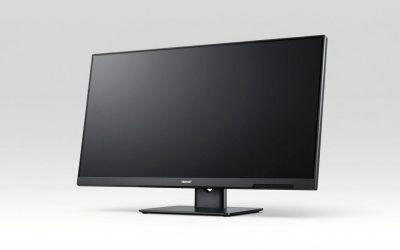
The GM34-CW is Cooler Master’s 34-inch ultrawide from its first wave of gaming monitors: a quantum-dot VA panel at 3440×1440, 144Hz, with FreeSync Premium (G-Sync Compatible works over DisplayPort) and a tight 1500R curve. In 2026 it typically sells in the $350–$500 bracket, which puts it well under the $700-and-up OLED ultrawides and directly against flat IPS alternatives like the Gigabyte M34WQ.
| Specification | Cooler Master GM34-CW |
|---|---|
| Panel / curve | 34-inch VA, 1500R |
| Resolution / refresh | 3440×1440, 144Hz (DisplayPort), 100Hz (HDMI) |
| Claimed response time | 1ms MPRT |
| Claimed contrast / brightness | 4,000:1, 400 nits (DisplayHDR 400) |
| Colour gamut | Quantum dot, ~95% DCI-P3, ~125% sRGB |
| Adaptive sync | FreeSync Premium, ~48–144Hz range with LFC |
| Ports | 1× DP 1.4, 2× HDMI 2.0, 1× USB-C (DP Alt Mode, ~90W PD), audio out |
| Stand / mount | Height, tilt, swivel; 100×100 VESA |
Measured performance: response time, input lag, contrast
Instrumented measurements of the GM34-CW diverge from the spec sheet in predictable VA ways. The headline figures look like this:
| Metric | Claimed | Measured (typical) |
|---|---|---|
| Average GTG response, 144Hz, balanced overdrive | 1ms | ~7ms |
| Dark-level transitions (near-black to mid-grey) | — | 18–30ms |
| Overshoot, top “Ultra Fast” preset | — | 15–25% (visible inverse ghosting) |
| Total input lag, 144Hz | — | ~4ms |
| Total input lag, 60Hz | — | ~10ms |
| Contrast ratio | 4,000:1 | ~3,600–3,900:1 |
| Black level at 200-nit white | — | ~0.05 nits (IPS: ~0.20) |
| DCI-P3 coverage | 95% | ~92% |
Motion clarity
A ~7ms average grey-to-grey is fine for a 144Hz panel — frames refresh every ~6.9ms, so most transitions just keep pace. The problem is specifically the dark-level transitions: at 18–30ms they lag two to four frames behind, which is what produces the classic VA “black smear” trail when bright objects move against dark backgrounds.
Input lag
Roughly 4ms of total latency at 144Hz is imperceptible for anyone outside professional play and matches most 144Hz ultrawides. Note the ~10ms figure at 60Hz — relevant if you feed it a console or a frame-rate-capped source.
Dark scenes: where the 1500R VA beats flat IPS — and where it loses
This is the real reason to pick the GM34-CW over an IPS rival. With a measured black floor around 0.05 nits, a night scene in a horror game or a space sim looks like actual darkness. A flat IPS ultrawide at ~0.20 nits renders the same scene as charcoal grey, and IPS glow — the silvery bloom toward the corners — gets worse on ultrawides because the corners sit at a wider viewing angle to your eyes.
The 1500R curve helps the VA panel here too: it keeps the far edges closer to perpendicular to your eyes, which reduces the gamma and contrast wash-out VA panels show at oblique angles. The trade-offs:
- Won: deep blacks, low black level, less corner glow, more immersive wrap for cockpit-style games.
- Lost: black smearing in exactly the scenes VA does best in — a bright muzzle flash in a dark corridor leaves a visible smear. Faster IPS panels (~3–4ms GTG, e.g. Nano IPS ultrawides) have grayer blacks but cleaner motion.
- Lost: geometry. The 1500R curve bends straight lines, which annoys some people in spreadsheets, CAD and photo work. Flat IPS is the safer all-rounder for mixed productivity.
Getting the full 144Hz: the bandwidth math
The most common setup mistake with the cooler master gm34 cw is using HDMI and never seeing 144Hz. The numbers explain why:
- Active pixels: 3440 × 1440 = 4,953,600 px (~5 MP, about 60% of a 4K frame).
- Bandwidth needed: 4,953,600 px × 144Hz × 24 bits ≈ 17.1 Gbps active, and ~19–20 Gbps once blanking overhead is included.
- HDMI 2.0 usable bandwidth: ~14.4 Gbps → shortfall. That’s why the spec limits HDMI to 100Hz at native res (4.95 MP × 100Hz × 24-bit ≈ 11.9 Gbps, ~13.5 Gbps with overhead — just barely fits).
- DisplayPort 1.4 usable bandwidth: ~25.9 Gbps → comfortable headroom. It even fits 10-bit colour at 144Hz (~23.5 Gbps) without DSC.
Practical rule: run the included DisplayPort cable from your GPU, and reserve the HDMI ports for consoles or a secondary laptop. The USB-C port carries the same DP Alt Mode signal — fine for a laptop at 144Hz if the laptop’s port supports it.
Settings worth changing
- Response Time: “Advanced”. The middle preset delivers the ~7ms average with minimal overshoot. “Ultra Fast” shaves ~2ms but introduces 15–25% overshoot — visible bright halos that look worse than the ghosting it removes.
- Adaptive Sync: On. The 48–144Hz FreeSync range includes LFC, so dips below 48fps stay tear-free.
- Colour: sRGB mode for SDR. Native gamut oversaturates reds and greens in standard content; the sRGB clamp restores accuracy. Leave it wide only for HDR/P3 material.
- MPRT/backlight strobe: Off. It kills Adaptive Sync, dims the panel and doesn’t fix the slow dark transitions anyway.
- Dark Boost: leave near default. Cranking it lifts the black floor toward IPS levels, erasing the VA contrast advantage you paid for.
- Brightness: ~25–35 for a typical lit room (~120 nits). The ~400-nit ceiling exists for HDR spec compliance, not daily use.
- HDR: temper expectations. DisplayHDR 400 with no local dimming adds a wider gamut but no extra contrast — SDR usually looks more consistent.
Should you buy it in 2026? Decision matrix
| Your situation | Verdict |
|---|---|
| Single-player/immersive gaming in a dim room | Strong fit — the contrast advantage is real and cheap |
| Competitive/esports priority | Skip — a fast IPS or 240Hz+ panel tracks motion better |
| Mixed work + gaming, colour or line accuracy matters | Flat IPS (e.g. Gigabyte M34WQ) is the safer pick |
| HDR movies are the main use | Skip — save toward a QD-OLED ultrawide |
| Primarily a console display | Poor fit — consoles output 16:9, so a third of the screen sits as black bars |
| Ultrawide on a tight budget, mid-range GPU | Strong fit — ~5 MP at 144fps is achievable without a flagship card |
FAQ
Does the GM34-CW do 144Hz over HDMI?
No. HDMI 2.0 tops out around 13.5–14.4 Gbps usable, and native 3440×1440 at 144Hz needs roughly 19 Gbps, so the monitor caps HDMI at 100Hz. Use DisplayPort or USB-C DP Alt Mode.
Does it work with PS5 or Xbox Series X?
It displays them, but neither console renders 21:9 — you get a 16:9 image pillarboxed in the centre, which wastes the ultrawide format. Fine as a secondary input, not a reason to buy.
Is the Cooler Master GM34-CW still worth it in 2026?
Yes, at its current $350–$500 range, specifically for dark-room gaming. Pay more for OLED if HDR matters, or buy flat IPS if desk work dominates.
Is the 1500R curve a problem for text and spreadsheets?
It’s noticeable but tolerable — lines bow slightly at the edges. If more than half your screen time is documents rather than games, a flat panel will feel more natural.