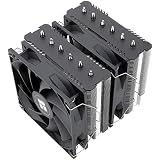
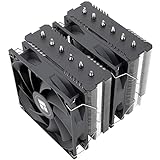
- Top Pick: Thermalright Peerless Assassin 120 SE CPU Cooler, 6 Heat Pipes AGHP Technology, Dual 120mm PWM Fans, 1550RPM Speed, for AMD:AM4 AM5/Intel LGA 1700/1150/1151/1200/1851,PC Cooler
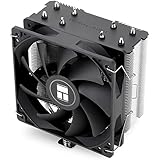
- Best Value: Thermalright Assassin X120 Refined SE CPU Air Cooler, 4 Heat Pipes, TL-C12C PWM Fan, Aluminium Heatsink Cover, AGHP Technology, for AMD AM4/AM5/Intel LGA 1150/1151/1155/1200/1700/1851(AX120 R SE)
- Premium Choice: Thermalright Peerless Assassin 120 SE ARGB CPU Air Cooler,6 Heat Pipes CPU Cooler, Dual TL-C12C-S PWM Fan, Aluminium Heatsink Cover,AGHP Technology,for AMD AM4/AM5/Intel LGA1700/115X/1155/1200/1851
Cooling used to be an afterthought. In 2026 it decides how your CPU behaves. Modern desktop chips no longer hit a hard ceiling and stop — they run right up against their thermal and power limits and clock themselves according to whatever headroom the cooler gives them. Two coolers on the same processor can produce genuinely different frame-time consistency in a long session, which is why the AIO-versus-air question keeps coming up in every build thread.
The honest answer is that both categories have become very good, and the gap that existed five years ago has narrowed to something most gamers will never notice. A 360 mm all-in-one liquid cooler still wins the raw thermal contest under sustained all-core load, but a modern twin-tower air cooler now delivers roughly 90–95% of that performance for a third of the money, with fewer parts that can fail. Below we break down where each one actually earns its place.
As an Amazon Associate we earn from qualifying purchases at no extra cost to you.


⚡ Save on Your Next PC — Amazon Prime
Prime members get fast free shipping on the systems above, plus early access to Prime Day & Black Friday PC deals. New members get a 30-day free trial.
Watch: AIO vs Air Cooler: Which Is Best in 2026? — Video Review
Quick Verdict
Buy a 360 mm AIO like the ARCTIC Liquid Freezer III Pro 360 if you run a high-wattage flagship CPU, stream while you game, do heavy rendering or compiling, or want a clean look with no tower blocking the RAM and GPU. Buy a twin-tower air cooler like the Thermalright Phantom Spirit 120 SE or Peerless Assassin 120 SE if you want the best performance per dollar, near-silent operation, and a cooler that will outlive the rest of the build.
Key Differences
- Peak cooling capacity: A 360 mm AIO handles sustained 250 W+ loads with room to spare; the best 120 mm twin towers are comfortable to roughly 220–250 W before they start to run warm.
- Thermal behaviour: Coolant acts as a heat buffer, so an AIO absorbs short spikes smoothly. Air coolers react faster to load changes but also shed heat faster once the load drops.
- Noise: Air coolers have one noise source — fans. AIOs add a pump, which can produce a low hum or gurgle that some builders find more intrusive than fan noise.
- Reliability: An air cooler has no moving parts beyond its fans and no fluid to permeate away. AIOs are sealed units with a finite service life, typically quoted around six years.
- Clearance and fit: Twin towers stand roughly 155 mm tall and can crowd tall RAM and the first PCIe slot. AIOs move that bulk to the case roof or front, but demand radiator space and mounting depth.
- Price: Air cooling is dramatically cheaper. A top-tier 120 mm twin tower typically costs a fraction of a premium 360 mm AIO of comparable class.
ARCTIC Liquid Freezer III Pro 360: The AIO Case
The Liquid Freezer III Pro 360 has become the default recommendation in its category for good reason. Its radiator is noticeably thicker than the 27 mm norm, which raises surface area without raising fan speed, and the integrated VRM fan on the pump block pushes air over the motherboard components that a tower cooler would normally catch incidentally. Under a sustained all-core workload it simply has more thermal mass and more radiator to work with than any 120 mm air cooler can offer.
The trade-offs are practical rather than performance-related. You need a case that genuinely supports a 360 mm radiator at the intended thickness, installation is a longer job, and you are accepting a pump as a wear item. If your CPU is a 16-core flagship, if you render or compile for hours at a time, or if you want the tower-free look around the socket, that trade is worth making.
Thermalright Twin-Tower Air Coolers: The Air Case
Thermalright reset expectations for this category, and the current line-up covers every preference. The Phantom Spirit 120 SE is the performance pick with seven heat pipes and dual PWM fans, sitting just behind entry-level 360 mm AIOs on most gaming loads. The Peerless Assassin 120 SE is the value benchmark at six heat pipes, with an ARGB version for lit builds and a Vision MAX variant that adds a 5-inch IPS screen if you want the display flourish AIO pump blocks are known for. The single-tower Assassin X120 Refined SE covers compact builds and mid-range CPUs.
What all of them share is the same core argument: no pump, no coolant, no failure mode that ends with liquid near your components. Fans are user-replaceable and cheap. For a gaming rig running a mid-range or upper mid-range CPU — where sustained all-core load is rare and gaming loads are bursty — an air cooler is very difficult to argue against.
Which Should You Buy?
- For a flagship CPU or heavy multitasking: pick the ARCTIC Liquid Freezer III Pro 360.
- For the best performance per dollar: pick the Thermalright Phantom Spirit 120 SE.
- For a tight budget with no compromise on temps: pick the Peerless Assassin 120 SE, or the ARGB version if you want lighting.
- For small cases or mid-range chips: pick the Assassin X120 Refined SE.
- For a showpiece build with a display: pick the Peerless Assassin 120 Vision MAX ARGB Black.
Frequently Asked Questions
Is an AIO worth it for gaming alone?
Usually not. Games rarely load all cores continuously, so a good twin-tower air cooler will keep clocks at the same level for far less money. The AIO advantage appears in sustained productivity work or when streaming and encoding alongside gameplay.
Do AIOs fail and leak?
Leaks are rare in modern sealed units. The realistic end-of-life issue is pump wear or gradual coolant permeation, which shows up as rising temperatures over several years rather than a sudden failure.
Will a twin-tower cooler block my RAM?
It can. Thermalright’s twin towers are designed around standard-height modules, and the front fan can usually be raised slightly to clear taller heat spreaders. Check both RAM height and your case’s CPU cooler clearance before ordering.
Are stock coolers ever enough in 2026?
Only for low-power or entry-level chips. On anything mid-range or above, even a budget twin tower delivers meaningfully lower temperatures and far less fan noise than a bundled cooler.
Final Verdict
For most gamers, a modern Thermalright twin tower is the smarter buy: near-AIO temperatures, no pump to fail, and money left over for a better GPU. Step up to the ARCTIC Liquid Freezer III Pro 360 when your CPU genuinely runs hot for hours at a time, or when your build’s layout and aesthetics call for it.