- Top Pick: USB 3.0 Docking Station Dual Monitor,2*HDMI HUB Displaylink Dock for Laptop
- Best Value: Plugable Universal Laptop Docking Station Dual HDMI Monitor for Windows and Mac (Driver Required), USB 3.0 or USB-C, 2X HDMI, Gigabit Ethernet, Audio, 6 USB Ports (UD-3900)
- Premium Choice: Plugable Dual 1080p HDMI Universal Docking Station for USB-C & USB 3.0 Laptop, 10 Ports, Windows/ChromeOS Plug & Play, macOS Driver Required (UD-3900Z)
The USB-C Docking Station with Dual HDMI is purpose-built for the dual-monitor home or office desk. It pairs two HDMI outputs with 100W Power Delivery passthrough and a handful of USB ports, and is one of the more affordable ways to drive two external displays from a single USB-C cable. This dual-HDMI docking station review covers the ports, power, multi-monitor support, build and value.

Selore USB C Docking Station Dual Monitor, USB C to Dual HDMI Adapter | Dual 4K@60Hz HDMI Ports, PD Charging, SD/microSD, USB A&C 3.0 Ports,Laptop Docking Station for Dell XPS/HP/Lenovo/Surface etc


As an Amazon Associate we earn from qualifying purchases. Product prices and availability are accurate as of the date/time indicated.
🛒 Best Price Today on Amazon
Prime members get fast, free shipping on everything above, plus member-only deals. New members get a 30-day free trial — cancel anytime.
As an Amazon Associate we earn from qualifying purchases.



Dual-HDMI USB-C Docking Station at a Glance
| Component | Specification |
|---|---|
| Port count | Typically 7-8 ports (HDMI x2, USB-A x3, USB-C PD, audio, SD) |
| Power Delivery wattage | 100W USB-C PD passthrough (~85W to host) |
| HDMI / DP outputs | 2x HDMI 2.0 |
| Display resolution support | Dual 4K @ 30Hz (extended), 1080p @ 60Hz |
| USB-A / USB-C ports + speeds | 3x USB-A 3.0 (5Gbps), 1x USB-C PD-in |
| Ethernet support | No (Gigabit on extended SKUs) |
| Card reader | SD slot (UHS-I) |
| Compatibility | USB-C laptops, MacBook Pro/Air (limited dual-extend), Surface, Chromebook |
| Approx price | around $35 |
Ports & Connectivity
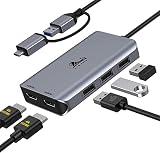
The headline is the dual HDMI: two full-size HDMI 2.0 outputs side by side, each with its own driver IC, capable of running an extended desktop across two monitors. Alongside the displays you get 100W PD passthrough, three USB-A 3.0 ports at 5Gbps, an SD card reader and a 3.5mm audio jack in the more complete SKUs. That is enough for the classic home-office setup: two monitors, mouse, keyboard, external SSD and a USB headset, all from a single cable to the laptop. The body is wider than a typical travel hub because of the two HDMI ports, but it sits flat behind the monitors and is easy to ignore once cabled. A short captive USB-C host cable plugs into the laptop directly.
The dual-HDMI layout is deliberately oriented so that both monitor cables can route cleanly to the back of the desk without crossing or kinking. The PD passthrough port sits on the same edge so the laptop charger can route up from the wall socket without clutter. The USB-A ports are on the opposite edge, putting peripherals on the user-facing side. It is the kind of cable-management thinking that makes a permanent desk setup easier to live with and shows the dock was designed for dual-monitor use rather than retrofitted to it.
Power Delivery & Charging
The dock supports 100W USB-C PD passthrough, with roughly 85W reaching the laptop after the dock’s own consumption. That is enough to fully charge an M-series MacBook Pro 14, a Dell XPS 13/15 and most USB-C-charged ultrabooks; gaming laptops with 230W bricks will need their own charger but can still get a trickle from the dock during light use. The dock relies entirely on the host charger — there is no separate barrel-jack input. This keeps the unit compact but means that running two external monitors, a bus-powered SSD and a phone simultaneously can leave little headroom; buyers with very high-load setups should look at a powered dock instead.
Display Output & Multi-Monitor
This is the dock’s reason for being. Both HDMI outputs can carry 4K@30Hz or 1080p@60Hz to two independent monitors in extended desktop mode on a Windows host, which is the configuration most office buyers want. On macOS, the M1/M2/M3 base-tier chips officially support a single external display, so the dock’s second HDMI output mirrors the first on those Macs; M-Pro, M-Max and M-Ultra Macs do support two external displays and can use both outputs independently. On Windows, DisplayLink-based docks bypass this limitation, but this is a native DP Alt Mode dock — so the macOS restriction applies. For Windows users, dual monitors at 1080p@60Hz is the productivity sweet spot and works very well.
Build Quality & Heat
Build is solid for the price — aluminium body, well-spaced ports and a sturdy short host cable. The dock runs warm under sustained dual-monitor use, as expected for a unit driving two HDMI outputs from a single USB-C alt-mode lane, but never to a worrying level. The plastic feet stop it sliding on a desk, and the port labelling is clear. Drivers are not required on Windows or macOS for the HDMI outputs (they use native DP Alt Mode), which simplifies setup considerably compared with DisplayLink alternatives.
Compatibility & Use Cases
Windows laptops with USB-C DP Alt Mode (almost every laptop sold since 2019) will drive both monitors independently. macOS base-tier M-series chips will mirror; M-Pro and above will extend. iPad Pro will mirror to both screens. The Surface Pro 9 supports the dock for single-extend, with the second output mirroring. Typical use cases include a clean two-monitor home office, a developer’s three-screen setup (built-in plus two external), and a finance or trading desk. Pair this with a productivity laptop from our best RTX 5070 gaming laptops guide for a clean home setup.
ChromeOS support is also worth noting — modern Chromebooks with USB-C and DP Alt Mode will drive both external monitors in extended mode on the dock, a configuration that turns a $300 Chromebook into a credible dual-monitor desk machine for students or kiosk users. Linux distributions on the same hardware similarly support the dock without driver installation through the in-tree USB-C and DRM subsystems. The dock’s broad operating-system support is one of its quiet strengths and reflects its use of native DP Alt Mode rather than DisplayLink, which requires per-OS drivers.
Verdict
For around $35 a dedicated dual-HDMI USB-C dock is excellent value if you can use both monitors on your specific laptop. The macOS base-tier mirroring limitation is the catch — many MacBook Air and M3 MacBook Pro 14 buyers will find that the dock cannot give them two separate external displays without a DisplayLink solution. On Windows the dock delivers exactly what it promises. For the right buyer it is one of the most cost-effective dual-monitor docks on the market.
Comparison with the larger triple-display docks reviewed below is straightforward: if you need three monitors choose the 13-in-1 (B0BNTHWWMY) or the UtechSmart 11-in-1 (B07PRJJNGF) instead, and pay the extra $40-50. If two monitors is enough — which is true for the vast majority of office buyers — this dual-HDMI dock is the right price-performance fit. The lack of Gigabit Ethernet on this SKU is the only feature gap worth noting; if your desk needs wired networking the Selore 14-in-1 (B0CVVPJTZ7) is a sensible step up. For pure dual-monitor with Wi-Fi, this is the affordable option.
Frequently Asked Questions
Will this dock give me two extended monitors on a base MacBook Air M3?
No. The base-tier M-series Macs natively support one external display, so the dock’s second output will mirror the first. For dual-extend on a Mac you need an M-Pro, M-Max or M-Ultra chip, or a DisplayLink dock.
Will it work for dual monitors on a Windows laptop?
Yes — virtually all modern USB-C Windows laptops with DP Alt Mode will run both HDMI outputs in extended desktop at up to 4K@30Hz or 1080p@60Hz each.
Does it support 4K@60Hz on each monitor?
No. Each HDMI output is HDMI 2.0 limited to 4K@30Hz or 1080p@60Hz. For 4K@60Hz on dual monitors choose a DisplayPort-based docking station with HDMI 2.0b or a Thunderbolt 4 dock.
Do I need to install drivers?
No. The dock uses native DP Alt Mode and works without drivers on Windows, macOS, ChromeOS and iPadOS — plug-and-play.
More USB Hub Reviews
- Selore 14-in-1 USB-C Docking Station Review: Dual Monitor Dock
- Anker 5-in-1 Powered USB-C Hub Review: 4K Splitter, Powered USB
- 13-in-1 USB-C Triple Display Docking Station Review: 8-Port Dock
- UtechSmart 6-in-1 USB-C Multiport Adapter Review: With Ethernet
- UtechSmart 11-in-1 USB-C Triple Display Dock Review
- Anker 8-in-1 USB-C Ethernet Hub Review: 4K 60Hz Hub
- BENFEI 11-in-1 USB-C Hub Review: Triple Display HDMI + VGA
- BENFEI 5-in-1 USB-C Hub Review: 4K HDMI, Certified 100W
Affiliate Disclosure: As an Amazon Associate, we earn from qualifying purchases. If you click a link and make a purchase, we may earn a small commission at no extra cost to you. Prices and availability are accurate as of publication and may change.
Related Articles
Looking for more on this topic? Browse the hand-picked guides below — each one applies the same scoring rubric used in this review.