Tails of Iron 2: Whiskers of Winter, Odd Bug Studio’s rodent soulslike sequel published by United Label and released on January 28, 2025, is one of the rare cases where the Linux flag on a Steam record survives every check underneath it. The store page claims Windows, Mac and Linux support, and the delivery layers behind that claim — depots, launch entries, published requirements — all carry a real Linux build rather than an empty field or a borrowed flag.
This article reads those layers one by one: what the base game’s record holds, what its two add-on apps add, what Valve’s Steam Deck paperwork actually graded, and what the ProtonDB file says for anyone who runs the Windows build anyway. It also rules on the second storefront.
As an Amazon Associate, we earn from qualifying purchases.
Quick answer
Yes. Tails of Iron 2: Whiskers of Winter ships a genuine native Linux build on Steam: the record carries a real Linux depot of about 5.96 GB, a Linux launch entry and populated Linux requirements. It is also Steam Deck Verified, although Valve’s badge graded a pre-release build through Proton rather than the native runtime.
What Steam’s own record says
Start with the flags, then refuse to stop there. The record for app 2473480 lists windows true, mac true and linux true, and the requirements behind those flags are filled in rather than decorative: the Linux minimum names a 2.8 GHz dual-core processor, 4 GB of RAM, a GeForce GTX 660 class card with 2 GB of video memory and 2 GB of storage, with a recommended tier above it, and the Mac requirements open at macOS 12 Monterey. Populated requirements are paperwork, though — intent, not delivery — so the ruling turns on what the sold package contains.
The depot census settles it. The package holds three platform depots of the same weight class: Windows at about 6.04 GB, macOS at about 6.06 GB, and Linux at about 5.96 GB, each with a current public manifest. A Linux depot within a few percent of the Windows build’s size is a full game, not a stub. The launch configuration holds three entries, one per platform, and the Linux entry starts a native 64-bit executable named TOI2.x86_64. Flags, requirements, depot and launch entry all point the same way: the native build is genuinely sold.
Two paperwork gaps deserve naming precisely because everything else agrees. The icon registry holds clienticon, clienttga and icon but no LinuxClientIcon, and the osextended string carries Mac notation only — macos64 and macosapplesilicon — with no Linux entry. Neither gap removes a build: the depot and launch entry are the delivery layers, and both are present and current.
The record carries no DRM notice and no account notice. Its controller-support field reads full, with DualShock and DualSense categories beside a gamepad-recommended tag. SteamDB’s detected-technology list names the Unity engine, the Epic Online Services SDK as a services layer, FMOD and Mono; no anti-cheat is named on any layer, and the Are We Anti-Cheat Yet database, read in full at 1,167 entries, holds no entry for this game. For a single-player game, that silence is the expected shape.
The family sweep: three flags, all of them earned
The base record’s add-on array holds exactly two apps, both read on their own records. The Digital Official Soundtrack (app 3246590, type music) flags Windows, Mac and Linux all true, and the Digital Artbook (app 3349180, type dlc) does the same; both fullgame pointers name app 2473480. The family Linux-flag count is therefore 3 of 3.
That count needs its usual caution. In many families the only Linux flag belongs to a soundtrack album, and counting flags would invent a native build that does not exist. Here the arithmetic runs the other way: the base game itself carries one of the three flags and backs it with a depot and a launch entry, so the add-ons’ matching flags are agreement, not camouflage.
The Steam Deck sheet: Verified, on a pre-release Proton run
Valve’s compatibility sheet resolves to Verified, the top category, with SteamOS separately rated Compatible. It passes the four checks the badge is built on: the default controller configuration is fully functional, the game shows Steam Deck controller icons, interface text is legible, and the default graphics configuration performs well. Its one note is the familiar external-controller caveat — an external pad may need a manual switch through the Quick Access menu. The sheet was read through SteamDB’s republication of Valve’s data, and its configuration block agrees with the app record’s own copy.
Two details of that paperwork matter more than the badge itself. First, the test is dated December 11, 2024, against build 16566903 — a pre-release build, graded weeks before the January 28, 2025 launch; the current public build is 24785538. Second, the sheet’s recommended runtime is a Proton release candidate, proton-9.0-3RC: Valve graded the Windows build through the compatibility layer even though a native build ships in the same package. Together they make this a supplement candidate: a re-test of the current build, or of the native runtime, would finally describe the product as sold today.
The ProtonDB file: Platinum, and thin
ProtonDB’s summary for this app was read in full. The settled, best-reported and trending tiers are all Platinum — a clean sweep — but the file behind those tiers holds only 7 reports, and ProtonDB’s own confidence rating is low. The tier is real and the sample is small.
The filing colour explains why a native game has a Proton file at all: most reporters ran the Windows build. Several desktop filings describe the game running well but the pad going undetected until the reporter switched to a GE-Proton build or to Proton Experimental, after which input worked. A Deck filing marked as a native run reports a steady 60 frames per second, and Deck filings on a stock recent Proton report the game running perfectly. The Windows build is a Platinum-class fallback with an occasional controller-detection quirk — and the native build holds the cleanest report in the set.
ProtonDB’s own game page classifies this title as Native and carries its “Natively Supports” heading. For once, that heading agrees with Steam’s record in full.
The storefront ruling: GOG sells the father’s war, not the son’s
GOG’s catalogue holds a full shelf for this series: the original Tails of Iron, its artbook, its soundtrack, the Crimson Knight pack, the Barbarian Ratsody pack and a Complete Edition — every one Windows-only. The sequel is not among them. A catalogue search for Whiskers of Winter returns no product for this game, and the natural product address for the sequel redirects to GOG’s general games catalogue. There is no GOG edition of Tails of Iron 2 in any operating system.
Gear that fits the record
Valve Steam Deck OLED 512GB

The handheld the Verified badge was written for. The game’s requirements are a rounding error next to the Deck’s APU, and the native build gives it a route independent of the Proton version of the week.
Specs
- Display: 7.4-inch HDR OLED, 1280 by 800, up to 90 Hz
- Processor: AMD Zen 2 and RDNA 2 custom APU
- Memory: 16 GB LPDDR5
- Storage: 512 GB NVMe, plus a microSD slot
- Wireless: Wi-Fi 6E and Bluetooth
- Channel note: Valve sells the Deck mainly through its own store, so Amazon listings are third-party sellers
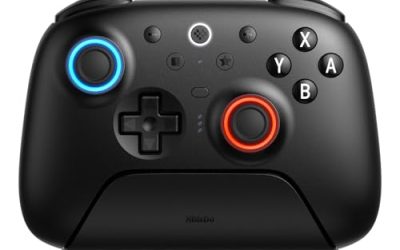
8BitDo Ultimate 2 Bluetooth Controller
A pad for the desk setup, where this record’s full controller support says the game is controller-first. The dock keeps it charged between sessions.
Specs
- Connectivity: Bluetooth wireless and USB-C wired
- Joysticks: TMR electromagnetic, anti-drift design
- Triggers: Hall effect, with mode switching
- Extras: two remappable back buttons, motion control
- In the box: charging dock included
Xbox Wireless Controller, Carbon Black
The default second pad for a Linux desk: it pairs over Bluetooth or its own wireless standard, and Steam Input support is universal.
- Connectivity: Xbox Wireless and Bluetooth
- Port: USB-C for wired play
- Controls: hybrid D-pad, dedicated Share button
- Power: AA batteries or optional rechargeable pack
Logitech G502 HERO
The game is gamepad-first, but its menus, inventory and forge screens are still mouse territory on a desktop Linux install, where a precise wired mouse speeds up long upgrade sessions.
Specs
- HERO optical sensor, up to 25,600 DPI
- 11 programmable buttons
- Adjustable weight system
- Wired USB connection
- On-board memory profiles
Samsung T9 Portable SSD 2TB
The game asks for 2 GB of storage, so this drive is about the library around it: a fast portable SSD holds the native catalogue this site tracks and moves installs between desktop and Deck without a second download.
Specs
- Capacity: 2 TB portable SSD
- Interface: USB 3.2 Gen 2×2, USB-C connector
- Maker-rated speeds: up to 2,000 MB per second read, 1,950 MB per second write
- Features: Dynamic Thermal Guard, maker-rated drop resistance
How to choose
Choose the native build first: it sits in the same package at no extra step, and the one native-marked report in the ProtonDB file is also its cleanest. Choose the Steam Deck with confidence in the hardware and a caveat about the paperwork — the badge grades a pre-release build through Proton, so treat it as a strong signal rather than a test of today’s code. Choose a controller before a mouse: the record’s own field rates support as full. Choose Proton only as a fallback, and if a pad goes undetected under it, the filings point to a GE-Proton build or Proton Experimental as the fix.
Who should skip
Skip the GOG wait: there is no edition of this sequel there, in any operating system, so holding out for a DRM-free copy means not playing it. Skip the purchase if a 7-report Platinum file feels too thin to trust — the native evidence is record-deep, but the community sample is small. Skip it if pre-release Deck paperwork bothers you on principle; the badge will not be re-graded until Valve re-tests. And skip it if the first game’s difficulty put you off; nothing here suggests the sequel softened.
FAQ
Is Tails of Iron 2 native on Linux?
Yes. The record flags Linux true and backs it with a Linux depot of about 5.96 GB holding a current public manifest, a Linux launch entry starting a native 64-bit executable, and Linux requirements populated at both tiers. Two paperwork gaps — no LinuxClientIcon, a Mac-only osextended string — do not change the ruling.
Is Tails of Iron 2 Steam Deck Verified?
Yes, with two caveats. Valve’s sheet resolves to Verified with all four checks passing and SteamOS Compatible, but the test ran on December 11, 2024 against a pre-release build, and its recommended runtime was a Proton release candidate rather than the native build.
How well does the Windows build run under Proton?
ProtonDB’s full summary reads Platinum on all three tiers, from 7 reports at low confidence. The recurring filing note is controller detection: some Proton versions did not see the pad until reporters switched to a GE-Proton build or Proton Experimental. The native build avoids that question entirely.
Can I buy Tails of Iron 2 on GOG?
No. GOG sells the original Tails of Iron and its add-ons, all Windows-only, but holds no edition of this sequel in any operating system. Steam is the only storefront for the game, and its package carries the native Linux build.
Final verdict
Tails of Iron 2: Whiskers of Winter is a genuine native Linux release, and unusually, every layer of the record says so: flags, populated requirements, a full-size Linux depot, a native launch entry, and a family whose three Linux flags include the base game itself. The blemishes are paperwork, not product — a missing client icon entry, a Mac-flavoured osextended string, and a Verified badge grading a pre-release build through Proton instead of the native runtime in the box. Buy it on Steam, run the native build, and let the Platinum Proton file stand as a fallback rather than the main road.
Product and ASIN Reference
| Product | ASIN |
|---|---|
| Valve Steam Deck OLED 512GB | B0CQ3RWQQZ |
| 8BitDo Ultimate 2 Bluetooth Controller | B0F194QFT2 |
| Xbox Wireless Controller, Carbon Black | B08DF248LD |
| Logitech G502 HERO | B07GBZ4Q68 |
| Samsung T9 Portable SSD 2TB | B0CHFS9K14 |