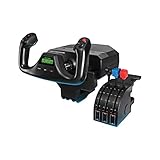
The Logitech G PRO Flight Yoke System is the civilian flight sim pilot’s answer to the question of whether to use a stick or a yoke. For airliner, regional turboprop, business jet and most general-aviation aircraft, real pilots fly with a yoke — a control column with a steering-wheel grip — rather than a fighter stick, and a serious sim setup respects that. The G PRO Yoke is the long-standing consumer benchmark in the category. This Logitech G PRO Flight Yoke System review covers the design, throttle quadrant, compatibility and value at around $300.

Logitech G PRO Flight Yoke System Professional Simulation - Black | Professional simulation, 3 modes, 75 programmable controls, configurable knobs, USB connection


As an Amazon Associate we earn from qualifying purchases. Product prices and availability are accurate as of the date/time indicated.
🛒 Best Price Today on Amazon
Prime members get fast, free shipping on everything above, plus member-only deals. New members get a 30-day free trial — cancel anytime.
As an Amazon Associate we earn from qualifying purchases.


Check Price on Amazon →


Check Price on Amazon →

Logitech G PRO Flight Yoke System at a Glance
| Component | Specification |
|---|---|
| Type | Yoke — push-pull control column with throttle quadrant |
| Compatibility | PC (Windows) — USB |
| Buttons / axes | 14 buttons, 1 hat, 3-axis throttle quadrant |
| Hall-effect sensors | No — standard sensors |
| Hat switches | 1 8-way hat on the yoke |
| Throttle / pedals included | 3-lever throttle quadrant included; rudder pedals sold separately |
| Detachable parts | Throttle quadrant is a separate USB unit; yoke clamps to desk |
| Connection | Wired USB — yoke and quadrant connect independently |
| Approx price | around $300 |
Build Quality & Realism
The G PRO Yoke is heavy, weighted and built to a serious standard. The yoke clamps to a desk edge — the supplied clamp accepts desks from a few millimetres to a couple of centimetres thick — and the column then projects out over the desk with a stainless-steel shaft on a precision rack-and-pinion mechanism. Pulling the yoke pulls smoothly through a long arc with progressive resistance, and rotating it left or right turns the steering-wheel grip with positive centring. The action is unmistakably yoke-like rather than stick-like, with the long travel that real airliner controls have.
The throttle quadrant is a separate three-lever unit that connects to the yoke (or directly to USB) and provides three independent axes — perfect for airliner throttle/prop/mixture in light aircraft, or for separate engine throttles in multi-engine setups. The yoke itself carries 14 programmable buttons and an 8-way hat on the inside of the grip, plus a built-in USB hub that lets the throttle quadrant connect through the yoke to a single PC USB port. Build is heavy plastic with metal mechanical components — closer to professional simulator hardware than to a budget consumer stick.
Compatibility & Platforms
The G PRO Yoke is a PC product, connecting over USB and recognised as a standard HID device. Microsoft Flight Simulator recognises the yoke and throttle quadrant on connection and offers default airliner-style mappings; X-Plane similarly assigns the yoke and quadrant correctly through its joystick dialog. There is no console support — the yoke’s complexity and price reflect a PC-only design.
Logitech G HUB provides additional configuration on Windows, including macro and profile management. The integrated USB hub on the yoke is a thoughtful touch — it lets the throttle quadrant, and indeed other USB peripherals, connect through the yoke without using additional PC USB ports. For the wider sim picture, our best flight sim gear and best flight sim cockpits guides cover yoke, pedals and cockpit setups.
Sim Programs / Game Support
Microsoft Flight Simulator is the natural home of the G PRO Yoke. Heavy airliners, Boeing-style aircraft, business jets, twin turboprops, light singles — all fly more naturally with a yoke than with a stick, and MSFS’s vast aircraft catalogue is largely yoke-friendly. The throttle quadrant’s three levers cover throttle/prop/mixture in light aircraft and twin engines in multi-engine machines.
X-Plane is equally well supported, with study-level airliner add-ons like the ToLiSS or JARDesign Airbus, the FlightFactor Boeings and the Carenado catalogue all working with the G PRO Yoke. Outside the civilian world the yoke is less suitable — combat fighters and aerobatic aircraft are stick-driven and the yoke’s long arc travel is the wrong tool — but the yoke does not stop you flying them, it just is not optimal. For pilots who want a serious civilian sim setup, our best flight sim cockpits guide covers permanent yoke mounts and chairs.
What’s in the Box
The G PRO Yoke ships with the yoke unit itself, the desk clamp (with adjustment for different desk thicknesses), the 3-lever throttle quadrant, the connecting cable between yoke and quadrant, the USB cable from yoke to PC, and a printed manual. The quadrant can be mounted to the desk separately or sit on the desk as a freestanding unit.
What is not included is rudder pedals. Logitech sells the G PRO Flight Rudder Pedals as a matching pedals product, which combined with the yoke and quadrant makes a complete civilian sim setup.
Who It’s For
The G PRO Yoke is for the PC civilian sim pilot — the MSFS airliner enthusiast, the X-Plane general aviation pilot, the student pilot using sim time to supplement real-world training, and the long-term sim pilot who wants a permanent yoke setup rather than a stick on the desk. The build quality justifies a long-term keep and the integrated USB hub is a sensible touch.
It is less suited to combat or aerobatic sim pilots, who want a fighter-style stick; to console players, since there is no console version; or to budget buyers, since the price reflects the build quality. For the civilian PC sim pilot it is the consumer benchmark.
Pros and Cons
Pros: Heavy, weighted yoke with long-throw rack-and-pinion action that mimics real airliner controls; 3-lever throttle quadrant included for throttle/prop/mixture or multi-engine setups; built-in USB hub for the quadrant; clamps firmly to desk edges from thin to thick; 14 programmable buttons and 8-way hat on the yoke grip; broad sim software support in MSFS and X-Plane; long-term keep build quality.
Cons: No Hall-effect sensors; PC-only with no console certification; rudder pedals are not included — the matching G PRO Pedals add significant further cost; yoke geometry is wrong for combat fighter sims; permanent desk-clamp installation reduces portability; chassis is heavy plastic with metal mechanicals rather than full metal throughout; not budget-friendly for sim newcomers.
Verdict
The Logitech G PRO Flight Yoke System has held its position as the consumer civilian yoke benchmark for good reason. At around $300 it delivers a heavy, weighted yoke with long-throw rack-and-pinion action, a separate 3-lever throttle quadrant, a built-in USB hub and broad sim software support. The lack of Hall-effect sensors is the only mild caveat. For the MSFS or X-Plane civilian pilot it is an easy recommendation and a long-term keep.
Frequently Asked Questions
Is the Logitech G PRO Flight Yoke compatible with Microsoft Flight Simulator?
Yes. MSFS recognises the yoke and throttle quadrant on connection and provides default airliner-style mappings. It is one of the most popular yokes for MSFS.
Does the G PRO Yoke include a throttle?
Yes. The G PRO Yoke ships with a separate 3-lever throttle quadrant, perfect for throttle/prop/mixture in light aircraft or multi-engine throttle control.
Does the G PRO Yoke include rudder pedals?
No. Rudder pedals are sold separately. Logitech’s G PRO Flight Rudder Pedals are the matching product within the G PRO ecosystem.
How does the G PRO Yoke attach to a desk?
It uses a supplied desk clamp that adjusts for different desk thicknesses, clamping the yoke firmly to the desk edge.
More Flight Stick & Sim Controller Reviews
- Logitech G PRO Flight Rudder Pedals Review: Civilian Sim Pedals
- MAYFLASH F300 Arcade Fight Stick Review: Multi-Platform Budget Stick
- 8BitDo Arcade Stick Review: Wireless Switch and PC Fight Stick
- Thrustmaster T16000M FCS HOTAS Review: Hall-Effect Joystick + Throttle
- Thrustmaster T-Flight Hotas X Review: Budget HOTAS for PS3 and PC
- Thrustmaster T-Flight Hotas One Review: Xbox-Certified Flight Stick
- Thrustmaster TFRP Flight Rudder Pedals Review: Sliding-Rail Sim Pedals
- Thrustmaster HOTAS Warthog Review: Metal A-10C Replica Flight Stick
Affiliate Disclosure: As an Amazon Associate, we earn from qualifying purchases. If you click a link and make a purchase, we may earn a small commission at no extra cost to you. Prices and availability are accurate as of publication and may change.
Related Articles
Looking for more on this topic? Browse the hand-picked guides below — each one applies the same scoring rubric used in this review.