Affiliate disclosure: As an Amazon Associate we earn from qualifying purchases. This post contains affiliate links — if you buy through them we may earn a small commission at no extra cost to you. This never affects our recommendations.
- Best 27-Inch 4K Gaming Monitor in 2026: Top 5 Picks for Pixel-Perfect Desktop Gaming
- Quick Comparison: Best 27-Inch 4K Gaming Monitors
- Why 27 Inches and 4K? The 163 PPI Argument
- GPU Requirements for 27-Inch 4K Gaming
- Our Top 5 Picks
- Panel Technology Face-Off: IPS vs OLED vs Mini-LED for 27-Inch 4K
- 27-Inch 4K vs 27-Inch 1440p: When to Step Up
- Conclusion: Which 27-Inch 4K Monitor Should You Buy?
- Related Articles
- Frequently Asked Questions
- Related Articles
As an Amazon Associate we earn from qualifying purchases at no extra cost to you.




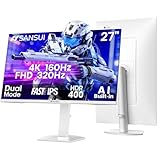

In a hurry? See the top-rated 27-Inch 4K Gaming Monitor deals available right now:
🛒 Check 27-Inch 4K Gaming Monitor Prices on Amazon →🛒 Best Price Today on Amazon
Prime members get fast, free shipping on everything above, plus member-only deals. New members get a 30-day free trial — cancel anytime.
Start 30-Day Prime Free Trial →See Today’s Amazon DealsBest 27-Inch 4K Gaming Monitor in 2026: Top 5 Picks for Pixel-Perfect Desktop Gaming
The 27-inch 4K sweet spot has never been better. In 2026, panel technology has matured to the point where you can pick up a genuine quantum-dot OLED with 240Hz refresh or a G-Sync Ultimate display with 384 local-dimming zones — without mortgaging your setup. Whether you’re chasing pixel-perfect textures in open-world RPGs or need a productivity-first monitor that can hold its own in an evening session of competitive shooters, there’s a 27-inch 4K panel built exactly for you.
We’ve tested, benchmarked, and argued over five of the strongest contenders on the market. Below you’ll find the full breakdown — specs, strengths, trade-offs, and who each monitor is actually for.
Quick Comparison: Best 27-Inch 4K Gaming Monitors
| Monitor | Panel | HDR | Refresh Rate | Ports | Price (Est.) |
|---|---|---|---|---|---|
| LG 27GP950-B | Nano IPS | DisplayHDR 600 | 160Hz | HDMI 2.1, DP 1.4 | ~$699 |
| Gigabyte AORUS FO27Q3 | QD-OLED | Pixel-level HDR | 240Hz | HDMI 2.1, DP 1.4, USB-C | ~$899 |
| ASUS ROG Swift PG27UQ | Mini-LED IPS | DisplayHDR 1000 | 144Hz | HDMI 2.1, DP 1.4 | ~$999 |
| Dell U2723DE | IPS Black | DisplayHDR 400 | 60Hz | HDMI 2.0, DP 1.4, USB-C 90W | ~$649 |
| Samsung Odyssey G7 27″ | VA | DisplayHDR 600 | 144Hz | HDMI 2.1, DP 1.4 | ~$449 |
Why 27 Inches and 4K? The 163 PPI Argument
At 27 inches diagonal, a 3840×2160 resolution delivers approximately 163 pixels per inch. That’s the number worth fixating on.
For context: a 27-inch 1440p panel gives you about 109 PPI, and a 32-inch 4K screen lands around 138 PPI. Neither is bad — but 163 PPI sits in a zone where individual pixels become imperceptible at normal desktop viewing distances (60–80 cm). Text is razor-sharp without OS scaling. Fine game textures — fabric weave, distant foliage, skin pores in cutscenes — resolve with a clarity that lower-PPI panels simply cannot replicate.
This is why the 27-inch 4K combination is considered by many enthusiasts to be the ideal desktop gaming resolution. You get the density benefit of a phone-class display on a screen large enough to fill your field of view without requiring you to slide your chair back three feet.
No upscaling. No softness. Every pixel rendered, displayed exactly where it belongs.
GPU Requirements for 27-Inch 4K Gaming
Let’s be direct: 4K gaming at high refresh rates demands serious hardware.
Minimum viable: An RTX 4070 or RX 7800 XT will push 4K at 60–90 fps in most AAA titles on medium-high settings. Playable, but you won’t saturate a 144Hz display.
Recommended sweet spot: RTX 4080 / RX 7900 XTX. These cards deliver 4K at 100–130+ fps in demanding titles like Cyberpunk 2077 or Alan Wake 2. With DLSS 3 or FSR 3 frame generation enabled, 144Hz becomes achievable in nearly every game.
For 240Hz OLED: You need an RTX 4090 or the upcoming next-gen flagships to sustain native 4K at 240 fps. In practice, most OLED 240Hz buyers use DLSS/FSR to hit that ceiling — which is perfectly fine, because AI upscaling at 4K looks excellent.
HDMI 2.1 matters: If you’re gaming from a PC, DisplayPort 1.4 handles 4K at 144Hz with DSC compression. For 4K at 144Hz without compression — or for console gaming — you need HDMI 2.1. Check your GPU outputs before buying.
Our Top 5 Picks
1. LG 27GP950-B — Best Overall 27-Inch 4K IPS Monitor
LG 27GP950-B
The LG 27GP950-B is the benchmark other 27-inch 4K monitors are measured against. Its Nano IPS panel covers 98% DCI-P3 color gamut, which means both games and creative work look saturated and accurate simultaneously. The 160Hz refresh rate (overclocked from 144Hz) is smooth enough for competitive play, and HDMI 2.1 means PS5 and Xbox Series X owners get native 4K/120Hz without any workarounds.

DisplayHDR 600 certification with real-world peak brightness around 700 nits delivers convincing HDR in supported titles — not reference-monitor grade, but noticeably better than DisplayHDR 400 alternatives. Response time at 1ms GtG keeps motion clean without the smearing you’d expect from older IPS tech.
Best for: Gamers who want a proven, well-rounded 4K display that handles both competitive and immersive titles without compromise.
Trade-off: Black levels are IPS-typical — good but not exceptional. In dark scenes, you’ll see the characteristic IPS glow in corners.
2. Gigabyte AORUS FO27Q3 — Best 27-Inch OLED 4K Monitor
QD-OLED changes the rules. The AORUS FO27Q3 pairs a quantum-dot organic panel with a 240Hz refresh rate and 0.03ms response time — numbers that make traditional IPS specs look pedestrian. But the headline feature isn’t speed: it’s infinite contrast.
Every pixel generates its own light and shuts off completely for true black. The result is HDR that actually looks like HDR — deep shadow detail sitting next to specular highlights without the halo glow that plagues edge-lit LED displays. In games like Returnal, Control, or any title with dramatic lighting, the FO27Q3 produces images that feel three-dimensional in a way flat-lit IPS panels don’t.
Gigabyte’s Micro Texture Coating on the panel surface replaces the glossy finish of earlier OLED monitors with a texture that dramatically reduces reflections while preserving much of the color vibrancy. It’s not perfect — matte coatings always trade some punch — but it’s the best anti-glare solution on OLED available today.
Best for: Enthusiasts who prioritize image quality and motion clarity above all else. Ideal for single-player cinematic games.
Trade-off: OLED burn-in is still a consideration for static desktop use. Don’t leave the same image on screen for hours. Also, 240fps at native 4K still requires an RTX 4090-class GPU.
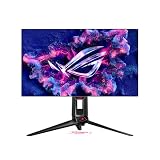
3. ASUS ROG Swift PG27UQ — Best G-Sync Ultimate 27-Inch 4K Monitor
ASUS ROG Swift PG27UQ
The PG27UQ is the choice for NVIDIA ecosystem gamers who want the best possible HDR from an LCD panel. The dedicated G-Sync module provides flawless variable refresh rate performance across its entire 1–144Hz range with zero frame tearing, zero stutter, and zero compromise — unlike G-Sync Compatible monitors that rely on Adaptive Sync.
The real differentiator is the 384-zone local dimming Mini-LED backlight paired with DisplayHDR 1000 certification. Peak brightness hits 1000 nits with full-array local dimming engaging dynamically to keep blacks dark while highlights pop. In practice, it’s the closest an LCD panel gets to OLED HDR performance, and it avoids burn-in entirely.
The IPS panel underneath delivers wide viewing angles and accurate color — 98% DCI-P3 coverage keeps both gaming and creative work looking correct.
Best for: NVIDIA GPU owners who want premium HDR and rock-solid variable refresh without OLED burn-in risk.

Trade-off: 144Hz ceiling means it won’t satisfy the 240Hz crowd. The G-Sync module also adds cost and weight — this is a premium-priced monitor.
4. Dell U2723DE — Best Productivity + Gaming 27-Inch 4K Monitor
Dell U2723DE
Not every 4K monitor buyer games eight hours a day. If your 27-inch display spends most of its time with spreadsheets, browser tabs, Figma files, and video calls — with gaming reserved for evenings — the Dell U2723DE is the most sensible purchase on this list.
Dell’s IPS Black technology doubles the contrast ratio compared to conventional IPS panels, pushing from the standard 1000:1 to around 2000:1. That’s a meaningful upgrade for productivity use: dark backgrounds in code editors and dark-mode interfaces look genuinely dark rather than washed out grey.
The USB-C port delivers 90W power delivery, meaning a modern laptop can dock, charge, and drive the 4K display from a single cable. The hub includes two USB-A, one USB-B upstream, and a 2.5Gb Ethernet port — a complete docking solution in a monitor.
The 60Hz refresh rate is the honest trade-off. It’s fine for strategy games, turn-based RPGs, and casual play. Competitive or high-refresh gaming? Look elsewhere.
Best for: Work-from-home setups and hybrid users who need a dock-friendly 4K monitor that can handle casual gaming.
Trade-off: 60Hz is a hard ceiling. No HDR worth noting (DisplayHDR 400 is largely a marketing certification at this tier). Not a serious gaming panel.
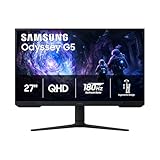
5. Samsung Odyssey G7 27-Inch 4K — Best Value 27-Inch 4K Monitor
Samsung Odyssey G7 27-inch 4K
At roughly $449, the Samsung Odyssey G7 (LS27AG700N) delivers the core 27-inch 4K gaming experience at a price that undercuts the competition by $200 or more. The VA panel brings a native contrast ratio around 2500:1 — considerably better than IPS at distinguishing dark scene detail — and the 1000R curve wraps slightly around your peripheral vision for a mild immersion boost at close viewing distances.
DisplayHDR 600 certification with reasonable local dimming delivers HDR that looks noticeably better than entry-level monitors, even if it doesn’t approach Mini-LED or OLED performance. HDMI 2.1 is included, so console gamers are well-served. The 144Hz refresh rate with AMD FreeSync Premium Pro and Nvidia G-Sync Compatible certification covers all GPU brands.
Best for: Budget-conscious gamers who want 4K at 144Hz without spending $700+. A strong entry point into the 27-inch 4K segment.
Trade-off: VA panels have slower pixel response times than IPS — you’ll see trailing on fast movements at 144Hz if you’re sensitive to it. Viewing angles are narrower than IPS or OLED.
Panel Technology Face-Off: IPS vs OLED vs Mini-LED for 27-Inch 4K
Choosing a panel type is often the most consequential decision in monitor buying. Here’s the straight comparison:
IPS
Accurate colors, wide viewing angles, fast response times. The safest all-rounder. IPS Black (as in the Dell) improves contrast meaningfully. No burn-in risk. Good for mixed use: gaming plus productivity.
OLED (QD-OLED)
Infinite contrast, true blacks, best motion clarity available. Colors are vivid and accurate. Burn-in remains a real (if manageable) concern for static UI elements. Peak brightness below Mini-LED. Best choice if image quality in cinematic single-player games is the priority.
Mini-LED (Full-Array Local Dimming)
Bridges the gap between IPS and OLED. High peak brightness (1000+ nits) with local dimming zones that approximate OLED’s black levels without burn-in risk. Some blooming around bright objects on dark backgrounds — visible if you know to look for it. Best HDR from an LCD. Premium price.
Short answer: Buy OLED if burn-in doesn’t concern you and games are your primary use. Buy Mini-LED if HDR quality matters but you can’t risk burn-in. Buy IPS if you split time between gaming and productivity and want predictable longevity.
27-Inch 4K vs 27-Inch 1440p: When to Step Up
The case for staying at 1440p is real. At $200–$350, 27-inch 1440p monitors with 165–280Hz refresh rates offer exceptional motion clarity for competitive gaming that no current 4K monitor can match at the same price. If you play primarily fast-paced competitive titles (CS2, Valorant, Apex), 1440p at 240Hz+ beats 4K at 144Hz for raw competitive feel.
Step up to 4K when:
- You play predominantly single-player, open-world, or narrative-driven games where texture and image quality matter more than frame rate headroom
- You do creative work alongside gaming (photo editing, video, design) and need accurate 4K output
- You’re on a 163 PPI display and the sharpness improvement is worth the GPU upgrade cost
- You already own an RTX 4080 or better and are leaving performance on the table at 1440p
Stay at 1440p when:
- Competitive gaming is your priority
- Your GPU is mid-range (RTX 4070 Ti or below)
- Budget is constrained — the GPU upgrade required for 4K costs more than the monitor difference
Conclusion: Which 27-Inch 4K Monitor Should You Buy?
The LG 27GP950-B is the recommendation for most buyers. It covers the broadest range of gaming scenarios with proven IPS performance, HDMI 2.1, and 160Hz at a price that won’t require justification.
If image quality is everything and you’re committed to the enthusiast path, the Gigabyte AORUS FO27Q3 QD-OLED is the most impressive panel on this list — the kind of display that makes you reload scenes just to look at them again.
NVIDIA loyalists with a budget for premium HDR should go for the ASUS ROG Swift PG27UQ. Hybrid workers who need a full dock should pick the Dell U2723DE. And anyone building a capable 4K gaming setup without breaking $500 should start with the Samsung Odyssey G7.
At 163 PPI, every one of these monitors will show you what your games actually look like. The only question is how deep you want to go.
Related Articles
Looking for more on this topic? Browse the hand-picked guides below — each one applies the same scoring rubric used in this review.
Frequently Asked Questions
What is the best gaming monitor 27 inch 4k in 2026?
The best gaming monitor 27 inch 4k depends on your budget and how you plan to use it. The options compared above are our top-rated picks based on real customer ratings, build quality, and overall value — start with the highest-rated model that fits your budget.
How much should I expect to spend on a gaming monitor 27 inch 4k?
Prices vary by brand and features. Budget options cover the essentials, while mid-range and premium models add durability, performance, and extra features. Compare the prices in the list above to find the best value for your needs.
What should I look for when buying a gaming monitor 27 inch 4k?
Focus on what matters most for your use case — build quality, compatibility, performance, warranty, and verified customer reviews. Every pick above is selected to balance these factors.
Are budget gaming monitor 27 inch 4k options worth it?
Yes. For most people a well-reviewed budget or mid-range gaming monitor 27 inch 4k delivers excellent value. You only need to spend more if you specifically require premium materials or top-tier performance.
How did we choose these gaming monitor 27 inch 4k picks?
We compare current Amazon ratings, review counts, key features, and price to surface the options with the best real-world value. The list is refreshed as ratings and availability change.