- Top Pick: Golf Daddy Golf at Home Simulator – AI Swing Analyzer & No Ball Practice Trainer – Real-Time Feedback, Outdoor & Indoor Golf Practice Mat for Skill Improvement, and Portable Setup for Daily Training
- Best Value: SLX MicroSim Indoor Mobile Golf Simulator: Fun Interactive Golf with Motion Sensor and Swing Stick for Indoor and Outdoor Golfing – Compatible with Android, iOS, PC (E6 Connect, GSPro, CreativeGolf)
- Premium Choice: Golf Net with Simulator Impact Screen and Target Cloth, 10x8ft Golf Practice Net for Backyard, Portable Heavy Duty Golf Hitting Net for Outdoor Indoor
Building a golf simulator at home used to mean dedicating an entire room to a bulky desktop tower, tangled cables, and a monitor you could never move. In 2026, the smarter play for most golfers is a portable gaming laptop. A capable laptop can drive demanding golf simulator software like GSPro, E6 Connect, and TGC 2019, talk to a launch monitor such as the Garmin Approach R10 or SkyTrak, and push a clean image straight to a projector or TV over HDMI. When your session is done, you close the lid and reclaim your garage. This guide breaks down exactly which gaming laptops make the best golf simulator brains, what specs actually matter for a smooth swing-to-screen experience, and how to match a machine to your budget and your bay.
- Why a Gaming Laptop Is the Smart Choice for a Golf Simulator
- What Specs a Golf Simulator Needs From a Gaming Laptop
- HDMI 2.1 and Output Ports: Connecting to Your Projector or TV
- Thermals: Surviving Long Golf Simulator Sessions
- Connecting a Launch Monitor Over USB or Bluetooth
- Best Gaming Laptops for Golf Simulators in 2026
- Related Guides
- Frequently Asked Questions
- More Gaming Guides
- Related Articles
As an Amazon Associate we earn from qualifying purchases. Prices and availability are accurate as of the date/time indicated and are subject to change.
Related guide: Nobara linux
As an Amazon Associate we earn from qualifying purchases.





🛒 Best Price Today on Amazon
Prime members get fast, free shipping on everything above, plus member-only deals. New members get a 30-day free trial — cancel anytime.
Why a Gaming Laptop Is the Smart Choice for a Golf Simulator
The single biggest reason to run your golf simulator on a laptop is portability. Most home setups live in a garage, a basement, or a spare corner that doubles as something else during the week. A gaming laptop lets you roll your enclosure and hitting mat out of the way, unplug one HDMI cable, and carry the whole computer to a shelf. Nobody wants a 30-pound desktop tower sitting in a dusty garage collecting sawdust and temperature swings from -5°F winter mornings to 95°F summer afternoons. A laptop is easier to store somewhere climate-controlled between rounds.
Portability also means flexibility. Take the same laptop to a buddy’s sim, a launch-monitor fitting, or a driving range with a portable projector screen, and your saved rounds, course library, and settings come with you. Because a modern gaming laptop has its own screen, keyboard, and trackpad built in, you can navigate menus and tune settings without hauling a separate monitor and keyboard into the bay. When it is time to play, one HDMI cable feeds your projector or TV, and you are swinging. For a deeper look at how the room, the mat, and the screen come together, see our complete home golf simulator build guide.
What Specs a Golf Simulator Needs From a Gaming Laptop
Golf simulator software is more GPU-hungry than people expect. GSPro in particular renders photorealistic courses with dense grass, dynamic lighting, and long draw distances, and it wants a strong graphics card to keep frame rates smooth. The good news is you do not need a flagship machine. You need the right balance of GPU, CPU, memory, and storage for the resolution you plan to display.
GPU: The Most Important Part for Golf Sim Graphics
Your graphics card determines whether GSPro looks like a slideshow or a smooth, immersive course. Here is how the current RTX 40-series tiers map to golf simulator use:
- RTX 4050 (budget): Perfectly capable of running GSPro, E6, and TGC at 1080p on a projector or TV with medium-to-high settings. This is the sweet spot if your projector is 1080p, which most home sim projectors are.
- RTX 4060 (mid-range): The best value for most golfers. It handles 1080p at high settings effortlessly and gives you headroom for 1440p, extra visual effects, and future software updates. If you are unsure which tier to buy, this is the safe pick.
- RTX 4070 (high-end): The tier you want if you are driving a 4K projector or a large 4K TV, or if you want maximum settings with buttery frame rates and room to grow. It also pairs well with more demanding titles beyond golf.
As a rule: match the GPU to the projector, not the other way around. A 1080p projector paired with an RTX 4050 or 4060 is a beautifully balanced, budget-friendly sim. A 4K projector deserves an RTX 4070. For a closer comparison of the display side, our golf simulator projector vs TV comparison walks through throw distance, brightness, and resolution.
CPU, RAM, and Storage
The launch monitor does the ball-flight math, but the laptop’s CPU still handles the simulation, physics, and feeding the GPU. A current-generation Intel Core i5/i7 or AMD Ryzen 5/7 is plenty. You do not need the absolute top CPU; a mid-tier chip keeps GSPro fed without bottlenecking your graphics card.
For memory, 16GB of RAM is the practical minimum for a smooth golf simulator experience in 2026, and it is what we recommend for every build. GSPro, your launch monitor’s connector app, and a web browser for scorecards can all run at once without stutter. If a machine offers 32GB at a reasonable price, take it, but 16GB is genuinely fine.
Storage should be a solid-state drive (SSD), never a spinning hard drive. Course packs, especially the huge community library available for GSPro, add up fast. A 512GB SSD is a workable starting point; 1TB is more comfortable if you plan to download dozens of courses. SSDs also load courses far faster, so you spend less time staring at loading screens and more time hitting.
HDMI 2.1 and Output Ports: Connecting to Your Projector or TV
A golf simulator laptop lives or dies by its video output. You want a full-size HDMI port so you can run a single cable to your projector or TV with no dongles. Check that the laptop has HDMI 2.1 if you are running a 4K display at higher refresh rates; HDMI 2.0 is fine for standard 1080p projectors. Most of the gaming laptops in our table below include full HDMI out plus USB-C with DisplayPort, giving you a backup path to the screen.
Cable length matters too. Garage and basement sims often need a 15- to 25-foot HDMI run from the laptop shelf to a ceiling-mounted projector. Buy a certified high-speed HDMI cable rated for the length; a cheap long cable is the number-one cause of flickering or dropped signal in a sim. If your run is very long, an active or fiber HDMI cable solves it. For the full parts rundown, including cables and mounts, check our best budget gaming laptops roundup for cross-shopping on price.
Thermals: Surviving Long Golf Simulator Sessions
A round of 18 holes plus warm-up can keep your laptop’s GPU under load for two hours or more. That is very different from a quick email session, and it is where cheap laptops struggle. Sustained load generates heat, and a laptop with weak cooling will thermal-throttle, dropping frame rates mid-round exactly when you want smooth visuals.
Look for gaming laptops with dual-fan cooling and multiple heat pipes, which every machine in our list has. Set the laptop on a hard, open surface, not carpet or a soft mat, so the intake vents underneath can breathe. In a hot garage, a simple laptop cooling stand or an inexpensive USB fan pad makes a real difference during summer sessions. Finally, keep the laptop plugged into wall power during play; running on battery caps GPU performance to save juice, which tanks your frame rate.
Connecting a Launch Monitor Over USB or Bluetooth
Your launch monitor is what turns a swing into a shot on screen, and connecting it is simpler than most beginners fear. The Garmin Approach R10 connects to the simulator software via Bluetooth, so make sure your laptop has current Bluetooth (5.0 or newer, standard on every laptop here). SkyTrak connects over Wi-Fi or USB depending on the model and software path, and most Bluetooth or Wi-Fi launch monitors pair through their own connector app that hands data to GSPro or E6.
Two practical tips: first, keep the launch monitor and laptop on the same reliable connection with minimal interference, since a crowded 2.4GHz Wi-Fi environment can cause dropped shots. Second, keep a spare USB-A port free for a wired connection or a dongle. Every laptop in the table offers a mix of USB-A and USB-C, so you will not run out of ports for the launch monitor, a wireless mouse, and a charging cable.
Best Gaming Laptops for Golf Simulators in 2026
Here are five best-selling gaming laptops that cover every budget and every projector resolution, from an entry 1080p garage sim to a premium 4K bay. The number-one pick is our Best Overall for the widest range of golfers.
| Laptop | Best for | GPU | Price range | Rating |
|---|---|---|---|---|
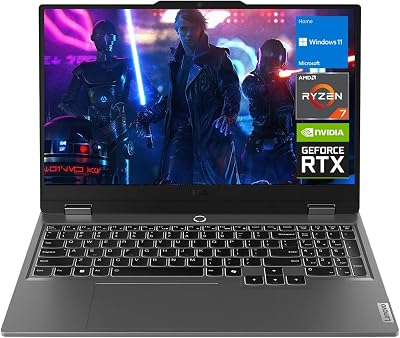
| Lenovo LOQ (Best Overall) | Best all-around 1080p/1440p golf sim value | RTX 4060 | $1,000–$1,200 | 4.7/5 |
| Acer Nitro V | Budget 1080p projector sims | RTX 4050 | $800–$950 | 4.5/5 |
| ASUS TUF Gaming A15 | 4K projectors and max settings | RTX 4070 | $1,300–$1,600 | 4.6/5 |
| HP Victus 15 | Value pick with strong cooling | RTX 4050 | $750–$900 | 4.4/5 |
| Razer Blade 14 | Premium compact portability | RTX 4070 | $2,000–$2,400 | 4.6/5 |
The Lenovo LOQ earns Best Overall because its RTX 4060 hits the ideal price-to-performance point for GSPro on a 1080p or 1440p projector, with solid cooling for long sessions. The Acer Nitro V and HP Victus 15 are the budget champions for 1080p garage sims. Step up to the ASUS TUF Gaming A15 if you run a 4K projector, and choose the Razer Blade 14 if compact size and premium build quality matter more than saving money. Whichever you pick, remember to prioritize the GPU tier that matches your display resolution.
Frequently Asked Questions
What laptop specs do I need for a golf simulator?
For a smooth golf simulator experience in 2026, target an RTX 4050 or 4060 GPU for a 1080p projector or an RTX 4070 for a 4K display, paired with a current Intel Core i5/i7 or AMD Ryzen 5/7 CPU, 16GB of RAM, and a 512GB or larger SSD. Also make sure the laptop has a full-size HDMI output and Bluetooth for your launch monitor. Those specs run GSPro, E6, and TGC comfortably.
Can a gaming laptop run GSPro on a projector?
Yes. A gaming laptop with an RTX 4050 or better connects to a projector with a single HDMI cable and runs GSPro at smooth frame rates. For a standard 1080p projector, an RTX 4050 or 4060 is ideal; for a 4K projector, step up to an RTX 4070. Just keep the laptop plugged into wall power during play so the GPU runs at full performance instead of battery-saving mode.
Is a gaming laptop or desktop better for a golf simulator?
A desktop gives you more raw performance per dollar and easier upgrades, but a gaming laptop wins for most home golf simulators because of portability. Garage and basement sims benefit enormously from being able to move and store the computer, and a laptop’s built-in screen makes setup and menu navigation easier. If your sim lives in a permanent, climate-controlled room, a desktop is worth considering; for everyone else, a laptop is the better fit.
What GPU do I need for a 4K golf simulator projector?
For a 4K projector, an RTX 4070 is the recommended GPU. It has the horsepower to render GSPro’s detailed courses at 4K with high settings and smooth frame rates, plus headroom for future software. An RTX 4060 can technically drive 4K but you may need to lower settings, so if 4K is your goal, budget for the 4070 tier and pair it with an HDMI 2.1 output and a certified high-speed cable.
More Gaming Guides
- Xbox Game Bar Not Recording? How to Fix It (2026)
- Bazzite vs Nobara vs CachyOS: The Best Linux Gaming Distro in 2026
- HDMI vs DisplayPort for Gaming in 2026: Which Should You Use?
Ready to decide? Our #1 pick for 2026 is the Lenovo LOQ.
Live price & availability on Amazon.