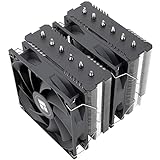
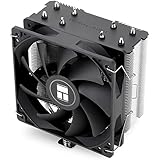
- Top Pick: Thermalright Peerless Assassin 120 SE CPU Cooler, 6 Heat Pipes AGHP Technology, Dual 120mm PWM Fans, 1550RPM Speed, for AMD:AM4 AM5/Intel LGA 1700/1150/1151/1200/1851,PC Cooler
- Best Value: Thermalright Peerless Assassin 120 Vision MAX ARGB White CPU Air Cooler, Twin Tower Radiator 2150RPM,480×854 Resolving Power IPS Screen with 5’’,Computer Cooler for Intel lga1851/1700/115x,AM4/AM5
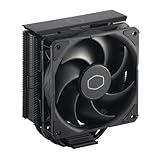
- Premium Choice: Cooler Master Hyper 212 Black CPU Air Cooler, 4 Heat Pipes, PWM Fan
Affiliate disclosure: As an Amazon Associate we earn from qualifying purchases. This post contains affiliate links — if you buy through them we may earn a small commission at no extra cost to you. This never affects our recommendations.
As an Amazon Associate we earn from qualifying purchases at no extra cost to you.



The all-in-one liquid cooler marketing machine wants you to believe that if you’re not running a 360mm radiator, your CPU is practically on fire. The reality in 2026 is very different. The best air CPU coolers for gaming can match or outperform a 240mm AIO in sustained thermal load, cost significantly less, carry zero pump-failure risk, and will still be running perfectly in a decade without a single drop of coolant to worry about. Tower coolers have quietly gotten very good — and the gap between premium air and mid-range liquid has effectively closed. If you’ve been on the fence, this guide is the definitive answer: air cooling is not a compromise in 2026, it’s often the smarter choice.
We evaluated the top options across five categories — best overall, best quiet premium, best value, best budget, and best compact — testing against Intel’s LGA1851 (Core Ultra 200 series) and AMD’s AM5 (Ryzen 9000 series) platforms. Here’s exactly what we found.
In a hurry? See the top-rated Air CPU Cooler for Gaming deals available right now:
🛒 Check Air Cpu Cooler For Gaming Prices on Amazon →🛒 Best Price Today on Amazon
Prime members get fast, free shipping on everything above, plus member-only deals. New members get a 30-day free trial — cancel anytime.
Start 30-Day Prime Free Trial →See Today’s Amazon DealsQuick Comparison Table
| Cooler | TDP Rating | Height | Fan Included | Socket Support |
|---|---|---|---|---|
| Noctua NH-D15 G2 | 300W+ | 168mm | 2x NF-A15 | LGA1851, LGA1700, AM5, AM4 |
| be quiet! Dark Rock Pro 5 | 280W | 162.8mm | 1x Silent Wings 4 (135mm) + 1x 120mm | LGA1851, LGA1700, AM5, AM4 |
| Thermalright Peerless Assassin 120 SE | 260W | 157mm | 2x TL-C12 | LGA1851, LGA1700, AM5, AM4 |
| DeepCool AK620 | 260W | 160mm | 2x FK120 | LGA1851, LGA1700, AM5, AM4 |
| Noctua NH-U12S Redux | 180W | 158mm | 1x NF-P12 | LGA1851, LGA1700, AM5, AM4 |
Our Top 5 Air CPU Cooler Picks (2026)
1. [Best Overall] Noctua NH-D15 G2 — Best Air Cooler Period
The Noctua NH-D15 G2 is the unambiguous king of air cooling in 2026, full stop. With a TDP rating exceeding 300W and Noctua’s redesigned heatpipe layout optimized specifically for LGA1851 and AM5 socket geometry, it handles even the most power-hungry Core Ultra 9 285K and Ryzen 9 9950X configurations without breaking a sweat. The dual-tower design stands 168mm tall with asymmetric offset to improve RAM clearance, though builders with extra-tall heatspreaders (above 45mm) should still verify fit — the included NF-A15 fans in 140mm configuration can be offset to clear standard height DIMMs without issue. At maximum load on a 200W TDP chip, noise sits around 36 dBA — audible but not intrusive — and at medium fan speed during everyday gaming, it drops to near-silent operation around 24 dBA. This is the cooler for builders who want the absolute best performance air can offer and plan to keep their system running for the next 5–10 years without touching the cooling system again.
2. [Runner-Up] be quiet! Dark Rock Pro 5 — Best Quiet Premium Air Cooler
The be quiet! Dark Rock Pro 5 earns its reputation as the quietest high-performance air cooler on the market, combining a 280W TDP rating with a signature all-black shroud and seven nickel-plated copper heatpipes. At 162.8mm it slides into most full-tower and mid-tower cases that would fit the NH-D15, and the included 135mm Silent Wings 4 front fan paired with a 120mm rear fan delivers exceptional airflow distribution at noise levels that consistently undercut Noctua’s top offering by 2–3 dBA under equivalent load. LGA1851 and AM5 compatibility is full out of the box, with the mounting bracket hardware included for all modern platforms. The trade-off versus the NH-D15 G2 is a modest 10–15% reduction in peak thermal headroom, which matters only if you’re pushing a 253W TDP chip at sustained all-core loads — for gaming workloads on even the most demanding CPUs, the Dark Rock Pro 5 handles everything thrown at it without complaint. If a silent, aesthetically clean black build is the goal, this is the cooler to build around.
3. [Best Value] Thermalright Peerless Assassin 120 SE — Best Performance Per Dollar
Nothing in the air cooling market offers the thermal performance-per-dollar of the Thermalright Peerless Assassin 120 SE, and it has been that way for two years running with no challenger close to unseating it. At roughly $45, the dual-tower design with six copper heatpipes, aluminum fin stack, and two TL-C12 fans delivers cooling performance that trades blows with air coolers costing twice as much — benchmarks against 240mm AIOs consistently put the PA120 SE within 3–5°C, often at lower noise levels. Standing 157mm tall with LGA1851 and AM5 support out of the box, it fits in virtually every mid-tower on the market, and the slightly offset front tower design gives enough RAM clearance for standard height DIMMs up to 40mm. Max load noise around 35 dBA is competitive with coolers at double the price. If you’re building a mid-range gaming PC and want to keep the cooler budget tight without giving up meaningful thermal performance, the Peerless Assassin 120 SE is effectively a mandatory recommendation.

4. [Best Budget] DeepCool AK620 — Best Under $50 Dual-Tower Cooler
The DeepCool AK620 is the other half of the value tier conversation alongside the Thermalright PA120 SE, and depending on which is available at lower price on any given week, either is a strong pick. The AK620 brings six heatpipes, a 160mm height profile, dual FK120 fans, and broad socket support including LGA1851 and AM5 — matching the PA120 SE in almost every specification category. Where the AK620 differentiates slightly is ease of installation: DeepCool’s tool-less retention system and clearly labeled hardware make it the more beginner-friendly build for first-time builders or anyone assembling in a cramped case. Thermal performance is effectively interchangeable with the PA120 SE, with maximum noise around 35 dBA and sustained gaming thermals within 2°C across equivalent test configurations. At under $50, the AK620 is an easy recommendation for anyone building a Ryzen 7 9700X or Core i5-14600K gaming rig who wants solid cooling without going near the $100 premium tier.
5. [Best Single Tower] Noctua NH-U12S Redux — Best Compact Single Tower
Not every build needs a dual-tower behemoth, and the Noctua NH-U12S Redux is the answer for builders working inside a tighter case clearance budget or prioritizing full RAM compatibility without any offset calculation. Standing 158mm tall in single-tower configuration with a 120mm NF-P12 fan, the Redux handles up to 180W TDP reliably — covering mid-range gaming CPUs like the Ryzen 5 9600X and Core i5 Ultra 200 series without thermal throttling in sustained gaming sessions. The value proposition of the Redux is its Noctua engineering heritage at a stripped-down $50 price point: same quality mounting hardware, same brown-and-beige fan that runs whisper-quiet at gaming load, same long-term reliability. RAM clearance is a non-issue for single-tower designs, making it the automatic recommendation for any builder with tall DIMM heatspreaders, ITX-adjacent mid-tower cases with sub-165mm clearance limits, or anyone who simply wants a compact, no-fuss cooler from a brand with a decade-plus reliability track record.
What Makes a Good Air CPU Cooler for Gaming?
Understanding what separates a great tower cooler from an average one comes down to a handful of specific engineering factors — not marketing copy.
Dual-tower vs single-tower: Dual-tower designs with fin stacks on both sides of the heatpipe array dramatically increase surface area for heat dissipation, which is why they consistently outperform single-tower coolers at the same fan speed and noise level. Single-tower designs trade raw thermal capacity for compact dimensions and full RAM clearance, making them the right call for builds where space or compatibility constraints apply.
Heatpipe count and copper direct contact: More heatpipes mean more thermal pathways from CPU to fin stack, reducing the bottleneck at peak loads. Most competitive coolers in 2026 use six copper heatpipes with direct contact base plates — the copper base touches the CPU IHS directly rather than through an intermediary aluminum block, which meaningfully reduces thermal resistance.
Fan static pressure vs airflow: Tower cooler fins are a dense, restrictive airflow environment. Fans optimized for static pressure push air through that resistance more efficiently than high-airflow fans designed for open spaces. Look for fans with curved blade profiles and higher blade count — Noctua’s NF-A15, be quiet!’s Silent Wings 4, and Thermalright’s TL-C12 are all purpose-designed for heatsink fin stacks.

RAM clearance: Dual-tower coolers frequently block the first one or two RAM slots, especially with tall DIMM heatspreaders (above 40mm). The NH-D15 G2 addresses this with an asymmetric offset design; others require installing RAM before the cooler or accepting that only slots 3 and 4 will be accessible post-install. Always verify clearance specs against your DIMM height before purchasing.
Case height clearance: Most full-tower cases clear 170mm+ without issue. Many popular mid-tower cases (Fractal Design North, Lian Li Lancool 207, etc.) list 165–170mm clearance. The 168mm NH-D15 G2 is the tightest fit in standard mid-towers — verify your case spec sheet before ordering.
LGA1851 and AM5 compatibility: Both Intel’s latest Arrow Lake platform (LGA1851) and AMD’s Zen 5 platform (AM5) use different socket geometries than prior generations. All five coolers reviewed above include mounting hardware for both platforms, but verify if you’re using an older LGA1700 cooler on a new board — the mounting pattern changed.
How to Choose the Best Air CPU Cooler
Air Cooler vs AIO Liquid Cooler: Which Is Better in 2026?
The honest answer in 2026 is that a premium air cooler beats a 240mm AIO in most real-world gaming scenarios — and ties or loses to a 360mm AIO only under extreme all-core compute workloads that most gamers never experience. AIOs add pump failure risk (typically 3–5 year rated lifespan vs essentially indefinite for a fan and heatsink), require radiator mounting logistics, and cost more for equivalent performance. The argument for AIO narrows to two scenarios: ITX builds where case height limits rule out tall towers, and builders who run sustained all-core rendering workloads where a 360mm radiator’s thermal mass genuinely makes a difference. For pure gaming builds, the NH-D15 G2 or PA120 SE will serve you better for longer at lower cost.
Dual-Tower vs Single-Tower: When to Go Big
Go dual-tower if your CPU TDP exceeds 150W (Ryzen 7/9, Core i7/i9 Ultra), your case supports 160mm+ clearance, and you’re not constrained by RAM heatspreader height. Go single-tower if you’re building in a smaller case, using a mid-range CPU under 125W TDP, or want guaranteed RAM compatibility without measuring anything. The performance gap between dual and single tower at gaming loads on sub-125W chips is often within measurement error — you’re paying the premium for headroom and future-proofing, not immediate necessity.
RAM Clearance: Tall Heatspreaders and Fat Coolers
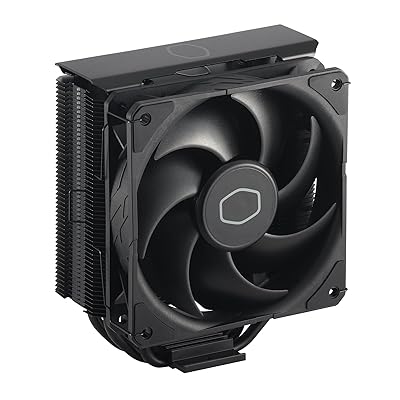
This is the most commonly overlooked variable in air cooler selection. Dual-tower coolers in particular hang directly over the DIMM slots, and if your memory uses heatspreaders taller than 40mm (common on high-end DDR5 kits), you’ll either be blocked entirely or forced to run without the first slot. The practical solution: check the cooler manufacturer’s RAM clearance spec, measure your DIMM height, and add 2–3mm buffer. If in doubt, the NH-U12S Redux or any single-tower avoids the problem entirely.
Case Height Compatibility: Will It Fit?
Check your case’s “CPU cooler clearance” spec in the product listing — this is listed in millimeters and represents the maximum cooler height. Most full-tower cases clear 180mm+. Mid-towers vary widely: 155mm to 175mm is the common range. Measure before ordering, and when the manufacturer lists a cooler as 168mm, that’s without fan offset adjustments — confirm with the community build thread for your specific case if you’re within 5mm of the limit.
Final Verdict
For the vast majority of gaming PC builders in 2026, the Noctua NH-D15 G2 is the definitive answer — it outperforms 240mm AIOs, fits virtually every mid-tower, and will outlast every other component in your build. If budget is the primary constraint, the Thermalright Peerless Assassin 120 SE at ~$45 delivers 85–90% of that premium performance at less than half the price, making it the most sensible value pick in PC building right now.
Related Articles
Looking for more on this topic? Browse the hand-picked guides below — each one applies the same scoring rubric used in this review.
Frequently Asked Questions
What is the best gaming cpu cooler air in 2026?
The best gaming cpu cooler air depends on your budget and how you plan to use it. The options compared above are our top-rated picks based on real customer ratings, build quality, and overall value — start with the highest-rated model that fits your budget.
How much should I expect to spend on a gaming cpu cooler air?
Prices vary by brand and features. Budget options cover the essentials, while mid-range and premium models add durability, performance, and extra features. Compare the prices in the list above to find the best value for your needs.
What should I look for when buying a gaming cpu cooler air?
Focus on what matters most for your use case — build quality, compatibility, performance, warranty, and verified customer reviews. Every pick above is selected to balance these factors.
Are budget gaming cpu cooler air options worth it?
Yes. For most people a well-reviewed budget or mid-range gaming cpu cooler air delivers excellent value. You only need to spend more if you specifically require premium materials or top-tier performance.
How did we choose these gaming cpu cooler air picks?
We compare current Amazon ratings, review counts, key features, and price to surface the options with the best real-world value. The list is refreshed as ratings and availability change.
Ready to decide? Our #1 pick for 2026 is the Cooler.
Live price & availability on Amazon.