- Top Pick: ASUS TUF Gaming LC III ARGB 360mm AMD/Intel Gaming Liquid CPU Cooler
- Best Value: ARCTIC Liquid Freezer III Pro 360 A-RGB – AIO CPU Cooler, Water Cooling
- Premium Choice: CORSAIR Nautilus 360 RS ARGB Liquid CPU Cooler – 360mm AIO – Low-Noise – Direct Motherboard Connection – Daisy-Chain – Intel LGA 1851/1700, AMD AM5/AM4 – 3X RS120 ARGB Fans Included – Black
Affiliate disclosure: As an Amazon Associate we earn from qualifying purchases. This post contains affiliate links — if you buy through them we may earn a small commission at no extra cost to you. This never affects our recommendations.
As an Amazon Associate we earn from qualifying purchases at no extra cost to you.


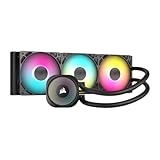


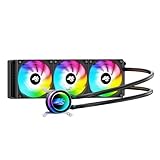

If you’re pushing a high-TDP processor like the Intel Core i9-14900K or AMD Ryzen 9 9950X, a 240mm AIO simply won’t cut it under sustained gaming or workload stress. A 360mm AIO liquid cooler gives your CPU the radiator surface area it needs to shed heat efficiently — keeping clocks stable, noise low, and thermal throttling out of the equation. But with dozens of triple-fan AIOs on the market in 2026, choosing the right one means weighing radiator thickness, pump quality, fan performance, software ecosystems, and yes, whether you actually need a display on your pump head. This guide cuts through the noise and presents the five best 360mm AIO liquid coolers for gaming right now, followed by a practical buying guide so you can match the right cooler to your build.
In a hurry? See the top-rated 360mm AIO Liquid Cooler for Gaming deals available right now:
🛒 Check 360Mm Aio Liquid Cooler For Gaming Prices on Amazon →🛒 Best Price Today on Amazon
Prime members get fast, free shipping on everything above, plus member-only deals. New members get a 30-day free trial — cancel anytime.
Start 30-Day Prime Free Trial →See Today’s Amazon DealsQuick Comparison Table
| Product | Radiator Size | Fans | TDP Rating | Display | RGB |
|---|---|---|---|---|---|
| Arctic Liquid Freezer III 360 | 360mm × 38mm | 3× P12 PWM PST | 400W+ | None | None |
| Corsair iCUE H150i Elite LCD XT | 360mm × 27mm | 3× 120mm PWM | 350W+ | 2.1″ IPS LCD | Yes |
| NZXT Kraken 360 | 360mm × 27mm | 3× 120mm F Series | 350W+ | 2.36″ Infinity Mirror | Yes |
| Lian Li Galahad II Trinity 360 | 360mm × 27mm | 3× SL-INF 120mm | 350W+ | Triple Infinity Mirror | ARGB |
| Thermalright Frozen Prism 360 White ARGB | 360mm × 27mm | 3× TL-C12CW | Not Rated | None | ARGB |
Our Top Picks
1. Arctic Liquid Freezer III 360 — Best Overall Performance
The Arctic Liquid Freezer III 360 is the performance benchmark in the 360mm AIO category for 2026. Arctic’s 38mm thick radiator — 11mm thicker than most competitors — dramatically increases coolant volume and surface area, translating directly into better heat dissipation under sustained loads. Paired with three Arctic P12 PWM PST fans optimized for static pressure, this cooler handles 400W TDP chips without breaking a sweat, making it the go-to choice for Intel’s most power-hungry processors.
The pump head is compact and practical — no display, no excess RGB — and the VRM fan built into the pump bracket is a genuinely useful feature that pushes airflow toward the socket area, benefiting nearby components like VRMs and M.2 slots. At around $109, it delivers thermal performance that rivals or beats AIOs priced $60–$80 higher.
Pros
- 38mm thick radiator delivers class-leading thermal performance
- Handles 400W+ TDP processors without throttling
- Built-in VRM fan provides supplemental socket area cooling
- Excellent value — top-tier cooling at a mid-range price
- Strong long-term reliability record from Arctic
Cons
- No pump head display or RGB for aesthetics-focused builders
- Software ecosystem is minimal compared to Corsair or NZXT
- Slightly heavier and bulkier installation due to thick radiator
2. Corsair iCUE H150i Elite LCD XT — Best Premium AIO with Display
Corsair iCUE H150i Elite LCD XT
The Corsair iCUE H150i Elite LCD XT is the premium choice for builders who want both exceptional cooling and a showcase-worthy aesthetic. The 2.1-inch IPS LCD display on the pump head can show CPU temperatures, fan RPM, custom images, or animated GIFs — a genuine talking point in any windowed case build. Three Corsair 120mm PWM fans provide strong airflow, and the iCUE software ecosystem is one of the most mature in the industry, integrating seamlessly with other Corsair RGB components.
Thermal performance is excellent but not quite at the level of the Arctic’s thicker radiator. You’re paying a premium for the display, software integration, and Corsair’s brand ecosystem. If your setup already runs iCUE for keyboard and RAM, this AIO slides in naturally. For pure thermal-per-dollar, it trails the Arctic — but for the all-in-one aesthetic package, it’s unmatched.
Pros
- 2.1″ IPS LCD display is bright, sharp, and fully customizable
- Deep iCUE software integration with other Corsair peripherals
- Strong 360mm thermal performance suitable for high-TDP CPUs
- Premium build quality and polished installation experience
- Wide compatibility across Intel and AMD platforms
Cons
- $199 price tag is steep compared to performance-only alternatives
- iCUE software can be resource-heavy and occasionally buggy
- LCD display adds failure point over time
- Radiator is standard 27mm thickness, not as thermally dense as Arctic
3. NZXT Kraken 360 — Best Design-Forward AIO

The NZXT Kraken 360 occupies the sweet spot between the Corsair’s LCD sophistication and a cleaner, more restrained aesthetic. The 2.36-inch infinity mirror display on the pump head produces a striking depth effect with RGB lighting, and NZXT’s CAM software is widely regarded as one of the lightest and most user-friendly monitoring suites available. Three NZXT F-Series 120mm fans deliver reliable airflow with reasonable noise levels.
Thermal performance lands between the Arctic and budget options — capable of handling modern gaming CPUs without issue, though it begins to show limits with the most extreme workloads. The clean cable routing and NZXT’s consistent product design make it a natural fit for NZXT case owners or any builder who values a tidy, minimal aesthetic. At $179, it’s priced competitively for what it delivers aesthetically, though the thermals don’t justify the cost premium over the Arctic purely on numbers.
Pros
- 2.36″ infinity mirror display creates a dramatic visual effect
- CAM software is lightweight, stable, and beginner-friendly
- Clean industrial design fits a wide range of build aesthetics
- Reliable performance across Intel and AMD platforms
- NZXT ecosystem compatibility (cases, fans, controllers)
Cons
- Thermal performance trails the Arctic Liquid Freezer III at this price
- CAM software feature set is narrower than Corsair iCUE
- F-Series fans are adequate but not class-leading for static pressure
- Infinity mirror display is more subtle than Corsair’s IPS LCD in daylight
4. Lian Li Galahad II Trinity 360 — Best ARGB Showcase AIO
Lian Li Galahad II Trinity 360
Lian Li’s Galahad II Trinity 360 is built for builders who want maximum visual impact without compromising on cooling. The SL-INF fans are genuinely impressive — each fan features an infinity mirror effect with ARGB lighting that synchronizes across all three, and the pump head adds a third infinity mirror element. The visual effect when all three fans and the pump head light up in unison is among the most striking of any AIO currently available.
Thermally, the Galahad II Trinity performs well, handling mainstream high-performance CPUs comfortably. The SL-INF fans are also acoustically decent given their visual complexity. At $189, it’s priced just under the Corsair but offers a more unique aesthetic proposition. The one drawback is the wiring complexity — managing ARGB and PWM connections for three infinity mirror fans requires careful cable management. Lian Li’s L-Connect software handles the RGB synchronization well.
Pros
- Triple infinity mirror fans create an unmatched visual effect
- Solid thermal performance suitable for most gaming builds
- L-Connect software handles ARGB sync reliably
- SL-INF fans are acoustically competitive despite complex design
- Strong build quality consistent with Lian Li’s standards
Cons
- Cable management is more complex due to per-fan ARGB connectors
- $189 price is hard to justify purely on thermals vs. cheaper alternatives
- L-Connect software ecosystem is smaller than Corsair or NZXT
- Pump head infinity mirror is smaller and less impactful than the fans themselves
5. Thermalright Frozen Prism 360 White ARGB — Best Budget 360mm AIO
Thermalright Frozen Prism 360 White ARGB
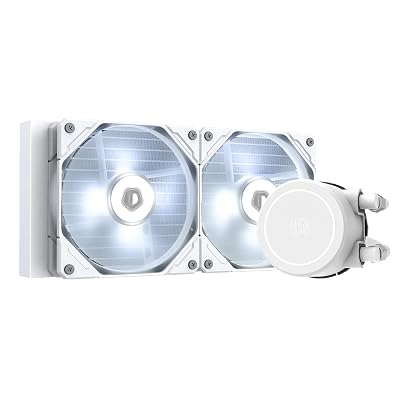
At roughly $69, the Thermalright Frozen Prism 360 White ARGB is one of the most remarkable value propositions in PC cooling. Thermalright has built a reputation for delivering performance that punches well above its price point, and the Frozen Prism 360 continues that tradition. Three TL-C12CW ARGB fans provide solid airflow, and the white colorway with ARGB lighting makes it visually competitive with AIOs that cost two to three times as much.
Thermal performance is genuinely good for gaming workloads. It won’t match the Arctic’s raw TDP ceiling or Corsair’s polish, but for mainstream gaming CPUs — even the Ryzen 9 9900X or Core i7-14700K — it keeps temperatures in check during extended gaming sessions. There’s no pump head display and no proprietary software, which keeps complexity minimal. For a first 360mm AIO build or a budget-focused performance rig, it’s an outstanding choice.
Pros
- ~$69 price makes 360mm cooling accessible on tighter budgets
- ARGB fans look excellent in windowed cases
- Competitive thermals for mainstream gaming CPUs
- No software dependency — plug and play simplicity
- White colorway is increasingly rare and visually clean
Cons
- No pump head display or premium aesthetic features
- TDP ceiling falls short of Arctic for extreme workloads (400W+)
- Build quality is good but not at the level of Corsair or NZXT
- No proprietary software means limited fan curve customization without third-party tools
How to Choose the Best 360mm AIO Liquid Cooler
360mm vs 240mm AIO: Is Bigger Always Better
The short answer: bigger is better for thermal headroom, but only if your case supports it and your CPU warrants it. A 360mm radiator provides roughly 50% more surface area than a 240mm unit, which translates directly into lower CPU temperatures and quieter fan operation at equivalent loads. For CPUs with TDPs above 200W — Intel’s Core i9 lineup, AMD’s Ryzen 9 chips, or any heavily overclocked processor — a 360mm AIO is the clear choice.
That said, a quality 240mm AIO is perfectly adequate for midrange CPUs like the Ryzen 7 9700X or Core i5-14600K. You’re paying more for a 360mm unit in both dollars and case space. Only step up to 360mm if your CPU genuinely benefits from the additional cooling capacity, or if you value the lower fan speeds and quieter acoustic profile that more radiator area allows.
Pump Head Features and Software Ecosystems
The pump head is what you see every time you look through your side panel. A display adds visual interest but also cost, complexity, and a potential long-term failure point. If you run an existing ecosystem — say, Corsair iCUE for your keyboard and RAM — matching your AIO to that ecosystem simplifies your software stack considerably.
For builders who don’t want software overhead, the Arctic Liquid Freezer III and Thermalright Frozen Prism offer no-software-required operation. Fan curves can still be managed through your motherboard’s BIOS or a tool like Fan Control. For builders who want tight RGB integration and on-screen monitoring, Corsair iCUE or NZXT CAM are the most polished options.
Fan Quality and Airflow at 360mm
With three fans on a 360mm radiator, fan quality matters enormously. Static pressure fans are preferable for radiator mounting — they push air through the dense fin stack more effectively than high-airflow fans optimized for open-air movement. Arctic’s P12 fans are widely regarded as the best value high-static-pressure fans available. Corsair’s LL120 and NZXT’s F-Series are solid performers. Thermalright’s TL-C12CW fans punch above their price.
Pay attention to fan speed ranges and noise levels. Most 360mm AIOs run their fans between 500–2000 RPM. At idle or light gaming loads, well-configured AIOs are nearly silent. Under sustained all-core loads, cheaper fans can become noticeably loud. Check independent noise measurements rather than manufacturer dB ratings, which are often measured under ideal conditions.
Case Compatibility for 360mm Radiators
Before purchasing a 360mm AIO, confirm your case explicitly supports a 360mm radiator. Most mid-tower cases support 360mm on the front panel; fewer support it on the top. Check your case specifications for both the radiator length (360mm) and the maximum radiator thickness supported — this is critical if you’re considering the Arctic Liquid Freezer III 360 with its 38mm radiator, which exceeds the standard 27mm thickness that some cases max out at.
Also consider RAM clearance when mounting a 360mm AIO on the top. Some top-mount configurations place the radiator directly above the DIMM slots, and tall RAM heatspreaders can create clearance conflicts. Front-mount installations generally avoid this issue but may require you to reverse your airflow configuration.

Noise Levels at Load
One underrated advantage of 360mm AIOs over 240mm units is the acoustic benefit. With more radiator surface area, the fans don’t need to spin as fast to achieve the same cooling result, which directly reduces noise. In practice, a well-configured 360mm AIO running a power-efficient gaming CPU is nearly inaudible during normal gaming sessions.
If noise is a priority, look for AIOs with fans that have wide PWM ranges (allowing very low minimum RPMs) and smooth bearing types. Fluid dynamic bearings (FDB) are generally quieter and longer-lasting than sleeve bearings. Most premium AIOs from Corsair, NZXT, and Arctic use FDB or equivalent quality bearings. The Thermalright at its price point also uses acceptable bearing quality for the cost.
Final Verdict
For pure thermal performance and value, the Arctic Liquid Freezer III 360 is the best 360mm AIO liquid cooler for gaming in 2026. Its 38mm radiator, high-quality P12 fans, and no-frills reliability make it the rational choice for anyone whose primary goal is keeping a powerful CPU cool without overspending.
If you want a premium showcase build with display integration, the Corsair iCUE H150i Elite LCD XT is the most polished all-in-one package. For a lighter software footprint with good looks, the NZXT Kraken 360 is a strong alternative. Builders chasing the most dramatic ARGB visual effect should look at the Lian Li Galahad II Trinity 360. And for anyone building a capable gaming rig on a tight budget, the Thermalright Frozen Prism 360 White ARGB at ~$69 is simply hard to argue with.
Match your choice to your CPU’s TDP, your case’s radiator clearance, and your aesthetic priorities — and any of these five coolers will keep your gaming rig running cool and stable through long sessions in 2026.
Related Articles
Looking for more on this topic? Browse the hand-picked guides below — each one applies the same scoring rubric used in this review.
Frequently Asked Questions
What is the best gaming cooling 360mm aio in 2026?
The best gaming cooling 360mm aio depends on your budget and how you plan to use it. The options compared above are our top-rated picks based on real customer ratings, build quality, and overall value — start with the highest-rated model that fits your budget.
How much should I expect to spend on a gaming cooling 360mm aio?
Prices vary by brand and features. Budget options cover the essentials, while mid-range and premium models add durability, performance, and extra features. Compare the prices in the list above to find the best value for your needs.
What should I look for when buying a gaming cooling 360mm aio?
Focus on what matters most for your use case — build quality, compatibility, performance, warranty, and verified customer reviews. Every pick above is selected to balance these factors.
Are budget gaming cooling 360mm aio options worth it?
Yes. For most people a well-reviewed budget or mid-range gaming cooling 360mm aio delivers excellent value. You only need to spend more if you specifically require premium materials or top-tier performance.
How did we choose these gaming cooling 360mm aio picks?
We compare current Amazon ratings, review counts, key features, and price to surface the options with the best real-world value. The list is refreshed as ratings and availability change.