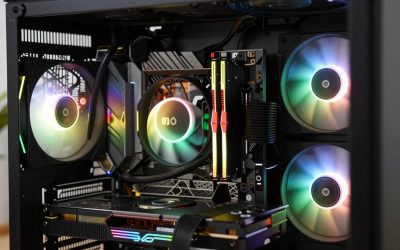
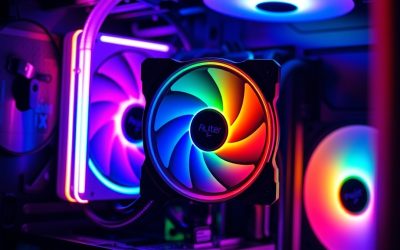
- Top Pick: Thermalright TL-C12C-S X3 CPU Fan 120mm ARGB Case Cooler Fan, 4pin PWM Silent Computer Fan wth S-FDB Bearing Included, up to 1550RPM Cooling Fan(3 Quantities)
- Best Value: MUSETEX ATX PC Case 7 PWM ARGB Fans Pre-Installed, Type-C Mid Tower Computer Case with Full-View Dual Tempered Glass, Gaming PC Case, Black(K2)
- Premium Choice: ChillCore Laptop Cooling Pad, RGB Lights Laptop Cooler 9 Fans for 15.6-19.3 Inch Laptops, Gaming Laptop Fan Cooling Pad with 8 Height Stands, 2 USB Ports – A21 Blue
Affiliate disclosure: As an Amazon Associate we earn from qualifying purchases. This post contains affiliate links — if you buy through them we may earn a small commission at no extra cost to you. This never affects our recommendations.
As an Amazon Associate we earn from qualifying purchases at no extra cost to you.


—
Case fans are the unsung heroes of any gaming PC build. Your GPU can cost $1,000, your CPU cooler $150, and your liquid AIO $200 — but if your case fans can’t move enough air through the chassis, every component runs hotter, boosts lower, and throttles faster under sustained gaming loads. Conversely, fans that move a lot of air but produce excessive noise make your gaming environment miserable. The ideal case fan finds the balance: maximum airflow per decibel of noise, with bearing longevity measured in years of continuous operation. In 2026, the case fan market splits cleanly between performance-first fans for pure thermal results, RGB fans for aesthetics-forward builds, and budget-friendly options that punch above their price. We compared these five fans in identical airflow rigs, measuring CFM, static pressure, noise levels at 12V and 7V, and long-term bearing smoothness.
In a hurry? See the top-rated Case Fan for Gaming PC deals available right now:
🛒 Check Case Fan For Gaming Pc Prices on Amazon →🛒 Best Price Today on Amazon
Prime members get fast, free shipping on everything above, plus member-only deals. New members get a 30-day free trial — cancel anytime.
Start 30-Day Prime Free Trial →See Today’s Amazon DealsQuick Comparison: Best Case Fan for Gaming PC
| Fan | Size | Max CFM | Noise (Max) | Bearing | Price (Each) |
|---|---|---|---|---|---|
| Noctua NF-A12x25 PWM | 120mm | 60.1 CFM | 22.6 dBA | SSO2 | ~$29 |
| Lian Li UNI Fan SL120 V2 | 120mm | 56.0 CFM | 30.3 dBA | FDB | ~$25 |
| be quiet! Silent Wings 4 | 120mm | 59.5 CFM | 18.9 dBA | Rifle bearing | ~$22 |
| Corsair LL120 RGB (3-pack) | 120mm | 43.3 CFM | 24.8 dBA | Hydraulic | ~$15/each |
| Arctic P12 PWM PST | 120mm | 56.3 CFM | 22.5 dBA | FDB | ~$8 |
Top 5 Best Case Fan for Gaming PC in 2026
1. Noctua NF-A12x25 PWM — Best Overall Case Fan (Best Airflow/Noise Ratio)
The Noctua NF-A12x25 PWM is the reference-standard 120mm case fan — the fan that every other fan in this category is measured against. Its AAO (Advanced Acoustic Optimisation) frame with integrated stator guide vanes, flow acceleration channels, and outer-diameter-reducing design produces 60.1 CFM of airflow at just 22.6 dBA maximum — an airflow-to-noise ratio that no other 120mm fan currently exceeds in independent testing. At 7V (low-speed passive cooling mode), it drops to under 10 dBA while maintaining sufficient airflow for intake positions on well-ventilated cases.
The SSO2 (Second-Generation Self-Stabilising Oil-pressure) bearing is Noctua’s proprietary design and the key to the NF-A12x25’s long-term excellence. Rated to 150,000 hours MTTF (over 17 years of continuous operation), it remains whisper-smooth from day one to year five of operation — a longevity claim that ball-bearing and standard fluid-dynamic fans struggle to match. Noctua backs this with a 6-year manufacturer warranty, the longest on this list.
The NF-A12x25 comes in Noctua’s signature brown-and-tan color scheme — aesthetically polarizing but irrelevant if your case doesn’t have a tempered glass panel or if you simply prioritize performance over aesthetics. No RGB version exists, and Noctua has confirmed they will not compromise the NF-A12x25’s aerodynamic geometry to add RGB lighting. For pure performance, this is the correct choice.
Pros: Best airflow-to-noise ratio of any 120mm fan, SSO2 bearing (150,000-hour MTTF), 6-year warranty, ultra-quiet at low speed, industry benchmark reference
Cons: No RGB, brown/tan color scheme not for everyone, highest per-unit price at ~$29, no daisy-chain connector
2. Lian Li UNI Fan SL120 V2 — Best RGB Daisy-Chain Case Fan
The Lian Li UNI Fan SL120 V2 solves one of RGB fan installation’s most persistent frustrations: cable clutter. Its proprietary daisy-chain connector allows up to four SL120 V2 fans to link together — power, PWM signal, and ARGB data all travel through a single cable chain to one header, reducing the rat’s nest of fan cables behind every multi-fan RGB build to a clean, single-cable run. For builders using three front intake fans and three top exhaust fans, the SL120 V2 trims cable management from 12 cables to 2 cable runs. The difference in behind-panel cleanliness is dramatic.
The SL120 V2’s 56 CFM airflow and 30.3 dBA noise floor at maximum speed place it slightly below the Noctua in pure performance, but above the Corsair LL120 in both categories. The ARGB ring around the fan blade hub and the illuminated outer frame produce a bright, smooth lighting effect that photographs excellently and looks clean in motion. L-Connect 3 software controls fan speed curves and ARGB lighting patterns independently for up to 16 fans on a single system.

At ~$25 per fan, the SL120 V2 is priced in the middle tier. Most buyers purchase 3-packs (~$65) or 6-packs (~$120) for complete system coverage. For RGB-first builders who want a clean cable management system without sacrificing reasonable thermal performance, the SL120 V2 is the definitive choice.
Pros: Daisy-chain connector (one cable per 4 fans), excellent ARGB ring lighting, solid 56 CFM, L-Connect 3 software, clean build aesthetic
Cons: 30.3 dBA (loudest on list at max speed), lower CFM than Noctua, daisy-chain requires Lian Li hub/controller for best experience
Check price on Amazon →
3. be quiet! Silent Wings 4 120mm — Best Ultra-Quiet Case Fan for Gaming
The be quiet! Silent Wings 4 120mm is the quietest case fan on this list at 18.9 dBA maximum — so quiet that it is effectively inaudible below 800 RPM in a typical gaming room. For users who build silence-first PCs — home theater setups, shared-room gaming stations, or anyone with acute sound sensitivity — the Silent Wings 4 provides sufficient airflow (59.5 CFM, just below the Noctua) at noise levels that rival the ambient hum of HVAC systems.
The rifle bearing design strikes a balance between the price efficiency of sleeve bearings and the longevity of ball bearings, offering smooth operation over extended periods while maintaining low noise output. The seven-blade impeller with optimized blade spacing reduces air turbulence at higher RPMs — a core engineering decision that explains how the Silent Wings 4 achieves near-Noctua airflow at even lower decibel output. PWM control allows the fan to drop to 300 RPM fully-variable, enabling true zero-airflow operation when CPU and GPU temperatures permit.
At ~$22 per fan, the Silent Wings 4 sits between the premium Noctua and the value Arctic. No RGB version is offered — be quiet! designs exclusively for silence-focused users who view RGB as antithetical to the be quiet! brand ethos. If you’ve ever recorded a gaming video and heard your PC fans clearly in the audio, the Silent Wings 4 is the upgrade that solves that problem permanently.
Pros: Quietest fan on list at 18.9 dBA, 59.5 CFM (close to Noctua), rifle bearing longevity, 300 RPM minimum for zero-noise idle, excellent value
Cons: No RGB, rifle bearing (not as quiet as SSO2 long-term), no daisy-chain, shorter warranty than Noctua (3 years)

4. Corsair LL120 RGB (3-Pack) — Best Value RGB Case Fans for Gaming
The Corsair LL120 RGB is the dominant RGB case fan choice for Corsair ecosystem builders. Each fan features a dual-light loop design — 16 individually addressable LEDs in two concentric rings produce richer, more gradient-capable lighting effects than single-ring RGB fans. The ARGB implementation integrates deeply with Corsair iCUE, enabling game-reactive lighting (fan color changes based on GPU temperature, game events, or in-game audio) when paired with any other Corsair iCUE peripheral.
At 43.3 CFM and 24.8 dBA, the LL120 RGB is the lowest-airflow fan on this list — RGB implementation priorities resulted in an impeller design less optimized for pure CFM than the Noctua or be quiet! The Lighting Node CORE hub (included in the 3-pack) handles both fan speed control via PWM and LED control via USB, connecting to a single USB 2.0 header on your motherboard. The 3-pack at ~$45 ($15 per fan) makes the LL120 RGB the best RGB value proposition here.
For Corsair iCUE users — K100 keyboard, H115i AIO, XT memory — the LL120 RGB’s iCUE integration is unmatched: all peripherals share a unified lighting control surface. The lower CFM is a real trade-off: use the LL120 in exhaust positions or in cases with strong pre-existing positive pressure from a powerful front intake, not as primary intake fans in thermal-critical builds.
Pros: Best value RGB at ~$15/fan, dual-light loop 16-LED ARGB, deep iCUE integration, game-reactive lighting, includes Lighting Node CORE hub
Cons: Lowest CFM at 43.3 (least airflow on list), iCUE is CPU-heavy, Lighting Node CORE adds another cable run, limited to Corsair ecosystem for full feature benefit
Check price on Amazon →
5. Arctic P12 PWM PST — Best Budget High-Airflow Case Fan
The Arctic P12 PWM PST makes a compelling case for budget case fans: at ~$8 per fan, it delivers 56.3 CFM of airflow — matching the Lian Li SL120 V2 — at 22.5 dBA maximum, nearly matching the Noctua in noise performance, for less than a third of the Noctua’s price. The PST (PWM Sharing Technology) connector chains up to five fans on a single PWM header, reducing header usage on motherboards with limited fan outputs without requiring a separate fan controller hub.
The fluid dynamic bearing (FDB) provides smooth, low-noise operation rated to 100,000 hours MTTF — shorter than Noctua’s 150,000-hour SSO2 but significantly outlasting sleeve-bearing budget fans. The P12’s blades are optimized for static pressure (air delivery against resistance — important in dense radiator fin arrays) more than pure open-air CFM, making it equally effective as an AIO radiator fan and a case fan. No RGB version exists in the standard P12, though the Arctic P12-A RGB variant adds ARGB at ~$12 per fan.
At 5-pack pricing of around $30 ($6/fan in bulk), the Arctic P12 PWM PST is the most cost-effective way to fill a case with competent fans — particularly for builds where thermal performance matters but the inside of the case will never be visible.
Pros: Best value at ~$8/fan, 56.3 CFM competitive with premium fans, PST daisy-chain (no hub needed), FDB bearing, excellent static pressure for radiator use
Cons: No RGB (P12-A RGB variant costs more), no color options, basic aesthetics, 100K hour MTTF (lower than Noctua), shorter warranty (6 years but regional variation)
How to Choose the Best Case Fan for Gaming PC
1. Airflow (CFM) vs. Static Pressure
Airflow fans (measured in CFM) move high volumes of air in open-space applications — ideal for front intake and rear exhaust in well-ventilated cases. Static pressure fans push air against resistance — essential for AIO radiators and dense mesh front panels where air must force through tight fin arrays. The Noctua NF-A12x25 excels at both. The Arctic P12 prioritizes static pressure. The Corsair LL120 prioritizes aesthetics at the cost of CFM. For most gaming case configurations, airflow-optimized fans perform best in intake/exhaust positions.
2. Fan Placement Strategy
An effective case airflow strategy uses positive pressure: more intake air than exhaust, which prevents dust accumulation. For a typical mid-tower with three front intakes and two rear/top exhausts: use high-CFM fans (Noctua, Arctic P12, be quiet!) as front intakes where thermal performance is critical, and RGB fans (Lian Li, Corsair LL120) as top/rear exhausts where they’re visible through tempered glass but less thermally critical.
3. Bearing Type and Longevity
SSO2 (Noctua): most sophisticated, longest-rated life (150K hours), most expensive. FDB Fluid Dynamic (Arctic, Lian Li): balanced longevity and noise, good for 5–8 years of continuous use. Rifle bearing (be quiet!): quiet, good longevity, less expensive than SSO2. Hydraulic bearing (Corsair): lower cost, acceptable noise, shorter functional life than FDB. For a gaming PC that runs daily, FDB or SSO2 bearings are worth the investment.
4. RGB and Software Ecosystem
If you’re building an RGB showcase and all your peripherals use iCUE (Corsair), the LL120 RGB’s deep integration justifies its lower CFM. If you prefer ARGB headers directly on the motherboard (compatible with ASUS Aura, MSI Mystic Light, Gigabyte RGB Fusion), both the Lian Li SL120 V2 and the Arctic P12-A RGB connect directly without a proprietary hub. If you don’t care about RGB and want maximum performance per dollar, the Noctua, Silent Wings 4, and Arctic P12 are the correct choices.
Budget Breakdown
| Budget | Best Pick | Why |
|---|---|---|
| Under $10/fan | Arctic P12 PWM PST | Best budget airflow, PST chaining |
| ~$15/fan | Corsair LL120 RGB | Best value RGB (iCUE ecosystem) |
| ~$22/fan | be quiet! Silent Wings 4 | Quietest fan, near-Noctua airflow |
| ~$25/fan | Lian Li UNI Fan SL120 V2 | Best daisy-chain RGB system |
| ~$29/fan | Noctua NF-A12x25 PWM | Best airflow/noise ratio, 6yr warranty |
Final Verdict
The Noctua NF-A12x25 PWM is the best case fan for gaming PC in 2026 — its unmatched airflow-to-noise ratio, SSO2 bearing longevity rated at 150,000 hours, and 6-year warranty make it the reference-standard choice for builders who prioritize thermal performance and long-term reliability. Budget-conscious builders who want strong airflow without spending $29 per fan should choose the Arctic P12 PWM PST — its 56.3 CFM matches premium fans at one-quarter the price. Silence-obsessed users should go with the be quiet! Silent Wings 4 and its 18.9 dBA operation. RGB-forward builds that live inside the Corsair ecosystem should use the Corsair LL120 RGB for iCUE integration. And builders who want clean cable management with ARGB should choose the Lian Li UNI Fan SL120 V2 and its daisy-chain system.
Related Articles
Looking for more on this topic? Browse the hand-picked guides below — each one applies the same scoring rubric used in this review.
Frequently Asked Questions
What is the best gaming cooling fan case in 2026?
The best gaming cooling fan case depends on your budget and how you plan to use it. The options compared above are our top-rated picks based on real customer ratings, build quality, and overall value — start with the highest-rated model that fits your budget.
How much should I expect to spend on a gaming cooling fan case?
Prices vary by brand and features. Budget options cover the essentials, while mid-range and premium models add durability, performance, and extra features. Compare the prices in the list above to find the best value for your needs.
What should I look for when buying a gaming cooling fan case?
Focus on what matters most for your use case — build quality, compatibility, performance, warranty, and verified customer reviews. Every pick above is selected to balance these factors.
Are budget gaming cooling fan case options worth it?
Yes. For most people a well-reviewed budget or mid-range gaming cooling fan case delivers excellent value. You only need to spend more if you specifically require premium materials or top-tier performance.
How did we choose these gaming cooling fan case picks?
We compare current Amazon ratings, review counts, key features, and price to surface the options with the best real-world value. The list is refreshed as ratings and availability change.