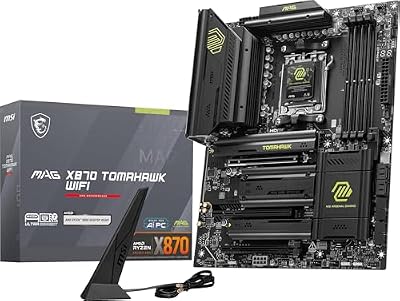
AM5 Motherboard USB4 Support: Ports, Speeds and Buying Checks
USB4 support on an AM5 motherboard gives you fast USB-C connections for external SSDs, docks and high-resolution displays. The catch is that USB4 is not a single fixed feature. Some boards have it built in, some add it through a separate controller, and the port labels do not always tell you what the port can do. This guide explains how to confirm USB4 support on an AM5 board, what it helps with in a gaming setup, and which checks to make before you buy.
This is a buying guide, not a transfer-speed test. We have not measured every port on the boards in the cards below, and real-world speed depends on the cable, the drive or dock you connect, and the device at the other end. Use the product cards as a starting point, then confirm the USB4 port count and the rear I/O layout on the product page. The hero listing is the closest match to the AM5 USB4 search, so read it as a representative of the category, not a guarantee of one exact model.


ASRock AMD X870E Taichi Ryzen Socket AM5 X870 Dual Channel DDR5 DIMMs 256 GB 8200 EATX Motherboard M.2 LED WiFi 7
What USB4 Adds to an AM5 Build
USB4 uses the USB-C connector and supports data speeds up to 40 Gbps on compliant ports. It also supports display output and power delivery over the same cable. For a gaming PC, the main benefits are faster external storage, cleaner cable management with a single dock, and the ability to connect a high-resolution monitor through one port. These are real benefits, but they matter most if you use external drives or a dock on a regular basis.
USB4 does not change how games run. Your frame rate depends on the graphics card, the processor and the game settings. The feature is about connectivity, not performance inside the game. If your main use is playing games from an internal SSD, a standard USB 3.2 port is enough for most accessories. Our guide to the best motherboard for a gaming PC explains how connectivity fits into the wider board choice.
USB4 Versus Thunderbolt and USB 3.2
USB4 and Thunderbolt use the same connector, but they are not the same standard. Thunderbolt has stricter requirements, and many Thunderbolt-certified devices need that support to work at full speed. A USB4 port does not always give you every Thunderbolt feature. Check whether the board page says USB4 or Thunderbolt, and whether the port is certified for the device you plan to use. USB 3.2 Gen 2×2 is a lower-cost option that can cover many external drive needs.
Port labels and cables
Port labels matter. A USB-C port on the rear panel may be USB 3.2, USB4 or a display-only port. Read the manual’s rear I/O diagram, which usually marks the USB4 ports. Cables also matter. A USB4 port works best with a cable rated for the speed you need. A cheap cable can limit the connection even when the port and drive are fast.
How USB4 Support Is Added on AM5
On AM5 boards, USB4 can come from the chipset or from an added controller chip. Both approaches can work, but they can differ in port count and in the features each port supports. Boards with more USB4 ports often use a dedicated controller, which adds cost. Simpler boards may include one USB4 port or none at all. If you need several USB4 ports, read the spec sheet carefully and do not rely on the feature list alone.
Board Choices for USB4 Buyers
Mid and upper tier AM5 boards are more likely to include USB4. If you plan to use an external NVMe enclosure, a dock or a high-resolution display on a single cable, a board with USB4 is worth the cost. If you only need USB-C for a phone or a basic drive, a lower tier board with USB 3.2 Gen 2 may be enough. Our guide to the best AM5 motherboard for gaming covers the main choices across tiers.
Comparison Criteria for AM5 USB4 Boards
The table below lists the checks that matter most. It uses ranges and general descriptions, not fixed prices, because retail prices change and differ by region.
| Criterion | What to check | Why it matters | Typical price range |
|---|---|---|---|
| USB4 ports | Count and labels in the rear I/O diagram | Number of fast devices you can connect | Premium feature |
| Controller type | Built in or added controller | Port count and feature set | Varies by model |
| Thunderbolt status | USB4 or Thunderbolt listed | Compatibility with certified devices | Check current price |
| Front panel header | USB4 or USB-C front header | Easy access on the case | Often a separate purchase |
| Chipset | X870, B850 or B650 class | Overall feature set and power stage | Check current price |
Who Should Pay for USB4
USB4 is useful for creators and gamers who move large files, use fast external storage or run a single-cable desk setup. It is also useful if you want to connect a dock that handles display, power and network through one port. If you own several USB-C devices that need high speed, the board feature can reduce clutter and avoid buying extra adapters.
Who Can Skip It
If your storage is mostly internal and your peripherals use standard USB, USB4 adds little value. A lower tier board with the ports you need will do the job. Save the money for a faster graphics card or a larger SSD, which will affect your games more.
Related Guides
More reading for this build: gaming motherboards overview motherboard buying tips X870 boards for a Ryzen 9 9950X3D value-focused boards. Another motherboard roundup for gaming PCs.
Frequently Asked Questions
Does USB4 make games run faster?
No. USB4 is a connectivity feature. It helps with external storage and displays, but game performance depends on the processor, graphics card and in-game settings.
Is USB4 the same as Thunderbolt?
Not exactly. They share a connector and some features, but Thunderbolt has stricter requirements. Check the board page and the device specifications before you assume full compatibility.
Can I add USB4 to an AM5 board that lacks it?
Some systems can use a separate add-in card, but support depends on the card, the slot and the board. Check compatibility with the manufacturer before buying, and confirm that the card fits your case and cooler.
For storage options that pair well with fast USB, see the best SSD for a gaming PC. For a wider look at the AM5 platform, read the best AMD motherboard for gaming.