- Top Pick: Cable Zip Ties,400 Pack Black Assorted Sizes 12+8+6+4 Inch,Multi-Purpose Self-Locking Nylon Cable Cord Management,Plastic Wire Ties for Home,Office,Garden,Workshop. By HAVE ME TD
- Best Value: Zip Ties Assorted Sizes(4”+6”+8”+12”), 400 Pack, Black Cable Ties, UV Resistant Wire Ties by ANOSON
- Premium Choice: White Zip Ties Assorted Sizes 4+6+8+12 Inch, 400 Pack, Clear Zip Ties, White Cable Ties, Zipties Clear, UV Resistant Wire Ties, Plastic Ties, Tie Wraps Assorted Sizes, SiKuLin
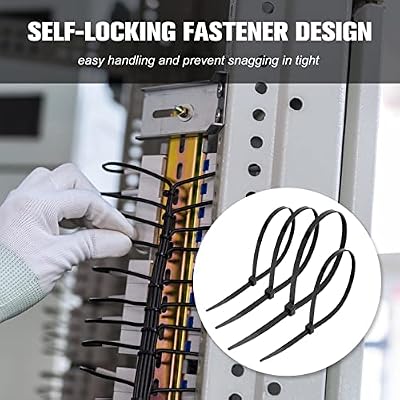
The 400-Pack Cable Zip Ties Assorted Sizes is the bulk-pack nylon zip-tie set every cable management project needs — a multi-size bundle of single-use plastic ties for permanent dressings, bundle tightening and routing along desk legs, cable trays and PC builds. The pack typically contains 100 each of four common lengths (4 in, 6 in, 8 in and 10 in) totalling 400 ties, in plain black nylon. At around $7 it is the standard-issue cable management consumable. This 400-Pack Cable Zip Ties review covers material, sizing, install and use cases.

Cable Zip Ties,400 Pack Black Assorted Sizes 12+8+6+4 Inch,Multi-Purpose Self-Locking Nylon Cable Cord Management,Plastic Wire Ties for Home,Office,Garden,Workshop. By HAVE ME TD




As an Amazon Associate we earn from qualifying purchases. Product prices and availability are accurate as of the date/time indicated.
🛒 Best Price Today on Amazon
Prime members get fast, free shipping on everything above, plus member-only deals. New members get a 30-day free trial — cancel anytime.
As an Amazon Associate we earn from qualifying purchases.



400-Pack Cable Zip Ties at a Glance
| Component | Specification |
|---|---|
| Type | Single-use cable zip ties (nylon) |
| Length per unit | Assorted: 4 in, 6 in, 8 in, 10 in (100 of each) |
| Capacity (cord count) | 2 to 8 cables per tie, depending on length |
| Cord diameter range | Bundles from about 1/4 in to 2 in outer diameter |
| Material | Nylon 6/6 (single-use ratchet head) |
| Color options | Black |
| Mounting method | Free — wraps around the cable bundle; not adhesive |
| Paintable | Not designed to be painted |
| Approx price | Around $7 for 400 ties |
Material Quality and Durability
Nylon 6/6 is the standard zip-tie material because it combines the right balance of tensile strength, flexibility and UV resistance for indoor cable work. The black colourant adds a small additional UV margin over natural-coloured ties, which is the practical reason black is the default colour for cable management even where the tie is invisible. Each tie has an integrated ratchet head moulded into one end; the tail threads through the head, ratchets one-way over a moulded set of teeth, and locks. Once locked the tie cannot be loosened — that is the essence of a single-use tie, and it is the property that gives the tie its security. The pack’s mix of lengths covers the practical range from 4-inch ties (for tightening a single cable to a desk leg) to 10-inch ties (for bundling three or four full-gauge cables behind a desk).
Installation and Mounting
Installation is straightforward but rewards two simple habits. First, leave half an inch of slack inside the loop after the cable bundle is gathered — over-tightening a zip tie around a cable can deform the cable jacket and, on signal cables like HDMI, can degrade the cable’s geometry. Second, trim the excess tail flush with a flush-cutter or sharp side-cutter rather than with scissors; flush-cutting leaves no sharp tag to catch on a finger or scrape against a moving part. Where the tie is routinely cut and replaced (a workstation where the cable set changes month to month), consider a small bag of hook-and-loop velcro ties for those positions instead, with single-use zip ties only at permanent dressings. The 400-pack assortment is sized to last across an entire build season.
Capacity and Cord Bundling
Tie length determines capacity. The 4-inch ties wrap around a single cable or a pair of thin signal cables — useful for dressing a single cable to a chair-mounted mic boom or strapping a single power cord to a desk leg. The 6-inch ties handle two to three cables — the bread-and-butter size for desk-back bundles. The 8-inch ties handle four to five cables — the right size for the back of a PC tower or the underside of a desk where multiple cables converge. The 10-inch ties bundle six to eight cables — for the main run from desk to floor outlet, or for the cable spine of a multi-PC bench. Having 100 of each length means you almost never reach for the wrong size.
Aesthetics — Hide vs Cover vs Color Match
Zip ties are not a stand-alone aesthetic product — they are a structural cable-management tool. A bundle dressed with zip ties looks tidy in the way a well-organised toolbox looks tidy: the ties are uniformly spaced, trimmed flush, with the heads turned to the same side. Inside a PC build with a tempered-glass side panel, careful zip-tie dressing of the PSU cables visible behind the motherboard tray is part of what distinguishes a custom-feel build from a stock one. Behind a desk or TV stand the ties are not seen at all. Black is the right colour for almost every install — colour-coordinated ties (white, brown, grey) are available from specialist makers if you need them, but the practical answer is black.
Use Cases — Desk, TV, Wall
Zip ties are the universal cable-management consumable. On a desk they tighten a multi-cable bundle and dress it to a desk leg or under-desk tray. Inside a PC case they hold the PSU cables flat against the case wall, route fan cables and clip the front-panel headers out of the airflow. Behind a TV stand they bundle the HDMI, audio and power cables into one tidy run. Around a workshop they manage extension cords and tool cables. The 400-pack is sized for an active builder or a household with multiple ongoing projects; for a single one-time setup a smaller pack would be cheaper, but for $7 the 400-pack is essentially infinite stock for years.
Verdict
At around $7 for 400 ties the 400-Pack Cable Zip Ties is the basic cable-management consumable every workstation, PC build and home theatre needs in stock. The mix of four lengths means the right size is always to hand, the nylon material is the right standard for indoor work, and the bulk count means you never run out. The single trade-off is that the ties are single-use — once locked they have to be cut and replaced — so for positions where cables change often, supplement the pack with a handful of hook-and-loop velcro straps. For a builder also pairing with best USB hubs for a multi-peripheral setup, the zip-tie pack is the structural cable-management consumable that ties the rest together. Buyers new to cable management often underestimate how many ties an active workstation actually uses — a typical desk-and-PC dress involves 20 to 30 ties between the floor run, the desk underside and the inside of the case, and a household with a media console and a workshop bench routinely doubles that. The 400-pack is sized so that single-tie decisions are cheap — when in doubt, add a tie — which is the right rhythm for clean cable work. Plain, dependable and well-judged at the price.
Frequently Asked Questions
Are these zip ties reusable?
No. They are standard single-use nylon ties with a one-way ratchet head — once locked, they must be cut and replaced. For positions where cables change regularly, use hook-and-loop velcro straps alongside the zip-tie pack.
What sizes are in the 400-Pack Cable Zip Ties assortment?
The standard mix is 100 each of 4 in, 6 in, 8 in and 10 in ties, totalling 400 — covering the practical range from single-cable dressing to six- or eight-cable bundling.
Can you over-tighten a zip tie on a cable?
Yes, and it is a common mistake. Leave about half an inch of slack inside the loop to avoid deforming the cable jacket — over-tight ties on HDMI or signal cables can degrade the cable’s geometry over time.
Are the 400-Pack Cable Zip Ties UV-resistant?
The black nylon has modest UV margin sufficient for indoor use. For outdoor cable management where the ties see direct sunlight, choose a UV-rated outdoor tie sold separately rather than the indoor 400-pack.
More Cable Management Reviews
- Alex Tech 25ft Split Wire Loom 1/4 in Review
- JOTO 4-Pack Cable Management Sleeve Zipper Review
- AGPTEK White Cable Sleeve 2-Pack 5ft 1.2 in Review
- Yecaye Cord Hider 113in One-Cord Concealer Review
- D-Line Cable Management Box Power Strip Holder Review
- Alex Tech 10ft Cord Protector Wire Loom 1/2 in Review
- Alex Tech 25ft Cord Protector Wire Loom 1/2 in Review
- Alex Tech 10ft Cable Sleeve 1/2 in Review
Affiliate Disclosure: As an Amazon Associate, we earn from qualifying purchases. If you click a link and make a purchase, we may earn a small commission at no extra cost to you. Prices and availability are accurate as of publication and may change.
Related Articles
Looking for more on this topic? Browse the hand-picked guides below — each one applies the same scoring rubric used in this review.