- Top Pick: Alex Tech 10ft – 1/2 inch Cord Protector Wire Loom Tubing Cable Sleeve Split Sleeving For USB Cable Power Cord Audio Video Cable – Protect Cat From Chewing – Black
- Best Value: Alex Tech 10ft – 1/4 inch Cord Protector Wire Loom Tubing Cable Sleeve Split Sleeving For USB Cable Power Cord Audio Video Cable – Protect Cat From Chewing Cords – Black
- Premium Choice: Alex Tech 10ft – 1 inch Cord Protector Wire Loom Tubing Cable Sleeve Split Sleeving For USB Cable Power Cord Audio Video Cable – Protect Cat From Chewing Cords – Black
The Alex Tech 10ft Cable Sleeve is an alternative listing of Alex Tech’s 1/2-inch split wire loom sold in a 10-foot length. It is the same proven recipe — a flexible polyethylene tube with a slit along its length that slips over an existing cable bundle without unplugging anything — and it is one of the most economical ways to bundle the cables on a desk into a single tidy run. At around $7 it is impulse-buy territory. This Alex Tech 10ft Cable Sleeve review covers material, capacity, install, aesthetics and who it is for.

Alex Tech 10ft - 1/2 inch Cord Protector Wire Loom Tubing Cable Sleeve Split Sleeving for USB Cable Power Cord Audio Video Cable - Protect Cat from Chewing Cords - White




As an Amazon Associate we earn from qualifying purchases. Product prices and availability are accurate as of the date/time indicated.
🛒 Best Price Today on Amazon
Prime members get fast, free shipping on everything above, plus member-only deals. New members get a 30-day free trial — cancel anytime.
As an Amazon Associate we earn from qualifying purchases.



Alex Tech 10ft Cable Sleeve at a Glance
| Component | Specification |
|---|---|
| Type | Split wire loom (slit polyethylene tube) |
| Length per unit | 10 feet (one continuous tube, cut to size) |
| Capacity (cord count) | 2 to 3 cables of typical desk gauge |
| Cord diameter range | Bundle up to roughly 1/2 in (12 mm) outer diameter |
| Material | Polyethylene (PE), flexible split tube |
| Color options | Black |
| Mounting method | Free-standing — rests on the floor or desk; no adhesive |
| Paintable | Not designed to be painted (low-energy plastic, paint adheres poorly) |
| Approx price | Around $7 |
Material Quality and Durability
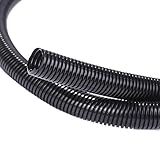
This sleeve is the same 1/2-inch split polyethylene tube the brand sells under its cord-protector listing, packaged in a 10-foot length. The PE construction is durable for indoor use: it stays flexible across normal room temperatures, resists kinking around desk corners, and does not become brittle the way some PVC products can after a year on a sunny shelf. The corrugated profile gives the tube radial strength without making it stiff, which matters when the loom has to bend tightly around the rear of a desk or under a low TV stand. The slit holds itself closed under the plastic’s memory, which is what makes the design work without zip ties along its length. Two or three rolling chair passes a day does not mark the loom; the only routine wear point is at the cut ends, where a clean scissor cut keeps the tube from fraying.
Installation and Mounting
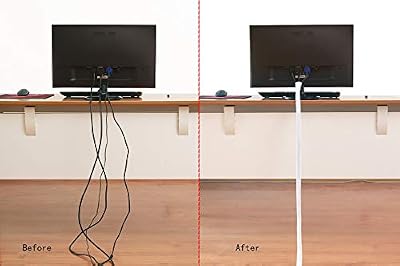
Installation is the loom’s main selling point. Open the slit at one end, lay the cable bundle into the channel, and walk your finger along the seam to close it over the cables. Nothing has to be unplugged — which means HDMI, DisplayPort, USB-C and any proprietary connectors on monitors or laptops can stay in place. The 10-foot length covers a typical desk-to-floor-outlet run with a margin for slack, and household scissors trim it cleanly. The loom itself is unmounted; for a vertical run along a desk leg, add three or four self-adhesive cable clips along the leg to hold the loom flat against the wood. Buyers running USB peripherals via a hub should also see our best USB hubs roundup.
Capacity and Cord Bundling
The 1/2-inch internal diameter takes two to three cables of typical desk gauge — for example a laptop power brick lead, an HDMI cable and a USB-A cable — with room to spare. The loom is partial-fill friendly: you do not need to fill it, and the slit lets you slip an extra cable in later as the setup grows. For a desk that consistently routes more than three cables in one run, step up to a 3/4-inch loom or use two parallel 1/2-inch runs for a cleaner appearance than an over-stuffed tube. The 10-foot length suits a typical desk corner where the run is short; for whole-room cabling, the 25-foot version of the same product makes more sense.
Aesthetics — Hide vs Cover vs Color Match
A wire loom bundles cables into a single visible tube — that is its job — but it does not hide them in the wall colour the way a paintable raceway does. Visually the black PE loom is unobtrusive on a dark floor, behind a black desk leg, or behind a TV stand; it stands out more against a white wall or pale carpet. Where the visible surface is the wall, the right product is a paintable raceway from Delamu or similar. Where the visible surface is the floor or the back of the desk, the loom is the better tool — and at roughly a third the price per foot of a raceway, it is the more economical answer where appearance is secondary to bundling.
Use Cases — Desk, TV, Wall
The 10-foot length covers three classic scenarios. On a typical L-shaped desk it bundles the laptop charger, monitor power, USB-C cable and HDMI run into one neat sleeve from the back of the desk down to a floor-mounted surge protector. Behind a TV stand it unifies the HDMI cables, set-top box power, soundbar power and a streaming stick USB lead into one run. In a multi-PC setup it bundles the cables behind one of the towers and joins the room’s main cable run. It is less suited to a single power cord running along a visible wall — a 1/4-inch loom is the right size there — and to long visible wall runs, where a paintable raceway is the right product.
Verdict
At around $7 the Alex Tech 10ft Cable Sleeve is a sensible default for anyone bundling two or three cables on or under a desk. It is the same proven 1/2-inch PE split loom that Alex Tech has been selling for years, sized for a typical desk-to-floor run. The trade-offs are the same across all PE looms: visible black tube rather than hidden wall channel, plastic rather than fabric, no mounting hardware in the box. For a buyer also picking out best quiet PC case fans for a fresh build, the loom is a low-cost finishing touch that turns the area behind the PC from a tangle into a single run. Buyers stepping into cable management for the first time tend to find the cheap-loom-plus-zip-ties combination the easiest learning curve in the category — you get a measurable visual improvement on the first run, you cannot mistakenly damage cables during install (no unplugging, no cuts), and the materials are cheap enough that mistakes do not matter. Many buyers eventually graduate to a wall raceway for the visible side of the run and a cable box for the surge strip, but the wire loom remains in the install as the floor-level layer that ties everything together. Plain, durable and well-judged for the price.
Frequently Asked Questions
Is the Alex Tech 10ft Cable Sleeve the same as the cord protector listing?
Yes. It is the same 1/2-inch split polyethylene wire loom — the same material, slit profile and diameter — sold under an alternative product listing in a 10-foot length.
Can you join two lengths of the Alex Tech cable sleeve?
Yes. Two cut lengths butt-join cleanly along their slits, and a single overlap clip or small wrap of tape secures the join. For longer runs you may prefer the 25-foot version to avoid joins entirely.
Does the Alex Tech cable sleeve fit thick power cords?
Single power cords typically sit inside the loom with capacity to spare. Two heavy IEC power cables in the same length can fill the loom — use a larger 3/4-inch loom for paired high-gauge runs.
How is the Alex Tech sleeve different from a fabric cable sleeve?
Polyethylene is more abrasion-resistant, lighter and washable, but it looks like plastic and the corrugated profile is visible. Fabric sleeves like the JOTO disappear into a textile environment but are less protective against foot traffic and chair wheels.
More Cable Management Reviews
- Delamu Cord Hider 157in Wire Wall Cover Review
- Delamu Cord Hider 157in Large Cable Manager Review
- Alex Tech 50ft PET Expandable Braided Sleeving Review
- 400-Pack Cable Zip Ties Assorted Sizes Review
- Alex Tech 25ft Split Wire Loom 1/4 in Review
- JOTO 4-Pack Cable Management Sleeve Zipper Review
- AGPTEK White Cable Sleeve 2-Pack 5ft 1.2 in Review
- Yecaye Cord Hider 113in One-Cord Concealer Review
Affiliate Disclosure: As an Amazon Associate, we earn from qualifying purchases. If you click a link and make a purchase, we may earn a small commission at no extra cost to you. Prices and availability are accurate as of publication and may change.
Related Articles
Looking for more on this topic? Browse the hand-picked guides below — each one applies the same scoring rubric used in this review.