- Top Pick: Delamu Cord Hider, 157in Wire Covers for Cords on Wall, Premium Cable Hider Cord Covers for Wires, Cable Management Wire Hiders for TV, Cable Raceway Kit, W0.95 H0.55in, White
- Best Value: Cable Hider, 157in Delamu Cord Hider Wall for Wall Mounted TV, Wire Hider Kit, Paintable Cable Concealer Raceway Management for Home & Office, 10XL15.7 W0.95 H0.55in, Black
- Premium Choice: Delamu 157in Cord Hider, Cord Cover Wall Cable Management, Paintable Wire Cover for Cords, Cable Hider Raceway Kit, Cable Cover Concealer, Wire Hiders for TV on Wall, 10 X L15.7 W1.18 H0.6in, Beige
The Delamu 157in Large Cable Manager is the wider sibling of the brand’s standard cord hider — a paintable PVC raceway with a deeper internal channel, sized for the four- to six-cable bundles that come with a modern home-theatre install. Where the standard cord hider suits a TV with one HDMI, a power cord and a soundbar cable, the large version handles the same plus a second HDMI, an Ethernet cable and a console power lead. At around $20 for 157 inches it is the right buy where the standard hider runs out of capacity. This Delamu Large Cable Manager review covers material, mount, capacity, paintability and who it is for.

Delamu 157in Cord Hider Wall, TV Cable Hider Cord Covers for Wires on Wall, Large Cable Management Raceway, Paintable Wire Hiders Wire Covers for Cords for TV on Walls, 10 X L15.7 W1.18 H0.6in, White





As an Amazon Associate we earn from qualifying purchases. Product prices and availability are accurate as of the date/time indicated.
🛒 Best Price Today on Amazon
Prime members get fast, free shipping on everything above, plus member-only deals. New members get a 30-day free trial — cancel anytime.
As an Amazon Associate we earn from qualifying purchases.


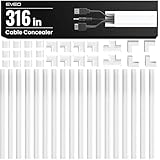
Delamu Large Cable Manager at a Glance
| Component | Specification |
|---|---|
| Type | Large cable raceway (paintable wall-mounted channel, wider profile) |
| Length per unit | 157 in (about 13 ft) total, supplied as multiple segments |
| Capacity (cord count) | Around 4 to 6 cables of typical home-theatre gauge |
| Cord diameter range | Bundle up to roughly 5/8 in (16 mm) total inside the channel |
| Material | Rigid PVC plastic (white) |
| Color options | White (paintable to wall colour) |
| Mounting method | Adhesive back (3M-style strip) on every segment |
| Paintable | Yes — PVC accepts wall paint over a light scuff |
| Approx price | Around $20 |
Material Quality and Durability
The large cable manager uses the same rigid PVC formulation as the standard Delamu raceway — the same wall thickness, the same snap-fit cover, the same paintability — and the only structural difference is the deeper internal cavity. PVC is the right material here: it holds a straight line across a long run, takes wall paint cleanly after a light scuff, and is essentially permanent indoors. The wider profile means the cover snap is correspondingly stronger, which holds the cover flat against a six-cable bundle without bowing. Two-part construction (base plus snap-on cover) lets you add cables later if your setup grows — a console added to the home-theatre stack a year after install drops into the existing channel without an exterior change. Five-year durability indoors is the realistic expectation; outdoors and under direct sun, the white surface yellows over time, which is a paint issue rather than a structural one.
Installation and Mounting
Installation follows the same flow as the standard raceway: measure the run, dry-fit the segments to confirm placement, then peel-and-stick. The wider segments are a little heavier than the standard profile, so it is worth pressing each one against the wall for a full minute after install — the adhesive cures hard over a few hours, and the initial press is what ensures full contact. The wider footprint also helps adhesion on textured wallpaper or rough painted surfaces where the standard profile sometimes struggles. Corner and tee fittings let the channel turn around a skirting board, step over a switch box or cross an existing power outlet. With a wall-mounted TV setup and one of the best monitor arms in our roundup, the large manager covers the full home-theatre bundle in a single visible line.
Capacity and Cord Bundling
The defining advantage over the standard cord hider is capacity. The large profile takes four to six cables of typical home-theatre gauge — two HDMI cables, a soundbar power, a TV power, an Ethernet cable and a console power lead — inside one channel without bowing the cover. Loaded to four or five cables the cover seats flush and the channel paints cleanly; loaded to six, the channel is full but still tidy. Where a future install might add more cables (a streaming stick power, a console power for a second console, a CEC-aware HDMI), the large profile gives you the spare capacity to plan in. The 157-inch total length is supplied as multiple shorter segments — a typical kit includes 12 to 16 inch pieces — and the segments butt-join cleanly along a run.
Aesthetics — Hide vs Cover vs Color Match
The large profile is a little more visible than the standard hider before paint — it is roughly twice as deep — but the same paint trick applies: paint it the wall colour after install and the channel reads as a low raised line that the eye glides over in normal viewing. Where a home-theatre install has too many cables for the standard cord hider, the choice is between two parallel narrow channels and one wider channel; the single wider channel is almost always the better visual answer because the eye notices one line less than it notices two. On a feature wall behind a wall-mounted TV, the painted large raceway is the standard solution professional installers use, and the paint match is the trick that makes it invisible.
Use Cases — Desk, TV, Wall
The large manager is sized squarely for a modern home-theatre install: a wall-mounted TV with two HDMI cables, a soundbar power lead, a TV power cord, an Ethernet cable to a console and a console power lead, all dropping from the TV mount to a floor outlet behind a piece of furniture. It also suits a high-end gaming desk against a feature wall where the cable count exceeds three — a desktop PC, a monitor, a secondary monitor and a USB hub between them push the bundle past the standard hider’s capacity. It is less suited to short runs with one or two cables (use the standard hider for those, since the large profile is unnecessarily prominent), and to flexing or rolling-chair runs (use a wire loom on the floor).
Verdict
At around $20 the Delamu Large Cable Manager is the right buy for any wall install with four or more cables — typically a modern home-theatre or a high-end gaming desk against a feature wall. The PVC construction is durable and paintable, the adhesive mount fits any modern smooth wall, and the wider internal channel takes the cable bundle a standard cord hider cannot. The trade-offs are mild: the wider profile is a little more visible pre-paint than the standard hider, and the price is correspondingly higher. For a buyer also working through best PC cases for a fresh build, the large manager handles the visible cable side of the install. Cleanly engineered and well-judged at the price.
Frequently Asked Questions
How is the Delamu Large Cable Manager different from the standard cord hider?
It uses the same paintable PVC construction but with a deeper internal channel — about 5/8 in versus the standard 3/8 in — so it takes four to six cables instead of three. Use the standard hider for light cabling and the large manager for home-theatre bundles.
Can you mount the Delamu Large Cable Manager horizontally?
Yes. The adhesive grips equally well on horizontal and vertical runs; the wider profile makes long horizontal runs particularly well suited because the cover holds its line against the cable bundle.
Does the Delamu large manager support corners and turns?
Yes. The kit includes corner and tee fittings that let the channel turn at skirting boards, step over a wall switch or cross an existing outlet without breaking the visual line.
Is the Delamu Large Cable Manager visible after paint?
Painted the wall colour after install, the raceway reads as a low raised line that the eye glides over in normal viewing. In raking light it remains visible, which is true of any raceway product on the market.
More Cable Management Reviews
- Alex Tech 50ft PET Expandable Braided Sleeving Review
- 400-Pack Cable Zip Ties Assorted Sizes Review
- Alex Tech 25ft Split Wire Loom 1/4 in Review
- JOTO 4-Pack Cable Management Sleeve Zipper Review
- AGPTEK White Cable Sleeve 2-Pack 5ft 1.2 in Review
- Yecaye Cord Hider 113in One-Cord Concealer Review
- D-Line Cable Management Box Power Strip Holder Review
- Alex Tech 10ft Cord Protector Wire Loom 1/2 in Review
Affiliate Disclosure: As an Amazon Associate, we earn from qualifying purchases. If you click a link and make a purchase, we may earn a small commission at no extra cost to you. Prices and availability are accurate as of publication and may change.
Related Articles
Looking for more on this topic? Browse the hand-picked guides below — each one applies the same scoring rubric used in this review.