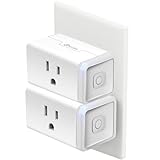
The Kasa Mini Smart Plug 15A 4-pack is TP-Link’s compact four-pack — the mid-line model that sits between the standard HS103 and the slimmer Ultra Mini. Each plug carries the same 15A / 1,800W rating, supports Alexa and Google Assistant (and Samsung SmartThings), runs the Kasa Smart app, and connects to 2.4GHz Wi-Fi without a hub. At around $40 for four it is a whole-home rollout pack with a compact chassis that handles typical lamp, fan and small-appliance loads cleanly. TP-Link’s long-term firmware support is the best in the category, which matters when a smart plug is expected to remain in service for years rather than months. This Kasa Mini 4-pack review covers setup, smart features, build, reliability and who should buy.

Kasa Smart Plug Ultra Mini 15A, EP10P4, Smart Home Wi-Fi Outlet | Works with Alexa & Google Home, No Hub Required, UP Certified, 2.4GHz Wi-Fi Only, 4-Pack, White




As an Amazon Associate we earn from qualifying purchases. Product prices and availability are accurate as of the date/time indicated.
🛒 Best Price Today on Amazon
Prime members get fast, free shipping on everything above, plus member-only deals. New members get a 30-day free trial — cancel anytime.
As an Amazon Associate we earn from qualifying purchases.




Kasa Mini 4-Pack at a Glance
| Component | Specification |
|---|---|
| Wattage capacity | 15A / 1,800W at 120V per plug |
| Wireless protocol | Wi-Fi 2.4GHz (no Bluetooth, no 5GHz) |
| Voice assistant support | Alexa, Google Assistant, SmartThings (no HomeKit) |
| Scheduling | Yes, per-plug schedules, scenes and Away mode in Kasa app |
| Away mode / Energy monitoring | Away mode included; no per-device energy reporting |
| Outdoor rated | No — indoor use only |
| Sockets per device | 1 socket per plug; 4 plugs in pack; compact chassis |
| Hub required | No — direct Wi-Fi pairing |
| Approx price | around $40 for the 4-pack |
Setup & App Experience
The Kasa Mini 4-pack uses the same setup flow as every other plug in TP-Link’s smart-plug lineup. Install the free Kasa Smart app, plug in the first Mini, and the app pairs it to your 2.4GHz Wi-Fi network in about a minute. The Mini supports the same Frustration Free Setup acceleration on second and subsequent plugs — once the first one is paired, the next three add faster because the app already knows your Wi-Fi. Labelling and room assignment take another couple of minutes, after which the four plugs appear as named devices in Alexa, Google Home and the Kasa app itself. The Kasa Smart app remains the polish leader in this category — clean, fast, and refined over years of TP-Link’s smart-home development. Linking to Alexa or Google is a single skill-link step.
Smart Features — Scheduling, Voice, Away Mode
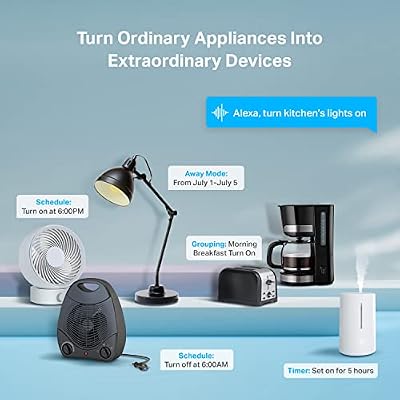
The Mini’s feature set is identical to the rest of the Kasa Wi-Fi line at this tier. Schedules turn plugs on and off at fixed times or at sunset and sunrise per location. Scenes group plugs into a single command — “Movie Night” off the office lamps and on the floor lamp, “Goodnight” off everything. Away mode mimics occupancy by randomising lamp on/off over a chosen window, which is a credible deterrent on trips. Voice support covers Alexa, Google Assistant and Samsung SmartThings. There is no Apple HomeKit support — that is the consistent gap across the Kasa basics. For households whose primary voice assistants are Alexa or Google, the Mini covers the full set of useful smart features without compromise. Hands-free voice control across four named plugs is one of the most-used features once a whole-home rollout is in place.
Energy Monitoring & Savings
Like the rest of the Kasa basics, the Mini does not include energy monitoring — Kasa reserves that for its energy-monitoring SKUs like the KP125M and KP115. The savings on the Mini come from scheduling, away-mode and habit-based off-cycles rather than wattage tracking. For most households that is the right trade-off at this price tier: most of the savings from smart plugs come from making the off-cycle automatic, not from wattage measurement. The 15A / 1,800W per plug rating matches the rest of the Wi-Fi line, so each plug independently handles any single appliance under 1,800W — a lamp, a coffee maker, a 1,500W space heater, a fan.
Build & Reliability
The Mini chassis sits between the standard HS103 and the slimmer Ultra Mini in size — more compact than the original HS103 but not as low-profile as the Ultra Mini. It still typically covers the second socket on a duplex outlet, so for shared-outlet installs the Ultra Mini is the better choice. Reliability is the standard TP-Link strength — firm contacts, solid chassis, dependable Wi-Fi reconnection after router reboots, and the best long-term firmware support in the category. The single physical button on the side makes manual override straightforward when the app isn’t to hand. For a four-plug rollout in a household where outlets aren’t shared between two plugs, the build is more than enough.
Who It’s For
The Kasa Mini 4-pack is the right pick for a whole-home rollout in households where outlet-sharing isn’t a concern — most installs have one plug per outlet, with the second socket either free or used for a non-smart appliance. The pack is fine value at around $10 per plug, and the Kasa app and dual-platform voice support remain best-in-class. If outlet space is tight and you need both sockets on a duplex outlet, step up to the Ultra Mini 4-pack. If you need HomeKit, look elsewhere. For everyone else doing a four-plug rollout on Alexa or Google, this is a strong default. Pair with a small gaming setup from our best gaming laptops under $1,200 guide.
Verdict
At around $40 for the four-pack the Kasa Mini 4-pack earns a recommendation as a sensible whole-home rollout pack for Alexa and Google Home households. It is functionally identical to the HS103 line and to the Ultra Mini at the software level, with a chassis that sits between the two on size and a build that matches the rest of the Kasa Wi-Fi line for reliability and long-term support. The decision between the Mini and the Ultra Mini comes down to whether you need two plugs per duplex outlet — if yes, choose Ultra Mini; if no, the Mini is a fine choice at the same approximate price tier and lets you use the value of four plugs across four separate outlets in different rooms. For Apple Home users the answer is to look elsewhere across the Kasa basics; for Alexa or Google households the Mini 4-pack is one of the more sensible rollout options at this price. See also our best NAS home servers for matching home-server scheduling automations and our USB-C hub buyer’s guide for desk-side power management.
Frequently Asked Questions
Is the Kasa Mini 4-pack the same as the Ultra Mini 4-pack?
They share the same firmware, app and feature set. The chassis differs — the Ultra Mini is slimmer and won’t block the second socket on a duplex outlet, while the Mini is more compact than the original HS103 but still typically blocks the second socket.
Does the Kasa Mini support Apple HomeKit?
No. The Kasa Mini supports Alexa, Google Assistant and Samsung SmartThings, but not Apple HomeKit. For HomeKit, choose the KP125M Mini Energy Monitoring plug instead.
Do the Kasa Mini plugs need a hub?
No. Each plug connects directly to your 2.4GHz Wi-Fi network via the Kasa Smart app — no bridge or hub is required.
Can I add the Kasa Mini to a household that already uses HS103 plugs?
Yes. All Kasa smart plugs share the same Kasa Smart app, account and scenes. Mixing HS103, Mini, Ultra Mini and energy-monitoring models in one household is fully supported.
More Smart Plug Reviews
- Kasa Ultra Mini Smart Plug 15A Single Review: 1-Pack Slim Plug
- Kasa Smart Wi-Fi Plug HS105 Review: Slim 12A Wi-Fi Plug
- Kasa Outdoor Smart Plug KP400 Review: 2-Socket Weatherproof Plug
- Mifaso Outlet Extender Review: 6-Outlet Surge Protector + USB
- Kasa Smart Plug Mini Energy Monitoring Review (KP125M)
- HBN Smart Plug 15A Review: Wi-Fi + Bluetooth Dual Plug
- HBN Smart Plug Mini 15A Review: Compact Wi-Fi Smart Plug
- Amazon Smart Plug Review: The Easiest Alexa Smart Plug
Affiliate Disclosure: As an Amazon Associate, we earn from qualifying purchases. If you click a link and make a purchase, we may earn a small commission at no extra cost to you. Prices and availability are accurate as of publication and may change.
Related Articles
Looking for more on this topic? Browse the hand-picked guides below — each one applies the same scoring rubric used in this review.