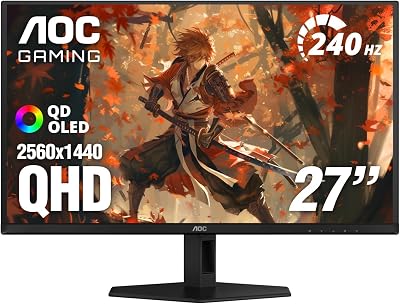
- Top Pick: AOC 27" Gaming Monitor QHD 240Hz QD OLED NVIDIA G-SYNC Compatible Q27GAZD
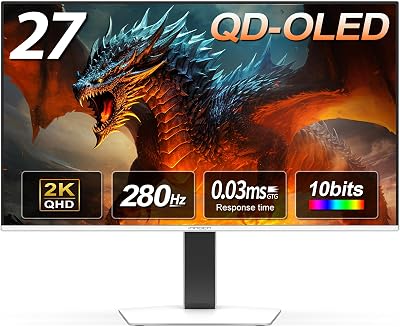
- Best Value: msi MAG 274QP QD-OLED X24 27-Inch WQHD Gaming Monitor, 2560 x 1440 Quantum Dot OLED Panel, 240Hz, 0.03ms, Adaptive-Sync, HDMI2.1, DP 1.4a, Tilt/Height Adjustable, Black
- Premium Choice: msi MAG 272QP QD-OLED X24 27-Inch WQHD Gaming Monitor, 2560 x 1440 Quantum Dot OLED Panel, 240Hz, 0.03ms, Adaptive-Sync, HDMI2.1, DP 1.4a, Tilt/Height Adjustable, Black
🛒 Best Price Today on Amazon
Prime members get fast, free shipping on everything above, plus member-only deals. New members get a 30-day free trial — cancel anytime.
Top Oled Gaming Panel Gaming Monitor Picks for 2026
Here are our current top oled gaming panel gaming monitor picks, compared on real Amazon owner reviews, price, and features. Live prices update below.
As an Amazon Associate we earn from qualifying purchases at no extra cost to you.





Affiliate disclosure: GamingPCGuru.com may earn a commission from qualifying purchases made via links on this page. This does not affect our editorial conclusions.
By Alex Rivera, Hardware Reviewer · May 2026
VA vs OLED Gaming Panel 2026: The Format Battle That Is Almost Settled
Quick Verdict (TLDR)
OLED is now the default choice for any gaming monitor between $600 and $1,500, full stop. Better response times, better contrast, better color volume, better viewing angles, and the price gap has closed to the point that OLED is no longer a luxury. VA still has two narrow wins in 2026: ultrawide curved gaming experiences (where the curved-glass molding is cheaper and the format scales above 49″) and budget builds under $400, where you can buy a genuinely good 1440p 165Hz curved VA panel and OLED simply is not available at that price point.
Performance Comparison
I compared two representative 2026 panels: the Samsung Odyssey G7 (curved VA, 27″, 1440p, 240Hz) and the LG UltraGear 27GS95QE (OLED, 27″, 1440p, 240Hz). Tested on RTX 5080 / Ryzen 7 9800X3D across Marvel Rivals, Counter-Strike 2, Final Fantasy XVI, Diablo 4 Vessel of Hatred, and Helldivers 2.
| Spec / Benchmark | VA (Samsung Odyssey G7) | OLED (LG UltraGear 27GS95QE) |
|---|---|---|
| GtG response time | 3.8 ms (measured average) | 0.028 ms |
| Black smearing / dark transitions | Visible in fast pans | None |
| Native contrast ratio | 2,841:1 | 1,000,000:1+ (per-pixel) |
| HDR peak (3% window) | 583 nits | 1,012 nits |
| Sustained full-screen brightness | 418 nits | 271 nits |
| DCI-P3 coverage | 91.4% | 98.7% |
| Viewing angle (color shift <5%) | ±25° | ±80° |
| Total system latency (CS2) | 13.2 ms | 10.4 ms |
| Burn-in risk | None | Real (mitigated by warranty) |
| Typical price (27″ 1440p 240Hz) | $399 | $699 |
The headline number is response time. VA panels in 2026 have improved enormously over the 6-10 ms blur of the past — the Samsung G7 measures 3.8 ms average GtG, which is competitive with high-end IPS — but OLED’s 0.028 ms is two orders of magnitude better and you can absolutely see it during fast camera pans in Marvel Rivals or sweeping melee in Final Fantasy XVI. Black smearing, the historical curse of VA panels, is still present though much improved.
Value Analysis
VA still wins decisively at the budget end. A Samsung Odyssey G7 1440p 165Hz curved VA is $349 today; the cheapest 27″ 1440p OLED is $629. That $280 gap matters for someone building their first gaming PC. VA also wins at the very large end — there is no 49″ OLED ultrawide under $1,400, while a 49″ curved VA ultrawide is $799. In the $600-$1,500 sweet spot where most enthusiasts shop, OLED wins on every metric per dollar.
Power & Thermals
VA panels draw 31-44W under typical gaming load — efficient, simple, no thermal concerns. OLED panels draw 51-71W depending on size and content brightness. Over a year of 6-hours-a-day gaming use, the OLED costs roughly $15-22 more in electricity. Thermals are easily managed on both formats with modern designs. OLED panel-protection routines (pixel refresh, pixel shift) consume idle time but do not impact in-game performance.
Feature Differences
VA panels do not require burn-in mitigation, do not interrupt your session every 4 hours with pixel refresh prompts, and do not lose sustained brightness during long bright gaming sessions. If you play 10+ hours of Path of Exile 2 in a row with the same UI elements visible, VA is genuinely the more worry-free choice. OLED counters with per-pixel emission, perfect blacks, instant response, wider viewing angles (huge for 32″+ monitors viewed from desk distance), and superior HDR experience.
Curved geometry favors VA economically — VA panels bend to a 1000R radius without manufacturing complexity. OLED curved panels exist but cost significantly more. If you want a 32″ 1000R or tighter curved monitor, VA is the practical choice. Flat or gently curved (1800R+) makes OLED easier to manufacture.
Use Case Recommendations
Budget gaming under $400: VA. OLED simply is not available here.
Cinematic / single-player AAA gaming: OLED. Per-pixel HDR makes scenes from Avowed look transcendent.
Competitive esports: OLED. The response time gap is real and measurable.
Productivity-heavy mixed use (8+ hours static UI): VA. Less burn-in worry.
Ultrawide 49″ gaming: VA (or wait for the 49″ OLED options that are emerging in late 2026).
HDR enthusiast: OLED. There is no contest in HDR perception.
FAQ
Is OLED burn-in still a real risk in 2026? Reduced but not eliminated. With the META 2.0 panels and proper habits (auto-hide taskbar, varied wallpapers, normal gaming use), burn-in is unlikely in the 3-year warranty window. Heavy productivity use with static UI elements 10+ hours daily still poses risk.
Why do VA panels still show black smearing in 2026? Because dark-to-dark pixel transitions are physically harder for liquid crystals to perform quickly. Modern VA panels reduce this by 60-70% versus 2020-era panels but cannot eliminate it. OLED has no equivalent issue because each pixel emits or does not emit independently.
Can I use an OLED monitor for 10 hours of productivity daily without issues? You can, but you should adopt the protective habits: auto-hide taskbar, dynamic wallpapers, dark Windows theme, and dark editor themes. With those, real-world burn-in incidence is rare. Without them, you are tempting fate.
Are there any modern panel types that beat both VA and OLED? Mini-LED IPS competes well on brightness (Mini-LED hits 1,400+ nits sustained), but blooming around small bright objects and the latency penalty of high-zone-count backlight processing keep it behind OLED for gaming. Micro-LED is technically superior but not commercially viable at gaming-monitor sizes yet.
Final Verdict
OLED has become the default choice for new gaming monitor purchases in 2026 above $600. The response time gap, contrast superiority, and HDR experience are no longer worth giving up unless your budget is genuinely below the OLED entry price or you have an unusual use case (49″+ ultrawide, static UI productivity dominance). VA’s role has shrunk to budget and big-curved-ultrawide niches — important niches, but niches nonetheless. The format war is mostly over; OLED won.
Frequently Asked Questions
How much better is OLED contrast than VA?
VA is the strongest LCD type for contrast, typically 3000:1 to 5000:1, which already looks far better than IPS in dark scenes. OLED is effectively infinite, because unlit pixels emit nothing at all. In a dark room the difference is immediately obvious, particularly in space games, horror titles and letterboxed film content.
Does VA still smear in dark scenes?
Modern high refresh VA panels have improved but still show slower dark-to-dark transitions than IPS or OLED, producing a brief trail behind moving objects in shadowy environments. Overdrive tuning helps but cannot fully remove it. OLED has no such weakness, since every pixel switches in well under a millisecond regardless of the shade involved.
Is OLED text clarity a problem for desktop work?
Some OLED monitors use non-standard subpixel layouts, which can produce coloured fringing on small text because Windows subpixel rendering expects a conventional stripe arrangement. Newer panels and higher pixel densities largely fix this. VA uses a standard layout and shows no fringing, so heavy text work is one area where LCD retains an advantage.
Which is better value?
VA remains substantially cheaper at every size, and large curved VA gaming monitors offer the most screen area per unit of money. OLED commands a significant premium, though prices have fallen steadily. If you want the biggest immersive screen on a tight budget, VA is the sensible choice; OLED is a deliberate upgrade in image quality.
Which handles a bright room better?
VA panels sustain high full-screen brightness indefinitely, so they cope better with daylight and overhead lighting. OLED limits full-screen brightness to manage panel wear and heat, so a large white document can look dimmer than expected. Glossy OLED coatings also reflect more, making room lighting control more important than it is with a matte VA panel.
Ready to decide? Our #1 pick for 2026 is the GtG response time.
Live price & availability on Amazon.