The SanDisk 2TB Extreme Portable SSD is the 2TB version of SanDisk’s iconic rugged portable SSD line — same IP65-rated chassis, same USB 3.2 Gen 2 speeds, twice the capacity of the 1TB model. For travellers, photographers and gamers who have outgrown a 1TB carry drive, it is the natural step up. This SanDisk 2TB Extreme Portable SSD review covers the capacity and interface, performance, durability and value.
- SanDisk 2TB Extreme Portable at a Glance
- Capacity and Interface
- Speed and Real-World Performance
- Durability, Form Factor and Portability
- Compatibility: PC, Mac, Console, Mobile
- Who Is the SanDisk 2TB Extreme Portable For?
- Pros and Cons
- Is the SanDisk 2TB Extreme Portable SSD Worth It?
- Frequently Asked Questions
- More Portable SSD Reviews
- Related Articles
- Related Articles
- Related Guides

SANDISK 4TB Extreme Portable SSD, Up to 2000MB/s Transfer Speeds-New Model | External Solid State Drive, IP65 Water & Dust Resistant, Up to 3M Drop Protection, 256-bit AES Encryption, USB-C 3.2 Gen 2





As an Amazon Associate we earn from qualifying purchases. Product prices and availability are accurate as of the date/time indicated.
🛒 Best Price Today on Amazon
Prime members get fast, free shipping on everything above, plus member-only deals. New members get a 30-day free trial — cancel anytime.
As an Amazon Associate we earn from qualifying purchases.






SanDisk 2TB Extreme Portable at a Glance
| Component | Specification |
|---|---|
| Capacity | 2TB |
| Interface | USB-C, USB 3.2 Gen 2 |
| Sequential read | Up to 1,050 MB/s |
| Sequential write | Up to 1,000 MB/s |
| Form factor | Pocketable rugged enclosure with carabiner loop |
| Durability rating | IP65 dust and water resistance, 2 m drop protection |
| Compatible devices | Windows PC, Mac, PS4, PS5 (PS4 games / PS5 game storage), Xbox One, Android USB-C |
| Price | Around $300 |
Capacity and Interface
2TB is the capacity for buyers who have run out of room on a 1TB drive. It is enough for a substantial game library — typically twenty or more modern AAA titles — or a full working photo library and a video project library combined, without compromise. The interface is USB-C with USB 3.2 Gen 2, which gives broad compatibility with any modern laptop, desktop, console or USB-C mobile device at the interface’s full ~1,000 MB/s ceiling. For a comparison of how USB 3.2 Gen 2 fits next to Gen 2×2 and USB4, see our USB 3.2 vs USB4 explained guide.
Worth noting at this capacity is the question of step-ups. SanDisk offers the Extreme line in 4TB as well, which is the natural next size if you regularly carry very large project libraries or want a single drive for both an active library and substantial archives. For most users, however, 2TB hits the sweet spot of capacity, cost-per-gigabyte and form factor — a 4TB SSD typically costs more per terabyte than a 2TB drive, and few users genuinely need that much portable storage in one device.
Speed and Real-World Performance
SanDisk rates the 2TB Extreme at up to 1,050 MB/s sequential read — the same speed class as the 1TB model and the practical ceiling of USB 3.2 Gen 2. In real use the larger capacity does not change how the drive feels: large game transfers complete in well under a minute on suitable hosts, 4K video editing directly off the drive is comfortable in most NLEs, and PS4 game loads from the drive are noticeably quicker than from a portable hard drive. The drive cannot exceed Gen 2 ceilings — for 2,000 MB/s+ speeds, the Gen 2×2 Extreme PRO is the upgrade path within SanDisk’s own line.
An important point with larger-capacity portable SSDs is the SLC cache and sustained-write behaviour. Modern portable SSDs use a fast SLC cache that absorbs initial writes at full advertised speed, then fall back to slower direct-to-TLC writes once the cache is exhausted. The 2TB Extreme typically has a larger SLC cache than the 1TB version, which means very long sustained writes — a full camera card offload, a multi-hundred-gigabyte project transfer — hold full speed for longer before any slowdown. For most real-world transfers, the cache is large enough that speed remains consistent throughout.
Durability, Form Factor and Portability
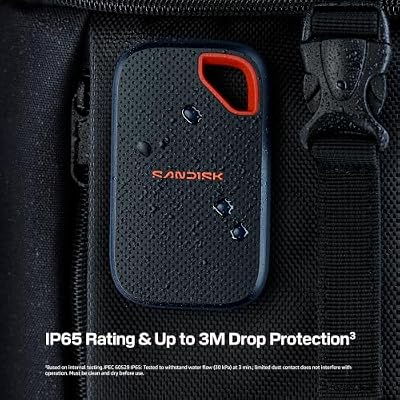
Durability is unchanged from the 1TB model and remains the SanDisk Extreme’s main draw. The chassis is IP65 — dust-tight and protected against low-pressure water jets — and rated for two-metre drops. The carabiner loop is retained, so the drive clips directly to a backpack or camera bag. The physical footprint is essentially identical to the 1TB version, which means you double your capacity without making the drive any harder to carry. For more rugged alternatives, see our best rugged portable SSDs guide.
Compatibility: PC, Mac, Console, Mobile
The 2TB Extreme is broadly compatible. On Windows and macOS it works as a standard external SSD with no drivers. On a PS5, the drive plays PS4 games directly and stores (but does not play) PS5 games — Sony’s internal expansion slot is the only path to running PS5 games at full speed, so the typical workflow is to keep a PS5 library on the SanDisk and move titles back to internal storage when you want to play them. On Xbox Series X|S, the same applies: all Xbox One games play directly from the SanDisk, but Series X|S games can only be stored on it, not played. For PS5-specific advice, see our best PS5 expansion SSD guide guide, and for Xbox see our best Xbox Series X|S storage guide guide.
For the PS5 cold-storage workflow specifically, 2TB is the sweet-spot capacity. A typical modern PS5 AAA game runs between 50GB and 150GB installed, so 2TB holds roughly 15-25 PS5 titles ready to copy back to the internal SSD when you want to play them. The copy itself runs at PS5 USB Gen 2 speeds — about 1,000 MB/s — so a 100GB game moves back to internal in roughly two minutes. The same workflow on a portable hard drive would take ten times as long, which is the practical case for a fast portable SSD as a PS5 companion drive.
Who Is the SanDisk 2TB Extreme Portable For?
The 2TB Extreme is for the buyer who needs a durable portable SSD with serious capacity. If you are a creator with a working photo and video library that has outgrown 1TB, a gamer who wants a large carry library, or a backup user who needs more headroom, the 2TB version is the natural choice — same chassis, same speeds, twice the room. It is less ideal for buyers who need the absolute fastest portable speeds (the Extreme PRO is the upgrade) and for those whose capacity needs comfortably fit in 1TB.
Pros and Cons
Pros: 2TB of pocketable rugged storage; up to 1,050 MB/s read on USB 3.2 Gen 2; IP65 rating; 2 m drop protection; carabiner loop; broad cross-platform compatibility.
Cons: Same Gen 2 speed ceiling as the 1TB model; PS5 games and Xbox Series X|S games can be stored but not played; price step up over the 1TB model is significant.
Is the SanDisk 2TB Extreme Portable SSD Worth It?
At around $300 the SanDisk 2TB Extreme Portable SSD is a strong choice for the buyer who needs both ruggedness and serious capacity. It is the same dependable product as the 1TB Extreme with double the room. For maximum speed within SanDisk’s range, the Gen 2×2 Extreme PRO is the upgrade. For buyers who want more compatibility-focused content-creation portables, see our best portable SSDs for content creators guide.
Frequently Asked Questions
How is the 2TB SanDisk Extreme different from the 1TB?
It uses the same chassis, the same USB 3.2 Gen 2 interface, the same IP65 rating and the same up to 1,050 MB/s rated speed. The only difference is double the capacity at a higher price.
Can I edit 4K video directly off the SanDisk 2TB Extreme?
Yes. At up to 1,050 MB/s the drive comfortably supports 4K video editing in most NLEs. For very demanding 8K timelines, a Gen 2×2 or USB4 drive is a better fit.
Is the SanDisk 2TB Extreme good for PS5?
It works as PS5 cold storage and plays PS4 games directly. PS5 games must be moved to the internal SSD or to an internal M.2 NVMe expansion drive to play.
Does the SanDisk 2TB Extreme work with iPad Pro?
Yes. It uses USB-C and works as a standard external SSD on USB-C iPads, including for direct ProRes capture in supported camera apps.
More Portable SSD Reviews
- SanDisk 1TB Extreme PRO Portable SSD Review
- Samsung T7 Portable SSD 1TB Review
- Samsung T7 Shield 2TB Portable SSD Review (Rugged)
- Samsung T9 Portable SSD 1TB Review
- Crucial X9 Portable SSD 1TB Review
- Crucial X10 Portable SSD 2TB Review
- Crucial X10 Pro 4TB Portable SSD Review (Flagship)
- Kingston XS2000 Portable SSD 500GB Review
Affiliate Disclosure: As an Amazon Associate, we earn from qualifying purchases. If you click a link and make a purchase, we may earn a small commission at no extra cost to you. Prices and availability are accurate as of publication and may change.
Related Articles
Looking for more on this topic? Browse the hand-picked guides below — each one applies the same scoring rubric used in this review.