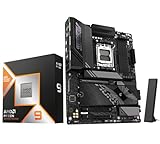
- Top Pick: AMD Ryzen 9 9950X3D 16-Core Processor
- Best Value: AMD Ryzen™ 9 9950X3D2 Dual Edition
- Premium Choice: AMD Ryzen™ 9 9950X 16-Core, 32-Thread Unlocked Desktop Processor
If you’re building or upgrading a high-end AM5 gaming PC in 2026, the shortlist almost always narrows to two AMD parts: the 16-core Ryzen 9 9950X3D and the 8-core Ryzen 7 9800X3D. Both use AMD’s second-generation 3D V-Cache, both drop into the same Socket AM5 boards, and both sit at or near the top of every gaming benchmark chart published in the last year. The real difference between them has very little to do with frame rates and almost everything to do with what you do when you’re not gaming.
That distinction matters more today than it did at launch. High-refresh 1440p is now the enthusiast default, GPUs have moved on again, and streaming, local AI tooling, and video editing have crept into the average gamer’s weekly workload. If those tasks are part of your routine, the 9950X3D is easy to justify. If they aren’t, that extra money is almost always better spent on a faster graphics card. Here’s how the two stack up, plus the bundle options worth a look.
As an Amazon Associate we earn from qualifying purchases at no extra cost to you.





⚡ Save on Your Next PC — Amazon Prime
Prime members get fast free shipping on the systems above, plus early access to Prime Day & Black Friday PC deals. New members get a 30-day free trial.
Watch: Ryzen 9 9950X3D vs 9800X3D: 2026 Showdown — Video Review
Quick Verdict
Buy the Ryzen 7 9800X3D if gaming is the priority and you want the best frames-per-dollar available on AM5 — it delivers essentially flagship gaming performance for a fraction of the outlay, runs cooler, and is easier to cool and power. Buy the Ryzen 9 9950X3D if you also render, compile, encode, or run heavy multitasking sessions alongside gaming, and you want one chip that never becomes the bottleneck in either discipline. Neither is a bad purchase; one is simply a specialist and the other a generalist.
Key Differences
- Core configuration: The 9950X3D is a dual-CCD 16-core/32-thread part, while the 9800X3D is a single-CCD 8-core/16-thread design. That’s double the parallel throughput on the Ryzen 9.
- Cache layout: Both carry a 3D V-Cache-equipped CCD, but the 9950X3D pairs it with a second standard CCD for a larger total L3 pool. Games run on the cache-heavy die; background threads spill onto the other.
- Gaming performance: In practice the two trade blows, typically within a few percent of each other at 1080p and effectively identical at 1440p and 4K where the GPU sets the ceiling.
- Productivity performance: Not close. The 9950X3D roughly doubles the 9800X3D in well-threaded rendering, compilation, and export workloads.
- Power and cooling: The Ryzen 9 sits in a higher TDP bracket and wants a strong 360mm AIO or a top-tier air cooler. The 9800X3D is far more forgiving and pairs happily with mid-range cooling.
- Cost and complexity: The 9950X3D commands a substantial premium and relies on Windows and chipset drivers to park cores correctly. The 9800X3D has no scheduling nuance to think about at all.
AMD Ryzen 9 9950X3D: The Do-Everything Flagship
The Ryzen 9 9950X3D 16-Core Processor is AMD’s answer to the “why should I have to choose?” question. Its cache-stacked CCD gives it the same class-leading gaming behaviour as its 8-core sibling, while the second compute die provides the raw throughput of a proper workstation chip. Blender renders, Handbrake exports, large codebase compiles, and multi-instance workloads all finish in roughly half the time. If you stream to Twitch with a CPU-based encoder while playing, or keep a dozen browser tabs, Discord, and a DAW open mid-session, the extra headroom is genuinely noticeable rather than theoretical.
The trade-offs are real but manageable. You’ll want a capable X870 or X870E board with solid VRM cooling, a high-end cooler, and reasonably current firmware so the driver stack schedules games onto the V-Cache die correctly. Bundles simplify this: the 9950X3D with Gigabyte X870E AORUS Elite and the Micro Center 9950X3D with MSI PRO X870E-P kits both pair the chip with a board that has the power delivery and BIOS maturity to handle it, which removes most of the guesswork from a new build.
AMD Ryzen 7 9800X3D: The Pure Gaming Pick
The Ryzen 7 9800X3D 8-Core, 16-Thread Desktop Processor remains the most sensible high-end gaming CPU you can buy, and 2026 hasn’t changed that. Eight Zen 5 cores sitting on top of a huge L3 pool is simply the right shape for how game engines behave — simulation-heavy titles, large open worlds, strategy games with big turn calculations, and competitive shooters at 300+ FPS all respond far more to cache than to core count. There is no second CCD, so there’s no scheduling behaviour to monitor and no scenario where a game lands on the wrong die.
It’s also the easier chip to live with. Lower power draw means less heat dumped into your case, quieter fan curves, and no need to budget for a flagship cooler or a top-tier board. Because it’s fully unlocked, there’s headroom for tuning if you want it. Its only genuine weakness is heavy multithreaded work: if you regularly render, transcode, or compile, eight cores will feel limiting in a way that no amount of cache can offset.
Which Should You Buy?
- For pure gaming at any resolution: pick the 9800X3D and put the savings toward a better GPU or a higher-refresh monitor.
- For gaming plus content creation or development: pick the 9950X3D — it’s the only one of the two that won’t slow you down outside of games.
- For a clean, hassle-free first AM5 build: pick one of the 9950X3D motherboard bundles if you want top-tier everything, or the 9800X3D on a
Explore Our Guides & Free Tools