Every year there is a sensible reason to delay a gaming PC purchase: a launch is coming, a sale is coming, or prices are about to soften. Late 2026 is different. The parts that usually get cheaper — memory, storage, and graphics cards — are getting more expensive instead, the mid-cycle GPU refresh many buyers were holding out for is not arriving, and the season’s one genuinely useful discount window, Black Friday, is only weeks away. The honest answer depends on what you are buying and what you already own.
This guide works through the evidence rather than the hype. If you would rather compare complete machines than timing, start with our best gaming PC guide and the best gaming PC specs for each resolution.
Affiliate Disclosure: As an Amazon Associate, we earn from qualifying purchases.
Quick answer: If you need a gaming PC in the next three to six months, buy now — ideally during the Black Friday window — because RAM, SSD, and GPU prices are forecast to keep rising into 2027 and no RTX 50 Super refresh is coming to reset them. Waiting only makes sense if your current PC still hits your target frame rate, or if what you want is priced far above MSRP.
Key Takeaways
- Memory is the problem. TrendForce expects DRAM contract prices to rise another 10–15% quarter over quarter in Q4 2026, with NAND flash (SSD memory) up 15–20%.
- There is no Super refresh to wait for. The RTX 50 Super series has been shelved, so the current RTX 50 lineup is what you are choosing from this season.
- GPUs are selling above MSRP. Tom’s Hardware’s price tracker put the best US price for an RTX 5070 Ti at $1,119 against a $749 MSRP in September 2026, and later checks found it higher still.
- Prebuilts cushion the blow. System builders buy in volume and have absorbed price increases better than DIY buyers.
- Black Friday is the exception, not the rule. It falls on Friday, November 27, 2026, with Cyber Monday on November 30 — use that window, but judge every “deal” against real street prices, not inflated list prices.
What Is Actually Happening to PC Prices in Late 2026
Memory prices are climbing, and forecasters expect more of the same
The defining story of the 2026 PC market is memory. AI data centers consume enormous amounts of high-bandwidth memory and server DRAM, and that capacity comes from the same production lines as the DDR5 in a gaming PC. With supply redirected, conventional memory has become scarce and expensive. TrendForce’s outlook, reported at the end of September 2026, calls for conventional DRAM contract prices to rise roughly 10–15% quarter over quarter in Q4 2026, with NAND flash up 15–20%, and its October 30 update found PC DRAM prices still rising in Q4.
Retail prices have followed: Tom’s Hardware’s price index, as reported in October, recorded the cheapest 32GB DDR5-6000 kit at the current listed price on October 14, 2026, up from about $400 in August, and no major forecaster expects a DRAM price drop before the second half of 2027 at the earliest. That scarcity is also why several entry-level gaming PCs now ship with 16GB of RAM rather than 32GB — a compromise to notice before you buy, not after.
Graphics cards are above MSRP, with no refresh coming
The GPU market tells a similar story. The RTX 50 series is the current generation, and the rumored RTX 50 Super refresh — which would have added higher-VRAM variants — has been shelved, a decision multiple reports tie to GDDR7 cost and availability. No new desktop GeForce generation has launched in 2026, so no imminent launch will depress prices on today’s cards.
Street prices reflect that. Tom’s Hardware’s GPU price tracker listed the best US price for an RTX 5070 Ti at $1,119 on September 28, 2026, against a $749 MSRP — nearly 50% over list — and an October 9 check by another buyer guide found the cheapest in-stock card at the current listed price. Prices move daily, so check the current price before buying — but the pattern is clear: with the best price for a mid-high-end card sitting hundreds of dollars above MSRP for months, “wait for the launch effect” is not a strategy, because there is no launch.
Prebuilt systems have absorbed the increases better than DIY
System builders purchase parts in volume, often under contracts agreed before the latest increases, and have absorbed rising costs better than individual shoppers. Prebuilt pricing has therefore not climbed as violently as the DIY parts market. A high-refresh 1440p specification built around a Ryzen 7 9800X3D and an RTX 5070 Ti, for example, totalled about $3,241 at Amazon prices read on November 3, 2026. In this market, comparing a prebuilt against the sum of its parts is not optional homework — it is where the value is.
The Case for Buying Now
Waiting is unlikely to make the core parts cheaper. The strongest argument for buying now is not urgency marketing; it is the forecast. DRAM and NAND contract prices are expected to rise again this quarter, GPU prices have risen through most of 2026 on memory costs alone, and analysts broadly expect the shortage behind those increases to persist into 2027. Waiting until spring is more likely to cost you more for the same specification than less.
There is nothing on the near horizon to wait for. In a normal cycle, patience buys you something: a Super refresh with more VRAM, a next generation that pushes last year’s cards down, or a rival launch that forces price cuts. None of those mechanisms is operating now, and both GPU makers have reportedly passed higher memory-bundle costs to board partners during the year. Today’s lineup is the lineup for the season.
The Black Friday window is days away, not months. Black Friday 2026 falls on Friday, November 27, with Cyber Monday on November 30, so “buy now” in practice means buying during that sale window, when prebuilts see the season’s real discounts.
A PC you need is worth more than a cheaper PC you waited for. If your current machine cannot run the games you want at the settings you want, every month of waiting is a month of compromised gaming in exchange for a saving the price trend says may never arrive.
The Case for Waiting
Your current PC still meets your target. If your machine holds the frame rate you want in the games you actually play, an upgrade now buys headroom you do not need at the worst prices in years. Keep a target specification in mind and buy when a genuine sale appears, rather than upgrading because the market feels frantic.
The specific item you want is the overpriced one. Inflation is not evenly distributed: some cards are far further above MSRP than others, and some prebuilts pair a strong GPU with cut corners elsewhere — 16GB of RAM or a small SSD in a machine priced like a flagship. If your exact model is the outlier, switching to a better-value alternative beats paying the outlier price today.
You are flexible on timing and specification. Buyers who can accept either of two GPUs, or a prebuilt from any of three brands, benefit most from Black Friday churn, when individual models dip briefly. Flexibility is worth real money this season; a rigid single-model target is not.
You were waiting for more VRAM, not a lower price. If you were holding out for an 18GB or 24GB Super variant for longevity at 1440p or 4K, that product is not coming this cycle, so your wait has no endpoint. The practical choice is between the current higher-VRAM options — the RTX 5070 Ti and above, or AMD’s 16GB cards — and accepting a shorter upgrade horizon on a cheaper card.
Buy Now vs Wait: The Summary
| Situation | Verdict | Why |
|---|---|---|
| You need a PC in the next 3–6 months | Buy now | RAM, SSD, and GPU prices are forecast to keep rising into 2027 |
| You were waiting for an RTX 50 Super card | Buy now | The refresh was shelved; the current RTX 50 lineup is the choice |
| Your current PC still hits your target FPS | Wait | No need to pay peak-cycle prices for headroom you won’t use |
| Your target model is far above MSRP | Wait — or switch models | Overpricing is uneven; alternatives and sale dips reward flexibility |
| You’re buying parts in stages | Buy memory and storage first | DRAM and NAND have the steepest forecast increases this quarter |
| You can shop Nov 27–30 | Buy in the window | Black Friday and Cyber Monday are the season’s real discount days |
The Verdict by Budget Tier
Under $1,000: Buy now, and watch the specification closely
At this tier, builders’ volume pricing matters most where margins are thinnest, so buy a prebuilt during the Black Friday window if you can — and scrutinize what was cut to hit the price: several entry machines now ship with 16GB of RAM instead of 32GB. Sixteen gigabytes is workable today, but make sure the machine can be upgraded later, and that storage is 1TB rather than 512GB for modern AAA games. Our guide to the best gaming PC under $1,000 tracks the configurations that get this balance right.
Around $1,500: Buy now — this tier benefits most
This is where the “buy a prebuilt rather than parts” argument is strongest, and the sweet spot for 1440p gaming with an RTX 5070-class GPU and 32GB of DDR5. Because this tier is heavy on exactly the components rising fastest — GPU, RAM, SSD — delay costs more here than anywhere else. If a system has the GPU you want, 32GB of RAM, and at least a 1TB SSD, a Black Friday discount makes it the easiest decision of the season.
Around $2,000 and above: Buy the system, be picky about the card
Above $2,000 you are paying for high-refresh 1440p or entry 4K performance, and the GPU is most of the bill — so GPU overpricing hits you hardest in absolute dollars, as the ~$3,241 total for that 9800X3D and RTX 5070 Ti parts build shows. Compare prebuilts with the same GPU before building, and treat a card priced several hundred dollars above MSRP as a reason to shop between models, not to abandon the purchase. A fair street price in the sale window is a good outcome this year; chasing MSRP is not realistic.
Flagship 4K: Buy only if you accept the premium
Flagship cards carry the most extreme markups of all, and no forecast suggests that changes soon. Buying here means paying for the best experience available, not for value — buy if that is the point; it was never the sensible tier, and in late 2026 it is less sensible than ever.
The Verdict by Buyer Type
First-time buyers and beginners
Buy now, and buy a complete system. You have no existing parts to fall back on, every component you need is on the rising-price list, and a prebuilt removes the parts-hunting and assembly risk when parts-hunting is least rewarding. The best beginner gaming PC guide covers what a first machine needs — and what it doesn’t — at each price.
GPU-only upgraders
Buy now if your current card is the bottleneck and the card you want is close to its typical recent street price; wait if it is at a spike — individual models swing week to week even inside a rising trend. Check the prerequisites first, too: power supply wattage and connectors, and whether your CPU would hold back a much faster card at your resolution.
Full-system upgraders
Buy now, but sequence it if cash flow requires staging (next section). A platform move to DDR5 means buying into the most inflated memory market in years — painful, but the forecasts say it gets more painful later. The exception is the upgrader whose current system still performs: for you, a GPU-only step now and a platform move when memory eventually softens is a legitimate split strategy.
If You’re Buying in Stages, Buy These First
If you must stage, the forecast tells you the order — and the risk: parts you postpone get more expensive while you wait. RAM and SSD first: DRAM and NAND have the steepest projected increases this quarter (10–15% and 15–20% at contract level), they drive system price rises, and an SSD can move to a future build unchanged. One caution: only buy DDR5 early if your platform decision is settled, since memory does not transfer between DDR4 and DDR5 systems. GPU second: prices are high but comparatively stable at their elevated level — buy it at a fair price for the model, especially in the Black Friday window. Case, power supply, cooler, and peripherals last: they are not part of the memory shortage, discount reliably in sales, and are easy to substitute.
Red Flags That Mean You Should Wait
- A “sale” price above the model’s recent street price. Inflated list prices make fake discounts easy. Check the model’s price history before believing a percentage-off claim.
- Flagship money for a cut-down specification. Paying $1,500 or more for 16GB of RAM and a 512GB SSD means absorbing the market’s worst compromise at a premium price — 32GB and 1TB should be standard at that money.
- A last-generation GPU at a current-generation price. Some older cards are listed at prices that only made sense during their own shortage. Compare against the current lineup, not the card’s launch reputation.
- A single-model ultimatum with no stock. If the one configuration you will accept is out of stock everywhere at sane prices, broaden the shortlist instead of paying a reseller’s markup.
- No upgrade path in a prebuilt. Proprietary power supplies, non-standard parts, and no free RAM or storage slots turn today’s compromise into tomorrow’s full replacement.
Frequently Asked Questions
Will gaming PC prices drop in early 2027?
No — there is no forecast support for it. TrendForce expects DRAM contract prices to rise again in Q4 2026, and memory supply is expected to stay tight through 2027. Individual products will still go on sale, but a general drop in early 2027 is a hope, not a projection.
Is it better to buy a prebuilt or build my own in late 2026?
For most buyers, prebuilt — unusually. Builders buying in volume have absorbed the increases better than DIY shoppers, so comparable prebuilts often cost less than the sum of their retail parts right now. Building still wins if you are reusing parts or find a genuinely discounted GPU — but price out both before assuming DIY is cheaper.
Should I wait for the RTX 50 Super series?
No. The Super refresh has been shelved, with multiple reports blaming GDDR7 memory cost and supply, and no new desktop GPU generation has launched in 2026. If VRAM is your concern, buy the higher-memory card that exists today rather than waiting for one that doesn’t.
Is 16GB of RAM enough for a new gaming PC in 2026?
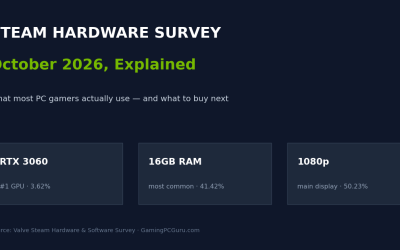
Enough to game, but it is the compromise tier, not the comfortable one — 32GB is what gives a machine longevity, which is why builders cutting systems to 16GB is worth noticing. Under $1,000 it can be acceptable if the system is upgradeable; at $1,500 and above, insist on 32GB. The latest Steam Hardware Survey underlines the point: 16GB is still the most common setup at 41.42% of systems, but 32GB sits close behind at 37.06% and is the tier new builds are moving to.
When is the best time to buy a gaming PC in late 2026?
The Black Friday window: Friday, November 27, 2026, through Cyber Monday on November 30 — the one period when retailer competition produces real discounts on complete systems even in an inflationary market. Go in with two or three acceptable models and judge deals against recent street prices, not list prices.
Final Verdict
Buy now — with conditions. The late-2026 market has removed the usual rewards for patience: memory and storage prices are forecast to rise again this quarter and stay tight into 2027, graphics cards are selling well above MSRP with no Super refresh coming to reset them, and prebuilt builders offer shelter from increases DIY buyers must absorb in full. If you need a gaming PC in the next six months, the Black Friday window from November 27 to 30 is your moment: pick a well-specified system from our best gaming PC guide, verify its price against recent street levels, and buy it.
Wait only if your reason survives scrutiny: your current PC still delivers, your target model is an overpriced outlier, or you are flexible enough to let the sale churn come to you. Waiting by default no longer works — the evidence points the other way.
Related Articles
- Best Gaming PC 2026: High-Performance Builds for Every Budget
- Best Gaming PC Under $1000 in 2026
- Best Beginner Gaming PC in 2026
- Best Gaming PC Specs for 2026
—
## SOURCES (not part of the article)
– RetailCoupons, “The Best Gaming PCs in 2026” (updated Nov 4, 2026) — memory/GPU prices climbing, RTX 50 Super shelved, entry systems shipping 16GB, builders absorbing increases: https://www.retailcoupons.com/best-gaming-pcs/
– SpecPicks, “9800X3D + RTX 5070 Ti PC Build 2026” (prices read Nov 3, 2026; citing Tom’s Hardware GPU tracker, Sept 28, 2026) — RTX 5070 Ti best US price $1,119 vs $749 MSRP; 1440p build total ~$3,241: https://specpicks.com/reviews/high-refresh-1440p-gaming-pc-build-2026
– Pandromeda, “RAM Prices: Buy Now or Wait for Them to Drop? [2026]” — TrendForce Q4 2026 DRAM +10–15% QoQ forecast, tight supply into 2027: https://pandromeda.com/hardware/should-you-buy-ram-now-or-wait-a-2026-buying-guide
– TechAmerica, “Gaming PC RAM Prices Rise as AI Demand Grows” (Nov 2026) — TrendForce Oct 30, 2026 update: PC DRAM contract prices still rising in Q4 2026: https://techamerica.ai/gaming/gaming-pc-ram-prices-keep-rising-as-ai-demand-tightens-memory-supply
– RunAIHome, “Black Friday 2026 for Local AI Builders” (Oct 22, 2026) — Tom’s Hardware price index: cheapest 32GB DDR5-6000 kit the current listed price on Oct 14, 2026; Black Friday Nov 27 / Cyber Monday Nov 30, 2026: https://runaihome.com/blog/black-friday-2026-local-ai-hardware-buy-now-or-wait/
– xGamerss, “Best Graphics Cards for 4K Gaming in 2026” (updated Sept 27, 2026) — no new GPU generation in 2026, Super refresh not arrived, Oct 9 check: cheapest in-stock RTX 5070 Ti the current listed price vs $749 MSRP: https://xgamerss.com/article/best-graphics-cards-for-4k-gaming-2026/
– Pandromeda, “GPU Prices in 2026: Buy Now or Wait for Them to Drop?” — reported board-partner GPU/memory bundle price increases through 2026, modest Black Friday GPU discounts expected: https://pandromeda.com/hardware/should-you-buy-a-graphics-card-now-or-wait-a-2026-buying-guide
– G2A News, “When will PC parts prices go down?” (updated Oct 16, 2026) — corroborating TrendForce Q4 2026 DRAM +10–15% and NAND +15–20% forecasts: https://www.g2a.com/news/features/hardware/when-will-pc-parts-prices-go-down-market-trends-forecasts-and-the-best-time-to-buy/
– Internal guides linked in the article: https://gamingpcguru.com/best-gaming-pc/ , https://gamingpcguru.com/best-gaming-pc-under-1000/ , https://gamingpcguru.com/best-beginner-gaming-pc/ , https://gamingpcguru.com/best-gaming-pc-specs/