Every month, Valve publishes the Steam Hardware & Software Survey, a snapshot of the PCs that Steam users are actually gaming on. It is not a sales chart and it is not a benchmark. It is something more useful for buyers: a reality check. The October 2026 edition is especially worth reading, because it reversed almost everything that made September’s results look like a turning point. The GeForce RTX 5070’s one month at the top of the GPU chart is over, 32GB of system memory has handed the lead back to 16GB, and the “typical” gaming PC once again looks reassuringly ordinary.
That ordinariness is the story. Launch coverage revolves around flagship cards and 4K high-refresh monitors, but the survey describes a different mainstream: a midrange graphics card, 16GB of RAM, 8GB of video memory and a 1080p screen. If you are speccing a new build or deciding what to upgrade next, that mainstream matters, because it is what game developers target and what settings menus are tuned around.
Quick answer: In October 2026 the most common gaming PC on Steam ran an NVIDIA GeForce RTX 3060 (3.62% of surveyed systems), 16GB of system RAM (41.42%) and a 1920×1080 display (50.23%), most likely on Windows 11 (72.51%). September’s apparent leap toward RTX 5070 cards and 32GB of RAM largely reversed, which tells you the survey moves with its sample, not just with what people buy. The practical takeaway for builders has not changed: midrange hardware at 1080p and 1440p is the mainstream target, and while 16GB is still the most common amount of RAM, 32GB remains the smart specification for a new machine you plan to keep.
Key Takeaways
- The RTX 3060 is back at number one on the combined GPU table at 3.62%; the RTX 5070 fell from 5.86% to 3.56% after a single month in front. On Valve’s PC-only GPU table, the two cards are tied at 3.78% each.
- The rest of the RTX 50 series also gave back September’s gains: the RTX 5060 dropped from 4.20% to 2.97%, and the RTX 5060 Ti from 3.87% to 2.55%.
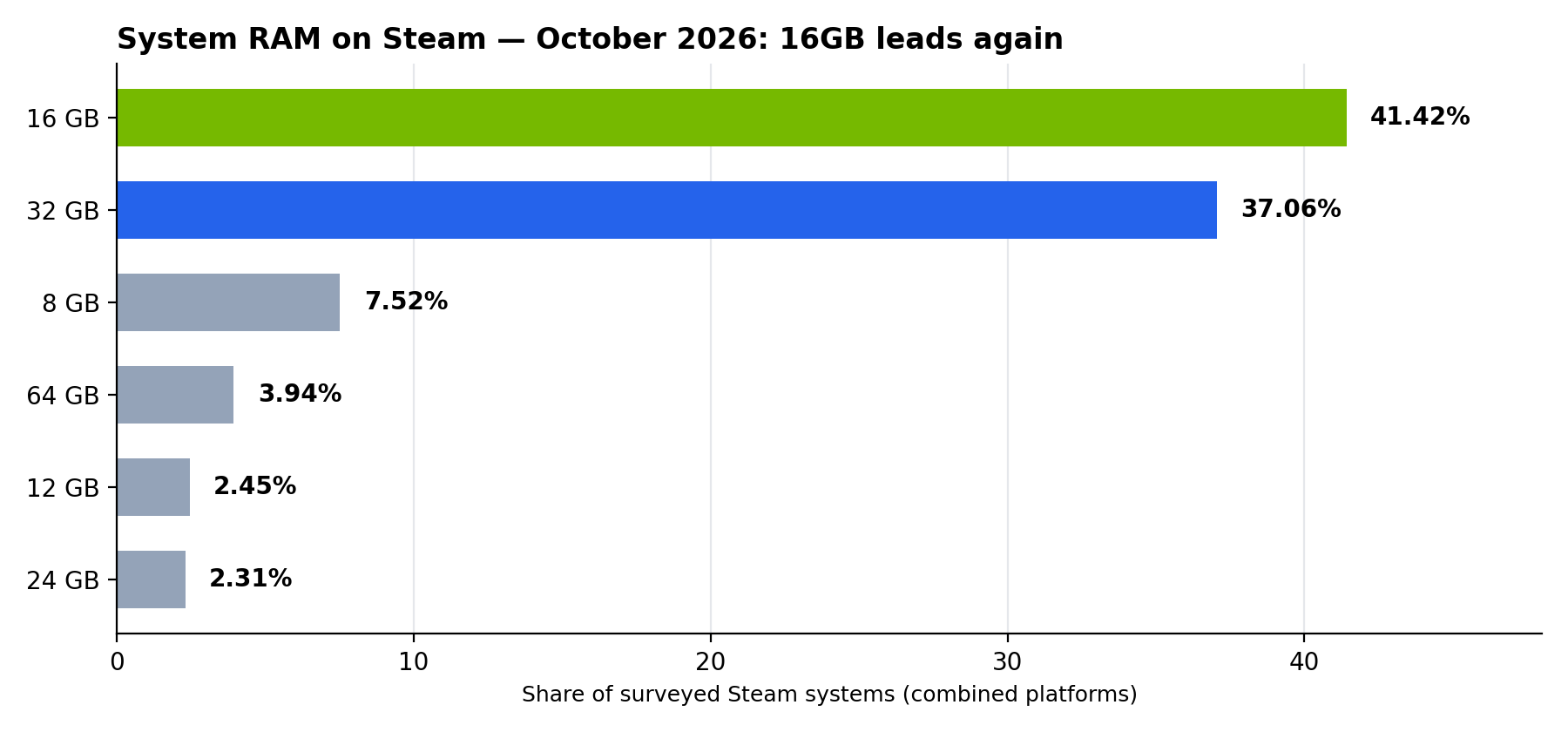
- 16GB is once again the most common amount of system RAM at 41.42% (up 3.60 percentage points), while 32GB fell 5.16 points to 37.06%.
- 1080p is still the dominant resolution at 50.23% of primary displays; 1440p sits at 21.82% and 4K at just 5.05%.
- 8GB remains the most common amount of VRAM at 26.92%, narrowly ahead of 16GB at 26.35%, with 12GB at 12.91%.
- Windows accounts for 93.70% of surveyed systems (Windows 11 at 72.51%, Windows 10 at 21.11%), Linux reached 3.95%, and among Windows users Intel holds 53.48% of CPUs against AMD’s 46.51%.
- Treat the survey as a noisy snapshot, not a census: Valve itself revised some originally published September figures, and a sharp swing in the respondent mix explains much of October’s reversal.
The October 2026 Numbers at a Glance
Valve runs the survey as a voluntary, anonymous sample of Steam users, published at the start of each month. The tables below use the default combined-platform view — Windows, Mac and Linux together — unless a row is labelled otherwise, with Valve’s own published month-on-month changes. The full dataset is published on Valve’s official Steam Hardware & Software Survey page.
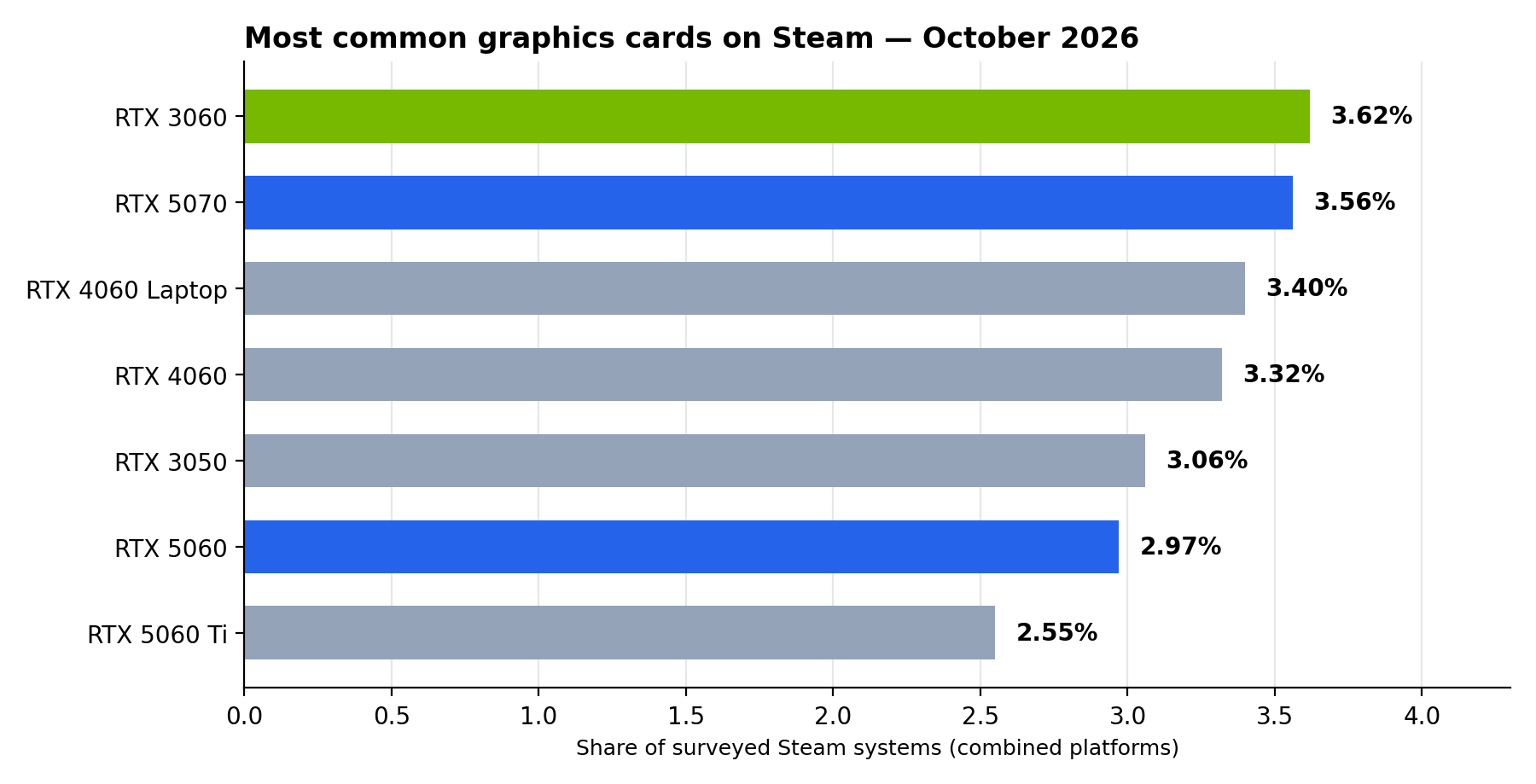
Top 5 GPUs, October 2026 (combined platforms)
| Rank | Graphics card | Share | What changed |
|---|---|---|---|
| 1 | NVIDIA GeForce RTX 3060 | 3.62% | Up from 3.54% in September; back at number one |
| 2 | NVIDIA GeForce RTX 5070 | 3.56% | Down from 5.86%; led for one month only |
| 3 | NVIDIA GeForce RTX 4060 Laptop GPU | 3.40% | Laptop gaming remains a large slice of Steam |
| 4 | NVIDIA GeForce RTX 4060 | 3.32% | The previous generation’s mainstream card |
| 5 | NVIDIA GeForce RTX 3050 | 3.06% | An entry-level card still in the top five |
Below the top five, the RTX 5060 fell from 4.20% to 2.97% and the RTX 5060 Ti from 3.87% to 2.55%. Note also that Valve publishes a separate PC-only video card table, and there the picture is a dead heat: the RTX 3060 and RTX 5070 are tied at 3.78% each, with the RTX 3060 listed first.
The rest of the typical Steam PC
| Category | Most common result | Share | Runner-up / context |
|---|---|---|---|
| System RAM | 16 GB | 41.42% | 32 GB at 37.06% |
| Video memory (VRAM) | 8 GB | 26.92% | 16 GB at 26.35%; 12 GB at 12.91% |
| Primary display | 1920 × 1080 | 50.23% | 2560 × 1440 at 21.82%; 4K at 5.05% |
| Operating system | Windows 11 64-bit | 72.51% | Windows 10 at 21.11%; Linux at 3.95%; macOS at 2.35% |
| CPU vendor (Windows only) | Intel | 53.48% | AMD at 46.51% |
The three-month trend: August to October 2026
One month of this survey is mostly sample noise, so here is the same data across the last three editions. Read August against October and the picture is stability, not upheaval.
| Metric (combined platforms) | Aug 2026 | Sep 2026 | Oct 2026 |
|---|---|---|---|
| Most common GPU | RTX 3060 — 3.76% | RTX 5070 — 5.86%* | RTX 3060 — 3.62% |
| 16GB system RAM | 41.20% | 37.82%* | 41.42% |
| 32GB system RAM | 37.45% | 42.22%* | 37.06% |
| 16GB VRAM | 26.92% | 27.21%* | 26.35% |
*September figures as originally published. Valve later revised some of them, and the survey’s respondent mix swung sharply that month — the Simplified Chinese share alone fell 9.41 points in October — so treat September as an outlier in the series, not a trend.
Why September’s “Turning Point” Reversed
If you read September’s survey coverage, it looked like PC gaming had jumped a generation in thirty days: the RTX 5070 surged to the top of the GPU chart and 32GB of RAM overtook 16GB for the first time. October reversed nearly all of it. Nobody scrapped a new graphics card or pulled a memory stick out of their PC in the space of a month — so what actually happened?
Follow the language column
The biggest swing in the October data is not a hardware category at all. It is the language breakdown of who took the survey. Simplified Chinese respondents fell 9.41 percentage points to 21.98% of the sample, while English rose 4.84 points to 39.04% and Russian rose 1.09 points to 10.14%. The survey is an opt-in sample that is not weighted by region, so when participation from a large market that skews toward newer hardware surges one month and recedes the next, every hardware column moves with it. The same reversals appear simultaneously in GPUs, RAM, VRAM and resolution, which is the fingerprint of a sample change, not a buying spree followed by a sell-off.
Valve corrected some September data, too
There is a second reason to hold the numbers lightly. Valve acknowledged that some of the data in its monthly survey results was incorrect — a Steam update addressed wrongly reported GPU models and VRAM data — and it revised previously published figures after the fact. September’s Linux share, originally published as 3.05%, was later raised to 3.90%, which means October’s 3.95% is a gain of just 0.05 points on the corrected number, not the near-full-point jump the raw monthly comparison suggests. Valve also does not publish the survey’s sample size or any margin of error. The survey is still the largest regular window into what gamers actually run — but single-month movements deserve scepticism, and trends are best read over three to six months.
GPUs: Midrange Still Rules Steam
The RTX 3060 refuses to retire
The RTX 3060’s return to first place is less a comeback than a reminder of how long mainstream cards stay in service. It held between roughly 3.5% and 3.9% of surveyed systems through the summer of 2026, and its October share of 3.62% sits in that range. Cards like the RTX 3060, RTX 4060 and RTX 3050 dominate because they were sold in enormous numbers in prebuilt PCs and laptops, and still play the games most people actually play. Developers know this: the installed base at the top of the survey is the audience a game has to run well on to sell, which is why RTX 3060-class performance remains a de facto target for optimisation.
The RTX 50 series is growing — just not as fast as September claimed
Strip out September’s spike and the RTX 50 series story is one of steady, unspectacular growth. On the PC-only table the RTX 5070 is tied with the RTX 3060 at 3.78%, which still makes it by far the most successful current-generation card in the survey, and a genuine mainstream part rather than a niche flagship. The RTX 5060 (2.97% combined) and RTX 5060 Ti (2.55%) gave back their September gains but remain well represented for cards in their first year. The direction of travel over a longer window is toward the new generation; the pace is just slower, and more dependent on pricing and prebuilt availability, than one noisy month suggested.
VRAM: 8GB is still the plurality
For all the debate about video memory, the most common amount on Steam is still 8GB, at 26.92% of systems. But the detail matters: 16GB cards are almost level at 26.35%, and 12GB accounts for another 12.91%, meaning cards with more than 8GB now collectively outweigh the 8GB installed base. That split explains the current market tension. At 1080p, 8GB remains workable for a large share of today’s games, which is exactly what the survey shows people doing with it. At 1440p with high texture settings, headroom is the safer buy. We go deeper on how VRAM, resolution and settings interact in our guide to the best gaming PC specs.
RAM: 16GB Is the Most Common, 32GB Is the Smart Buy
October put 16GB back on top at 41.42%, up 3.60 points, while 32GB fell 5.16 points to 37.06%. Read through the lens of the language swing, the honest interpretation is that the two capacities are close, 16GB still holds a plurality, and September’s crossover was amplified by who happened to answer the survey that month. The installed base has not suddenly downgraded, and the long-term drift toward 32GB has not been cancelled by one month’s sample.
The buying advice, however, is not a coin toss. If you already have 16GB, the survey is proof that you are in the mainstream, not behind it: games are built and tested with 16GB systems firmly in mind. If you are buying or building new in late 2026, 32GB is the specification we recommend in our best gaming PC guide, for three practical reasons. First, a new machine is a multi-year purchase, and memory requirements only move one way. Second, gaming PCs multitask by default — a game, a browser, Discord and streaming tools compete for the same pool. Third, upgrading later means matching or replacing your existing kit, so starting larger avoids an awkward mid-life upgrade. Most common is a statement about the past; smart buy is a statement about the life of your next PC.
Displays: 1080p Is Still King, 1440p Is the Sweet Spot
Half of all primary displays on Steam — 50.23% — are 1920×1080, and that share actually rose 2.32 points in October as the sample swung back. 1440p accounts for 21.82% — down 5.22 points from September’s sample-inflated 27.04%, the mirror image of 1080p’s rise rather than a wave of monitor downgrades — and 4K for just 5.05%. In other words, the resolution enthusiasts argue about most, 4K, is the resolution the fewest gamers use, while 1080p remains the default experience for the majority and 1440p is the established step up.
This is why graphics card recommendations should always start with your monitor. A GPU is only “overkill” or “not enough” relative to a resolution and refresh rate, and the centre of gravity is still 1080p, with 1440p high-refresh as the growth area our best gaming monitor picks are built around. Planning a system and screen together? A midrange card paired with a good 1440p high-refresh monitor matches where the mainstream is heading far better than spending the whole budget on GPU power for a 4K panel almost nobody owns.
CPUs and Operating Systems: Slow-Moving, With One Genuine Trend
Among Windows users, Intel processors account for 53.48% of surveyed systems against AMD’s 46.51%, with Intel gaining 0.89 points in October. Treat a sub-one-point move as noise rather than momentum; the durable fact is that the Windows installed base is split roughly evenly, and both vendors appear throughout our recommended builds because gaming performance at this level is rarely decided by the badge on the CPU. Core counts tell the same mainstream story: eight-core processors lead at 28.68% and six-core chips follow at 27.29%, so more than half of Windows systems run one of those two configurations.
The operating system picture has one real trend and one illusion. The real trend is Windows 11: at 72.51% of all surveyed systems, up 1.17 percentage points on the month, it is consolidating as the default, while Windows 10 continues to fade, down 2.50 points to 21.11%. Windows overall holds 93.70% and macOS 2.35%. The illusion is Linux’s apparent near-point jump: October’s 3.95% against the originally published September figure looks dramatic, but against Valve’s revised September figure of 3.90% it is essentially flat. Linux approaching 4% of Steam is still a notable milestone for a platform that lived near 1% for years — it just arrived gradually, not in one month.
VR: Valve’s own headset shows up
VR remains a small corner of Steam, but October brought a notable arrival: Valve’s recently released Steam Frame climbed 3.72 points to 4.13% of VR headsets. Meta’s Quest 3 still leads the category comfortably at 27.27%. For buyers the takeaway is unchanged — VR is an add-on to a capable PC, not a reason to spec one — but a first-party Valve headset gaining share this quickly is worth watching.
What This Means If You’re Buying or Building
Buying a new PC
Spec to the mainstream’s destination, not its rear-view mirror, but do not overshoot it. A sensible late-2026 build targets 1440p, pairs a current midrange graphics card with a modern six- or eight-core CPU, and includes 32GB of RAM and fast NVMe storage. That recipe sits one comfortable step ahead of the survey’s typical machine — RTX 3060-class GPU, 16GB of RAM, 1080p screen — which is exactly where you want to be: comfortably above the hardware developers treat as the baseline, without paying flagship prices for performance aimed at resolutions only 5% of gamers use. Our round-up of the best gaming PCs under $1,000 shows how much of that recipe is achievable on a mainstream budget.
Upgrading an existing PC
Let the survey double-check your priorities. If your system resembles the typical Steam PC, the upgrades in order of likely impact are:
- Graphics card, if yours is older than the RTX 3060 class. The GPU does most of the work in most games, and the installed base shows how long a good midrange card stays relevant. Match the card to your monitor — there is little value in a 1440p-class card on a 1080p 60Hz screen.
- Memory, if you are still on 8GB or a single stick. Moving to 16GB puts you with the plurality of Steam users; moving to 32GB removes memory as a concern for the life of the machine and helps with multitasking while you play.
- The monitor, if you have GPU headroom you are not using. With 1440p at 21.82% and rising over the long term, a high-refresh 1440p display is the upgrade you can see every minute, provided your card can drive it.
- Platform and CPU last, unless yours is genuinely old. The survey’s near-even Intel/AMD split is a reminder that recent mainstream CPUs from either vendor handle gaming well; replace yours when it limits the GPU, not by habit.
Three upgrades that match the data
Everything above points to the same three purchases. These are the specific products we would shortlist for each one — static picks, checked against the survey data rather than this week’s discounts.
Graphics card: ASUS Dual GeForce RTX 5060 Ti 16GB GDDR7 OC
The upgrade the VRAM table argues for: a current-generation mainstream card with 16GB of memory, the tier that has grown all year, sized for 1080p high-refresh and 1440p play.
Memory: Corsair Vengeance RGB DDR5 32GB (2x16GB) 6000MHz CL30
The 32GB specification the trend supports, in the DDR5-6000 CL30 configuration current AMD and Intel platforms are tuned for. For DDR5 builds only — DDR4 systems need a DDR4 kit instead.
Monitor: LG UltraGear 27GP850-B (27-inch QHD, 165Hz)
The 1440p step-up the display data points to: a 27-inch QHD Nano IPS panel at 165Hz, the resolution and size that 21.82% of Steam users already run and the natural next move from 1080p.
What not to do
Do not rebuild your plans around a single month’s survey. September would have told you the RTX 5070 had taken over PC gaming and 16GB was obsolete; October reversed both claims without the real world changing at all. Use reviews, your resolution and your games list to make the final call.
Frequently Asked Questions
What is the most common graphics card on Steam in October 2026?
The NVIDIA GeForce RTX 3060, at 3.62% of surveyed systems on the combined-platform table. The RTX 5070 is a close second at 3.56%, and on Valve’s PC-only table the two are tied at 3.78% each.
Is 16GB of RAM still enough for gaming in 2026?
Yes for most gamers: 16GB is the most common configuration on Steam at 41.42%, and games are developed with that installed base in mind. For a new build you intend to keep for several years, though, 32GB (37.06% and the long-term growth tier) is the smarter buy for headroom and multitasking.
Why did the Steam survey change so much between September and October 2026?
Mainly because the sample changed. The survey is voluntary and anonymous, and the share of Simplified Chinese respondents fell 9.41 points to 21.98% in October, shifting every hardware category at once. Valve also revised some originally published September figures, which further shrinks several of the apparent swings.
What resolution do most PC gamers play at?
1920×1080. It accounts for 50.23% of primary displays in the October survey, ahead of 2560×1440 at 21.82% and 3840×2160 (4K) at 5.05%.
Does the Steam Hardware Survey represent all PC gamers?
No. It is a voluntary, anonymous sample of Steam users who are offered and accept the survey in a given month. Valve does not publish the sample size or a margin of error, and the demographic mix varies month to month. It is best used for broad trends over several months, not single-month movements.
Final Verdict
October’s survey is a useful correction — to September’s data, and to the idea that PC gaming has moved on to flagship hardware. Most gamers run an RTX 3060-class card, 16GB of RAM, 8GB of VRAM and a 1080p display on Windows 11, and developers build for that audience. Buy one step ahead of it: a midrange current-generation GPU chosen for your actual resolution, 32GB of RAM in a new build, and money kept back for the monitor that makes it visible. When next month’s survey lands, read the trend, not the headline.
Related Articles
- Best Gaming PC Specs for 2026
- Best Gaming PC 2026: High-Performance Builds for Every Budget
- Best Gaming PC Under $1,000 in 2026
- Best Gaming Monitor 2026