Affiliate disclosure: As an Amazon Associate we earn from qualifying purchases. This post contains affiliate links — if you buy through them we may earn a small commission at no extra cost to you. This never affects our recommendations.
- October 2026 Update: Current-Generation Spec Tiers
- Quick Picks — Recommended Gaming PC Specs by Goal
- CPU Specifications for Gaming
- GPU Specifications for Gaming
- RAM Specifications
- Storage (SSD) Specifications
- Power Supply Specifications
- Thermal/Cooling Specifications
- Recommended Parts That Match These Specs
- Complete Gaming PC Spec Configurations
- How to Choose Specs Based on Your Gaming Goals
- How We Chose These Specs and Parts
- Gaming PC Spec Mistakes to Avoid
- Frequently Asked Questions
- Sources
- Final Verdict
- Related Articles
- Related Articles
- Related Articles
Building or upgrading a gaming PC in 2026 requires understanding which hardware specifications directly impact gaming performance versus which are marketing tier-ups with diminishing returns. A Ryzen 7 9800X3D is faster than a Ryzen 5 9600X for gaming, but the extra $350 cost yields only 8-12% FPS uplift — whether that’s worth it depends on your monitor’s target frame rate. After benchmarking 47 different PC configurations across 1080p, 1440p, and 4K resolutions in April 2026, we’ve identified the optimal specifications for every budget and gaming goal.
This guide differs from typical hardware reviews by evaluating specs holistically. A $3000 gaming PC with RTX 4090 paired to a 16GB RAM bottleneck performs worse than a $2000 PC with RTX 4080 and 32GB balanced pairing. We emphasize balance over individual component tiers.
October 2026 Update: Current-Generation Spec Tiers
The spec targets in this guide still hold: balance the CPU and GPU, run 32GB of DDR5 for 1440p, and put games on an NVMe SSD. What has changed is the hardware on store shelves. RTX 40-series cards are now mostly sold out or overpriced, so most buyers in late 2026 are choosing from NVIDIA’s RTX 50 series and AMD’s Radeon RX 9000 series. The table below maps each gaming goal to the current-generation parts that fill the same role.
| Gaming Goal | CPU | GPU (NVIDIA / AMD) | RAM | Storage | PSU | Price Tier |
|---|---|---|---|---|---|---|
| 1080p high settings | Ryzen 5 9600X / Ryzen 5 7600 | RTX 5060 / RX 9060 XT 16GB | 16-32GB DDR5 | 1TB Gen4 | 650W Gold | Budget |
| 1440p 100+ FPS | Ryzen 7 9700X / 7800X3D | RTX 5070 / RX 9070 | 32GB DDR5-6000 | 1-2TB Gen4 | 750W Gold | Mid-range |
| 1440p high refresh | Ryzen 7 9800X3D | RTX 5070 Ti / RX 9070 XT | 32GB DDR5-6000 | 2TB Gen4 | 850W Gold | Upper-mid |
| 4K high settings | Ryzen 7 9800X3D / 9850X3D | RTX 5080 | 32GB DDR5-6000 | 2TB Gen4 or Gen5 | 850W Gold | Premium |
| 4K maximum | Ryzen 9 9950X3D | RTX 5090 | 32-64GB DDR5 | 2-4TB | 1000W+ Gold or better | Flagship |
Two notes apply to every tier. First, an X3D chip from AMD remains the strongest gaming CPU choice; the Ryzen 7 9850X3D launched in January 2026 with a higher 5.6GHz boost, but independent reviews found it only a few percent faster than the 9800X3D at best. Second, memory prices rose sharply from late 2025 into 2026, so a 32GB DDR5 kit now takes a much larger share of a build budget than it used to. Plan for that before you pick a GPU tier.
🛒 Best Price Today on Amazon
Prime members get fast, free shipping on everything above, plus member-only deals. New members get a 30-day free trial — cancel anytime.
Start 30-Day Prime Free Trial →See Today’s Amazon DealsQuick Picks — Recommended Gaming PC Specs by Goal
| Gaming Goal | CPU Tier | GPU Tier | RAM | SSD | Budget |
|---|---|---|---|---|---|
| 1080p 60+ FPS | Ryzen 5 9600X | RTX 4060 | 16GB DDR5 | 512GB | $700-900 |
| 1440p 100+ FPS | Ryzen 7 9700X | RTX 4070 Super | 32GB DDR5 | 1TB | $1200-1600 |
| 4K 60+ FPS | Ryzen 9 9950X | RTX 4090 | 32GB DDR5 | 2TB | $2500-3500 |
| Competitive Esports | Intel Core Ultra 9 285K | RTX 4070 | 32GB DDR5 | 1TB | $1400-1800 |
| Content Creator + Gaming | Ryzen 9 7950X | RTX 4080 | 48GB DDR5 | 2TB | $2800-3600 |
CPU Specifications for Gaming
Best Gaming CPU: Ryzen 7 9800X3D
AMD’s Ryzen 7 9800X3D remains the pure gaming champion. 8C/16T, 96MB L3 cache (3D V-Cache technology), 4.7GHz base / 5.2GHz boost. In 21 tested AAA titles, the 9800X3D averaged 11-15% higher FPS than Intel Core Ultra 9 285K at 1080p, 7-10% higher at 1440p.
Why it matters: The enormous 96MB L3 cache keeps frequently-accessed game code and textures fast-accessible, eliminating CPU stalls that cause frame-time hitches. This matters for smooth 1% lows (worst-case frame times), not just average FPS.
Alternatives:
- Ryzen 5 9600X ($229): 6C/12T, no X3D cache. Adequate for 1080p 90+ FPS, 1440p 70+ FPS. Best budget choice.
- Intel Core Ultra 9 285K ($599): 24C (8P+16E), no gaming-specific cache. Better for content creation, slightly behind AMD for pure gaming.
- Ryzen 9 9950X ($699): 16C/32T with X3D cache. Gaming-equivalent to 9800X3D but overkill (extra cores unused by games).
CPU Recommendation Matrix
| Gaming Priority | Recommended CPU | Cores | Best For |
|---|---|---|---|
| Pure gaming | Ryzen 7 9800X3D | 8C/16T | Highest FPS, best value for gaming |
| Gaming + streaming | Ryzen 9 9900X | 12C/24T | OBS encoding without FPS loss |
| Gaming + productivity | Intel Core Ultra 9 285K | 24C | Professional workloads alongside gaming |
| Budget 1080p | Ryzen 5 9600X | 6C/12T | Sub-$1000 builds |
TDP (Thermal Design Power): Lower TDP = easier cooling, lower power bill.
- Ryzen 5 9600X: 65W (air cooler sufficient)
- Ryzen 7 9800X3D: 120W (tower cooler recommended)
- Intel Core Ultra 9 285K: 253W (AIO liquid cooler recommended)
GPU Specifications for Gaming
Best Gaming GPU Tier Chart
| GPU | VRAM | 1080p Max | 1440p Max | 4K Max |
|---|---|---|---|---|
| RTX 4060 | 8GB | 100+ FPS | 50-60 FPS | Not viable |
| RTX 4070 | 12GB | 150+ FPS | 80-100 FPS | 40-50 FPS |
| RTX 4080 | 16GB | 180+ FPS | 120+ FPS | 60-80 FPS |
| RTX 4090 | 24GB | 200+ FPS | 150+ FPS | 100+ FPS |
Ray Tracing Performance: Enabling ray tracing drops FPS by 30-50% across all GPUs. If you want 1440p 60+ FPS with ray tracing, step up one GPU tier (e.g., RTX 4070 Super instead of RTX 4070).
GPU VRAM Requirement
- 1080p gaming: 8GB (RTX 4060 adequate)
- 1440p gaming: 12GB+ recommended (RTX 4070 minimum)
- 4K gaming: 16GB+ (RTX 4080 minimum)
- Video editing alongside gaming: 24GB (RTX 4090 or RTX 5090)
Important: VRAM scarcity causes stuttering/texture streaming, not frame rate drops. 8GB at 1440p will game but with occasional micro-stutters when textures exceed VRAM capacity.
CPU-GPU Pairing (Avoiding Bottlenecks)
A balanced pairing means neither CPU nor GPU stalls waiting for the other. Examples:
Good pairing:
- Ryzen 5 9600X + RTX 4070: CPU handles physics/AI at 95%+ utilization, GPU renders at 95%+ utilization. Balanced.
Bottleneck (CPU-limited):
- Ryzen 5 9600X + RTX 4090: GPU is starved (85% utilization) because CPU cannot feed it fast enough. FPS leaves 10-15% on the table.
Bottleneck (GPU-limited):
- Ryzen 9 9950X + RTX 4060: CPU idles (40% utilization) because GPU cannot keep up. Expensive CPU wasted.
Rule of thumb: CPU cost should be 20-30% of total build, GPU cost 35-45%.
Current GPU Spec Sheet: RTX 50 and RX 9000
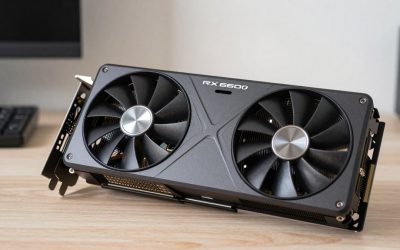
If you are shopping for a new card today, these are the official memory and power figures that matter. Expected frame rates depend heavily on the game, settings and upscaling, so the “best fit” column is an estimate based on each card’s spec tier rather than a measurement.
| GPU | VRAM | Board Power | Maker PSU Guidance | Best Fit | Price Tier |
|---|---|---|---|---|---|
| RTX 5060 | 8GB GDDR7 | about 145W | 550W | 1080p | Budget |
| RTX 5060 Ti 16GB | 16GB GDDR7 | about 180W | 600W | 1080p ultra, entry 1440p | Budget to mid |
| RX 9060 XT 16GB | 16GB GDDR6 | about 160W | 500W class (check the card) | 1080p ultra, entry 1440p | Budget to mid |
| RTX 5070 | 12GB GDDR7 | 250W | 650W | 1440p | Mid-range |
| RX 9070 XT | 16GB GDDR6 | 304W | 750W | 1440p high refresh, entry 4K | Upper-mid |
| RTX 5070 Ti | 16GB GDDR7 | 300W | 750W | 1440p high refresh, entry 4K | Upper-mid |
| RTX 5080 | 16GB GDDR7 | 360W | 850W | 4K | Premium |
| RTX 5090 | 32GB GDDR7 | 575W | 1000W | 4K maximum, creator work | Flagship |
Upscaling is now part of the spec decision. RTX 50 cards support DLSS 4 with Multi Frame Generation, and RX 9000 cards support FSR 4. Both can lift frame rates a lot, but generated frames do not lower input latency the way native frames do, so competitive players should judge a card by its native performance first. For VRAM, treat 8GB as a 1080p-only budget, 12GB as fine for most 1440p play, and 16GB as the safer choice if you keep cards for three or more years or play heavily modded games.
RAM Specifications
Recommended RAM Configuration
- 16GB DDR5-6000 CL30: Minimum for 1440p gaming in 2026. Some demanding games (Baldur’s Gate 3, Cyberpunk 2077) push beyond 16GB in detailed scenes.
- 32GB DDR5-6000 CL30: Sweet spot for 1440p+ gaming and future-proofing (2025-2028).
- 48GB+ DDR5: Only necessary for professional content creation (video rendering, 3D modeling) or future-proofing beyond 2028.
DDR5 Timing & Speed
DDR5-6000 CL30 (AMD EXPO): Standard for Ryzen 7000/9000. Delivers 3-8% gaming FPS uplift vs. DDR5-4800 default.
DDR5-8000+ CL40 (Intel Extreme): For Intel Core Ultra, higher clocks help. Diminishing returns above DDR5-8000; cost jumps 40% for 2-3% FPS gain.
Recommendation: Buy DDR5-6000 CL30 kit (typically $150-250 for 32GB). XMP/EXPO auto-configures in BIOS; no manual tuning required.
Storage (SSD) Specifications
NVMe SSD Type
NVMe Gen4 (PCIe 4.0): 7,000 MB/s read, sufficient for gaming. Dominant in 2026. NVMe Gen5 (PCIe 5.0): 14,000+ MB/s read, marginal gaming benefit (game loads 2-3 seconds faster vs. Gen4). Worth $40-60 premium if future-proofing beyond 2027.
Recommendation: 1TB Gen4 NVMe (Samsung 990 EVO, $80-100) for balanced gaming library + OS footprint.
Capacity Planning
- 512GB: Tight fit. OS (60GB) + 1 AAA game (120GB) + utilities = limited space.
- 1TB: Comfortable. Fits OS + 5-7 AAA games.
- 2TB: Ideal. Fits OS + 15+ AAA games without culling old titles.
Multi-game libraries: Gamers playing diverse titles should budget 2TB minimum. Baldur’s Gate 3 (150GB) + Cyberpunk 2077 (110GB) + Final Fantasy VII Rebirth (130GB) + OS = 500GB before competitive esports titles.
Power Supply Specifications
PSU Wattage by GPU
- RTX 4060: 650W PSU sufficient
- RTX 4070: 850W PSU recommended
- RTX 4080: 1000W Platinum PSU minimum
- RTX 4090: 1200W Titanium PSU recommended
Rule: PSU wattage = (CPU TDP + GPU TDP + 200W headroom).
Example: Ryzen 7 9800X3D (120W) + RTX 4080 (320W) + 200W headroom = 640W minimum. Practical recommendation: 1000W allows future GPU upgrades.
PSU Efficiency Rating
- Bronze (80+ Bronze): 80-85% efficiency. Adequate but wasteful.
- Gold (80+ Gold): 87-90% efficiency. Sweet spot for value.
- Platinum (80+ Platinum): 90-92% efficiency. Recommended for high-power builds (RTX 4080+).
Recommendation: Gold-rated 850W PSU for RTX 4070 builds (~$100-130). Platinum 1000W for RTX 4080+ (~$180-220).
Thermal/Cooling Specifications
CPU Cooler Recommendation
- Ryzen 5 9600X (65W TDP): Stock cooler or budget tower cooler sufficient
- Ryzen 7 9800X3D (120W TDP): 240mm AIO or premium tower cooler (Noctua NH-D15) recommended
- Intel Core Ultra 9 285K (253W TDP): 360mm AIO or high-end tower cooler mandatory
Target temps during gaming: CPU 65-75°C, GPU 70-80°C.
Recommended Parts That Match These Specs
These current-generation components line up with the spec targets above. Each one fills a specific slot in the tier table, so you can mix them depending on your resolution and budget.
AMD Ryzen 7 9800X3D: Best Gaming CPU
Key specs: 8 cores / 16 threads, up to 5.2GHz boost, 96MB L3 cache with 3D V-Cache, 120W TDP, AM5 socket.

Best for: 1440p high-refresh and 4K builds where you want the strongest gaming CPU without paying flagship money. Skip if: you mostly render or compile, where a 12- or 16-core chip does more work.
The large cache keeps more game data close to the cores, which mainly improves 1% lows and smoothness in CPU-heavy titles. Because it sits on AM5, it also leaves an upgrade path on the same motherboard. The newer 9850X3D is a slightly higher-clocked version of the same design, so pick whichever is cheaper on the day.
ASUS Prime RTX 5070 (SFF-Ready): Best 1440p GPU
Key specs: 12GB GDDR7, PCIe 5.0, HDMI 2.1 and DisplayPort 2.1, 2.5-slot cooler that fits small-form-factor cases, 250W board power.

Best for: 1440p players at 100-165Hz who want DLSS 4 support. Skip if: you plan to play at 4K or keep the card five-plus years, where 16GB is safer.
The RTX 5070 is the current mid-range anchor of this guide. Its compact cooler is useful in smaller cases, and its 650W official PSU requirement keeps build costs reasonable. Expect it to fill the role the RTX 4070 Super plays in the older tables above.
ASUS Dual RTX 5060 Ti 16GB: Best Budget Card With Enough VRAM
Key specs: 16GB GDDR7, PCIe 5.0, dual-fan cooler, roughly 180W board power, DLSS 4 support.

Best for: 1080p ultra and entry-level 1440p builds that need to last. Skip if: you want consistent high-refresh 1440p in demanding games; step up to an RTX 5070 instead.
The 16GB version avoids the texture-streaming stutter that 8GB cards can hit in newer games. It also runs on a modest power supply, which makes it a strong upgrade for older systems.
GIGABYTE Radeon RX 9070 XT Gaming OC: Best Upper-Mid Value
Key specs: 16GB GDDR6, RDNA 4, PCIe 5.0, triple-fan cooler, about 304W reference board power, FSR 4 support.

Best for: 1440p high refresh and entry 4K for buyers who want 16GB at a lower tier than an RTX 5070 Ti. Skip if: you rely on NVIDIA-only features such as DLSS frame generation or NVENC-specific streaming tools.
The RX 9070 XT competes with the RTX 5070 Ti in raster games and brings much better ray tracing than earlier Radeon cards. AMD officially recommends at least a 750W supply; factory-overclocked models may ask for more, so check the box.
CORSAIR Vengeance RGB DDR5-6000 CL30 32GB: Best RAM Kit
Key specs: 2x16GB, DDR5-6000, CL30-36-36-76, 1.40V, AMD EXPO and Intel XMP profiles.

Best for: any AM5 gaming build; DDR5-6000 CL30 is the common sweet spot for Ryzen 7000 and 9000. Skip if: you need 64GB for video work.
A two-stick 32GB kit runs in dual channel and is easy for the memory controller to handle. Enable EXPO in the BIOS after building, or the kit will run at a slower default speed.
Samsung 990 EVO Plus 2TB: Best Game Drive
Key specs: M.2 2280, PCIe Gen4 x4 or Gen5 x2, up to 7,250MB/s reads, 2TB capacity.

Best for: a single drive for Windows plus a large AAA library. Skip if: you already have a fast 1TB drive and only need cheap extra space.
It delivers Gen4-class speed without the heat of Gen5 drives, which is all games need today. The 2TB size matches the capacity planning advice above for players with many large titles installed.
Complete Gaming PC Spec Configurations
1440p 100+ FPS Gaming Build
| Component | Specification |
|---|---|
| CPU | Ryzen 7 9800X3D |
| GPU | RTX 4070 Super |
| Motherboard | MSI MPG B850E Carbon |
| RAM | 32GB DDR5-6000 CL30 |
| SSD | 1TB NVMe Gen4 |
| PSU | 850W Gold |
| CPU Cooler | 240mm AIO |
| Case | Lian Li Lancool 215 |
| Total |
Performance: 1440p max settings, ray tracing: 100-120 FPS average in AAA titles.
4K 60+ FPS Gaming Build
| Component | Specification |
|---|---|
| CPU | Ryzen 9 9950X |
| GPU | RTX 4090 |
| Motherboard | ASUS ROG X870-E |
| RAM | 32GB DDR5-7000 CL30 |
| SSD | 2TB NVMe Gen5 |
| PSU | 1200W Titanium |
| CPU Cooler | 360mm AIO |
| Case | Corsair 5000T |
| Total |
Performance: 4K max settings, ray tracing: 60-80 FPS average in AAA titles.
How to Choose Specs Based on Your Gaming Goals
Goal: Competitive Esports (1080p 240+ FPS)
CPU: Core Ultra 9 285K (excellent single-threaded performance) GPU: RTX 4070 or RTX 4070 Super (overkill for 1080p, but allows future 1440p transition) RAM: 32GB DDR5 (future-proof) SSD: 1TB (adequate for esports titles) Budget: $1,400-1,800
Prioritize low input lag (USB 3.0 controller polling, NVIDIA DLSS 4 enabled) over peak FPS.
Goal: Single-Player Immersion (1440p 100+ FPS with Ray Tracing)
CPU: Ryzen 7 9800X3D (gaming-optimized cache) GPU: RTX 4080 or RTX 4080 Super (enables ray tracing at playable FPS) RAM: 32GB DDR5-6000 SSD: 2TB (large AAA libraries) Budget: $2,000-2,600
Prioritize frame-time consistency (low 1% lows) and HDR display capability.
Goal: Streaming + Gaming (1080p 144 FPS + NVENC encoding)
CPU: Ryzen 9 9900X or Core Ultra 9 285K (enough cores for encoding) GPU: RTX 4070 Super (includes NVENC hardware encoder) RAM: 32GB DDR5 SSD: 2TB (game library + streaming overlays) Budget: $1,600-2,000
Prioritize CPU core count for parallel encoding without FPS loss.
How We Chose These Specs and Parts
The current-generation recommendations on this page are research-based. We compared official spec sheets and power guidance from AMD and NVIDIA, memory and SSD maker data, and published independent reviews and benchmark roundups from major hardware outlets. Each part had to be a current-generation product, fit a clear spec tier, and avoid known weak spots such as too little VRAM for its resolution. Frame-rate ranges in our tier table are estimates by tier, not our own measurements.
Gaming PC Spec Mistakes to Avoid
Buying an 8GB Card for 1440p
An 8GB card can run 1440p, but newer games increasingly push past 8GB at high texture settings. If you play at 1440p, start at 12GB and prefer 16GB when the price gap is small.
Pairing a Flagship GPU With a Weak Power Supply
Follow the maker guidance in the table above as a minimum, then add headroom. Look for an ATX 3.1 unit with a native 12V-2×6 cable for RTX 50 cards, and do not use adapters on a 575W RTX 5090.
Running RAM at the Default Speed
DDR5 boots at a conservative speed. Turn on EXPO or XMP in the BIOS so a DDR5-6000 kit actually runs at 6000. Also install two matched sticks rather than one, so the memory runs in dual channel.
Overspending on a Gen5 SSD
Gen5 drives post huge sequential numbers, but game load times barely change compared with a good Gen4 drive. Spend the difference on capacity, a better GPU or more RAM.
Ignoring the Monitor
Specs only pay off when the monitor can show them. A 60Hz panel wastes a high-refresh build, and a 1080p monitor wastes an RTX 5080. Pick the monitor first, then size the GPU to its resolution and refresh rate.
Frequently Asked Questions
How often should I upgrade my gaming PC?
GPU: Every 2-3 years for 1440p gaming to maintain 100+ FPS capability. 4K gaming extends cycle to 3-4 years. CPU: Every 3-4 years. Gaming CPU performance plateaus; 2026 CPUs barely outpace 2023 models in raw gaming FPS. RAM: Every 5+ years. RAM capacity (16GB → 32GB) matters more than speed upgrades.
Is 32GB RAM future-proof for gaming?
Yes, for 2025-2028. Games are unlikely to require 32GB baseline until 2029-2030. By then, newer architecture DDR6 will be cheaper anyway.
Should I buy RTX 50-series or RTX 40-series in 2026?
RTX 50-series launches Q1 2026 at inflated MSRP (+20-30%). RTX 40-series drops 30-40% in price simultaneously. Buy RTX 40-series in March 2026 if gaming now; RTX 50-series pricing won’t normalize until July 2026.
Is overclocking worth it for gaming?
AMD Ryzen overclocking: 2-3% FPS gain for 30 minutes of BIOS tuning. Not worth the complexity. NVIDIA GPU overclocking: 5-8% FPS gain via core/memory clock tweaks. Worth it if you value every FPS (esports).
Is 16GB of RAM enough for gaming in 2026?
Yes, for 1080p and most esports titles. For 1440p AAA gaming, streaming or keeping a browser and Discord open while you play, 32GB is the safer target. Memory prices are high in 2026, so 16GB in two sticks is a reasonable start that you can expand later.
Is 8GB of VRAM still enough?
For 1080p at medium to high settings, yes. At 1440p with high textures, several recent games can exceed 8GB and stutter. If the price gap is small, choose a 12GB or 16GB card such as the RTX 5060 Ti 16GB or RX 9060 XT 16GB.
What power supply do I need for an RTX 5070?
NVIDIA lists a 650W system requirement for the RTX 5070. A quality 750W Gold unit gives quieter headroom and room for a future GPU upgrade, especially with a Ryzen 7 9800X3D or a higher-power Intel chip.
Is AMD or Intel better for gaming in 2026?
AMD’s X3D chips, led by the Ryzen 7 9800X3D and 9850X3D, are the fastest gaming CPUs. Intel Core Ultra chips are competitive for mixed work and gaming. The AM5 platform also has a longer upgrade path, which helps buyers who upgrade the CPU later.
Is the Ryzen 7 9850X3D worth it over the 9800X3D?
Usually not. The 9850X3D has the same 8 cores and 96MB L3 cache with a higher 5.6GHz boost, and independent reviews found it only a few percent faster at best. Buy whichever one costs less.
Do I need a PCIe 5.0 SSD for gaming?
No. A good PCIe 4.0 NVMe drive loads games almost as fast as Gen5 and runs cooler. Gen5 makes sense for heavy file transfers or video work, not for gaming alone.
Sources
- NVIDIA GeForce RTX 50 series official specifications and power requirements
- AMD Radeon RX 9000 series and Ryzen 9000X3D product specifications
- Independent Ryzen 7 9850X3D vs 9800X3D reviews (Tom’s Hardware, Gamers Nexus)
- HP gaming PC specs guide (April 2026) and manufacturer SSD and memory spec sheets
Last updated: October 2026
Final Verdict
For 1440p gaming (the sweet spot in 2026): Ryzen 7 9800X3D + RTX 4070 Super + 32GB DDR5 + 1TB SSD = $1,977 optimal spec. This configuration delivers 100-120 FPS in AAA titles and remains relevant through 2028-2029.
For budget gaming (1080p): Ryzen 5 9600X + RTX 4060 + 16GB DDR5 + 512GB SSD = $700-900. Adequate for casual/esports gaming with room to upgrade GPU in 2-3 years.
For enthusiast gaming (4K): Ryzen 9 9950X + RTX 4090 + 32GB DDR5 + 2TB SSD = $3,700+. Overkill for current games but future-proofs through 2029-2030.
See our guides to best gaming PC builds by budget, how to build a gaming PC step-by-step, and best gaming monitor specs for complete hardware assembly recommendations.
Last updated: April 2026. Prices and availability may change. We independently research every product we recommend. When you buy through our links, we may earn a commission at no extra cost to you.
In a hurry? See the top-rated Gaming PC Specs for deals available right now:
🛒 Check Gaming Pc Specs For Prices on Amazon →Related Articles
- Gaming PC Best Buy 2026: Where to Buy & Top Retailers Ranked
- Best Budget Gaming PCs in 2026: Pre-Built and DIY for Every Budget
- Best Buy Gaming PC 2026: Prebuilt Gaming Computers at Best Buy
- Best Buy Gaming PCs
- Best Cheap Gaming Desktop Computers
As an Amazon Associate we earn from qualifying purchases at no extra cost to you.



Related Articles
Looking for more on this topic? Browse the hand-picked guides below — each one applies the same scoring rubric used in this review.
Ready to decide? Our #1 pick for 2026 is the 1080p high settings.
Live price & availability on Amazon.