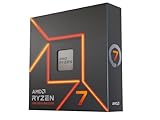
The AMD Ryzen 7 9800X3D and the Ryzen 7 7800X3D remain the two most recommended gaming processors you can drop into an AM5 motherboard, and they are closer relatives than the model numbers suggest. Both are 8-core, 16-thread chips carrying 96MB of L3 cache thanks to AMD’s 3D V-Cache technology, and both punch well above their core count in the games that live and die by memory latency.
What separates them in 2026 is generation, headroom, and price. The 9800X3D is a Zen 5 part with second-generation stacked cache and a fully unlocked multiplier. The 7800X3D is the Zen 4 original that created the category and now sells at a meaningful discount when stock allows. With current flagship GPUs pushing frame rates higher than ever at 1440p, the CPU sitting behind them matters more than it did two years ago.
As an Amazon Associate we earn from qualifying purchases at no extra cost to you.







⚡ Save on Your Next PC — Amazon Prime
Prime members get fast free shipping on the systems above, plus early access to Prime Day & Black Friday PC deals. New members get a 30-day free trial.
Watch: Ryzen 7 9800X3D vs 7800X3D: Upgrade in 2026? — Video Review
Quick Verdict
Choose the AMD Ryzen 7 9800X3D if you want the fastest mainstream gaming CPU available, you pair it with a high-refresh monitor and a top-tier graphics card, or you also stream, compile, and edit video. Choose the AMD Ryzen 7 7800X3D if frames per dollar is your priority. It still lands within single-digit percentages of its successor in most titles, and bundle deals make it the smarter value build.
Key Differences
- Architecture: The 9800X3D runs Zen 5 cores with wider execution resources, while the 7800X3D uses Zen 4. Generational IPC gains show up most in CPU-bound simulation and strategy games.
- Cache placement: AMD moved the stacked cache underneath the compute die on the 9800X3D. The cores sit closer to the cooler, which lifts sustained clocks. The 7800X3D stacks cache on top, capping thermal headroom.
- Clock speeds: The 9800X3D boosts to 5.2GHz from a 4.7GHz base. The 7800X3D runs 4.2GHz base and 5.0GHz boost, and it holds lower effective clocks under load.
- Overclocking: The 9800X3D is the first fully unlocked X3D chip, supporting manual multiplier tuning and aggressive PBO. The 7800X3D is locked, leaving only curve optimizer undervolting and memory tuning.
- Gaming performance: Expect roughly 8 to 12 percent higher average frame rates from the 9800X3D at 1080p, stretching past 20 percent in cache-and-clock-sensitive titles. At 4K the gap often shrinks to nothing.
- Power and cooling: The 7800X3D is famously efficient, frequently drawing under 90W in games. The 9800X3D perm
Explore Our Guides & Free Tools