
RX 9080 Graphics Card Review 2026: What to Check Before You Buy
Searches for an RX 9080 are common, but we could not confirm that AMD has released a Radeon card under that name. The RDNA 4 cards we can verify from AMD’s own launch material are the Radeon RX 9070 XT, the RX 9070 and the RX 9060 XT. This page is therefore not a review of a specific RX 9080 model. It makes no claims about clock speeds, memory configuration, benchmark results or launch date for a product we cannot confirm. What it does provide is a buying framework for high-end AMD graphics cards, so the advice holds whether the name turns out to be a future model, a regional label or a retailer’s shorthand.
The hero listing below is the closest match we found for the query. Treat it as a starting point, not as proof that the named card exists. Read the product title and the specification table on the listing for the exact GPU, memory size and warranty terms before you order, because retail titles often use a marketing name that differs from the chip maker’s product name. We have not run our own benchmarks for this article.

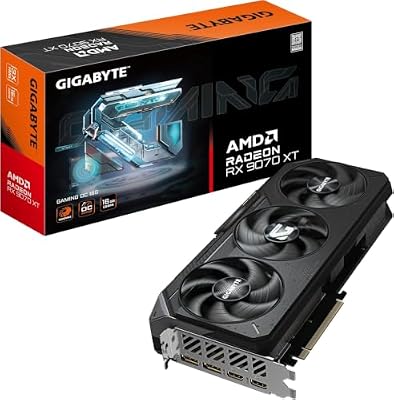
GIGABYTE Radeon RX 9070 XT Gaming OC 16G Graphics Card, PCIe 5.0, 16GB GDDR6, GV-R9070XTGAMING OC-16GD Video Card

ASRock Graphics Board Steel Legend RX 9070 XT 16G AMD Radeon RX9070XT RX9070XT SL 16G / AX
What the RX 9080 Name Does and Does Not Tell You
AMD’s Radeon naming follows a pattern. The first digit family points to a generation, and the following digits suggest a rough position in the stack. That pattern is useful for orientation, but it is not a guarantee. A name that looks logical can still refer to a card that was never released, a rebadged model or a partner variant with its own clocks and cooler. The safe habit is to confirm the model on AMD’s product pages and on at least two independent reviews before you compare prices.
Avoid buying on the strength of forum posts, pre-launch leaks or video thumbnails that quote specifications without a source. If a listing does not name the GPU, the memory size and the memory type clearly, move on. Good retailers publish these details in the first few lines of the product page.
Verify the model before you compare prices
Write down the exact model string from the listing, then check it against the manufacturer’s site. If the string does not match any published product, the card may still be a valid purchase, but you should judge it on its listed specifications and the warranty it carries, not on the name you searched for.
The Specs That Matter for a High-End Radeon
Memory capacity
For a card in the premium Radeon tier, memory capacity is the first number to check. The RX 9070 XT and RX 9070 both use 16GB of GDDR6, which gives them comfortable headroom for 1440p gaming with high-resolution textures. A card in this class should carry at least that much memory if it is priced as a premium product. If a listing shows less, ask why before you pay the premium.
Memory bus and bandwidth
Capacity alone does not decide speed. The width of the memory bus and the memory speed together set how much data the card can move each second. Compare these figures between cards in the same tier rather than against older generations, because architecture changes shift the balance. A wider bus with slower memory can match a narrower bus with faster memory in some workloads and fall behind in others.
FSR and upscaling support
AMD’s upscaling stack is a major part of the value case for Radeon cards. FSR 3.1 works across a broad range of games and hardware. FSR 4 is an AI-based upscaler that AMD supports on its RDNA 4 cards, so its availability depends on the title and the driver. Check the game’s options menu and AMD’s supported-title list for the games you play most, because upscaling quality and frame rate gains vary widely.
Ray tracing and path tracing
Ray tracing remains the area where high-end cards separate most clearly. Titles that offer path-traced modes push hardware harder than standard ray-traced effects. If those modes matter to you, read reviews that test the specific games you plan to play rather than relying on a single headline number.
High-End AMD Card Comparison
The table below compares the classes of card you are likely to see when you search for a premium Radeon. It uses broad ranges on purpose. Prices change with supply, promotions and regional tax, so check the live listing before buying.
| Card class | Typical memory | Best for | Typical price range |
|---|---|---|---|
| RX 9070 XT-class (verified RDNA 4 model) | 16GB GDDR6 | 1440p high settings, FSR-supported titles | Check current price |
| Premium custom-cooled RDNA 4 card | 16GB GDDR6 | Quieter cooling, larger heatsinks, higher factory clocks | Check current price |
| RX 9080 search result (model not confirmed) | Confirm on listing | Buy only after verifying model and specs | Check current price |
| RX 9060 XT-class (mainstream RDNA 4) | 8GB or 16GB GDDR6 | 1080p and light 1440p gaming | Check current price |
If you are weighing a card in this tier against the lower end of the range, our guide to the RX 9070 review explains where the mainstream RDNA 4 card sits. For a head-to-head against the RX 9070 XT, see our RX 9070 XT review.

Sapphire 11348-03-20G Pulse AMD Radeon™ RX 9070 XT Gaming Graphics Card with 16GB GDDR6, AMD RDNA 4


As an Amazon Associate we earn from qualifying purchases. Product prices and availability are accurate as of the date/time indicated.
Cooling, Power and Case Fit
Premium cards are long, heavy and power-hungry. Before you buy, measure your case for card length and thickness, and check whether the front fans and top radiator mount can work with a large triple-fan cooler. A card that does not fit is a return, and returns cost time even when the retailer accepts them.
Power is the second check. A quality 750W power supply from a reputable brand is a common recommendation for cards in this tier, but you should confirm the manufacturer’s stated requirement on the listing. Choose a unit with an ATX 3.x or newer connector and a 12V-2×6 cable or adapter that matches the card. Our guide to the best power supply for gaming covers the wattage and efficiency ratings that make sense for a build like this.
Thermals and noise
Large custom coolers keep temperatures and fan speeds lower, which matters more than raw cooler size. Look for reviews that report hotspot temperature and fan noise at load, not just a single peak number. If you run a small case, a dual-slot card with moderate power draw can be a better daily choice than a triple-slot model that struggles to breathe.
If temperatures become a problem after installation, our guide on how to check GPU and CPU temperature shows the monitoring steps to take before you change any settings.
GIGABYTE Radeon RX 9070 XT Gaming OC 16G Graphics Card, PCIe 5.0, 16GB GDDR6, GV-R9070XTGAMING OC-16GD Video Card


As an Amazon Associate we earn from qualifying purchases. Product prices and availability are accurate as of the date/time indicated.
Who Should Buy a High-End Radeon Right Now
Our ranked advice depends on your resolution target and how long you plan to keep the card.
1. Buyers targeting 1440p with high settings
A verified 16GB RDNA 4 card is the strongest fit. It has the memory for demanding textures and enough raster performance for high-refresh 1440p play in most current titles. Pair it with a modern CPU and a monitor that matches its output. Our guide to the best 1440p monitor for gaming helps you choose a panel that will not waste the card’s headroom.
2. Buyers who want 4K with upscaling
A premium Radeon can reach 4K in many games when you combine upscaling with tuned settings. Expect to make trade-offs on path-traced effects. Our best GPU for 4K gaming guide sets out how the top tier compares for that resolution.
3. Buyers on a tight budget
If the premium price is hard to justify, a mainstream RDNA 4 card will cover most 1080p and light 1440p needs at a lower cost. The best GPU for a gaming budget list shows how the value picks line up across price points.
Frequently Asked Questions
Is there an RX 9080 graphics card?
We could not confirm a released AMD Radeon card named RX 9080 at the time of writing. The verified RDNA 4 models include the RX 9070 XT, RX 9070 and RX 9060 XT. Check AMD’s product pages before buying anything sold under the RX 9080 name.
Should I buy the hero listing on this page?
Only after you have confirmed the exact model, memory size, warranty and price on the listing. The hero card is the closest match to the search, not a verified RX 9080 model.
How much memory do I need for a premium Radeon?
For 1440p and 4K gaming in the current generation, 16GB is the comfortable target. Cards with less memory can still perform well, but they have less room for high-resolution textures in newer games.
Is FSR better than DLSS?
Neither is better in every case. FSR works across more hardware, while DLSS is limited to NVIDIA GPUs. The right choice depends on the games you play and the visual quality you see in each one.
Final Recommendation
The safest ranked choice is a verified 16GB RDNA 4 card from a reputable board partner with a large cooler, a 750W or larger power supply and a clear warranty. If the listing you are considering cannot show a confirmed model name and full specifications, do not buy it on the strength of the RX 9080 name. Compare the hero listing and the alternatives on memory, cooling and price, and read the manufacturer’s pages for the model you finally choose. For a broader view of the premium field, our AMD vs NVIDIA buyers guide covers the trade-offs between the two vendors, and our RDNA 4 vs Blackwell architecture explainer shows how the two design approaches differ.


